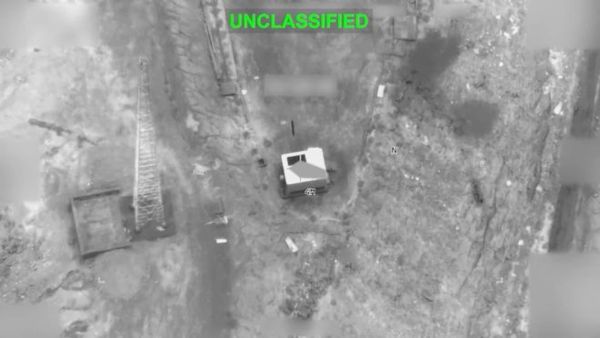
Iran said on Wednesday, September 2, that US strikes on its territory had killed 11 people, while a residential complex in Kuwait was hit by what authorities described as an enemy drone amid widening regional attacks.
Seven people were killed and eight wounded when US missiles struck three locations in the southwestern province of Khuzestan overnight, Iran’s state-run IRNA news agency reported, citing the province’s deputy governor for security and law enforcement affairs.
The deaths followed a separate attack reported on Tuesday, September 1, in southern Sirik county, where the Iranian Red Crescent said four people, including a child, were killed and more than 50 wounded in a US attack at a wedding. The two incidents brought the reported death toll from the latest US strikes to 11.
Firefighting teams in Kuwait contained a fire that broke out at a residential complex in the capital at dawn on Wednesday after the building was targeted by what authorities described as an enemy drone.
Brigadier General Mohammed Badar Ibrahim, spokesperson for the Public Fire Force, said teams from the Al Helali and Al Madeenah centres responded immediately and brought the blaze under control.
No injuries were reported, and the damage was limited to property, he said.
The United States struck around 100 targets during raids on Tuesday, including Revolutionary Guard air defence sites, radar systems, mine-laying capabilities, communications sites, anti-ship cruise missile launchers and attack drone launchers, Axios reported, citing US officials.
The operation also included strikes on two Iranian government-owned tankers under a new “tanker-for-tanker” policy approved by President Donald Trump, according to Axios. The tankers were anchored off the Iranian coast, north of the US naval blockade line, when American drones fired missiles at their engine rooms. Axios described the attacks as the first time the US military had struck Iranian oil tankers in response to attacks on shipping in the strait.
US officials said the wider operation had weakened Iran’s offensive capabilities around Hormuz and could reduce threats to commercial vessels for at least a month. A spokesman for US Central Command said the military did not target civilians and was aware of casualty reports issued by Iranian official media.
Iran’s Islamic Revolutionary Guard Corps said it carried out overnight attacks on US assets in Kuwait, Bahrain, Jordan and Erbil, in Iraq’s Kurdistan region, as part of its response to the latest American strikes.
Iran’s army separately said it targeted radar installations and assembly points of US forces at Sheikh Isa Air Base in Bahrain using intensive suicide drone attacks, according to state media.
Iran’s Khatam al-Anbiya Central Headquarters said its offensive operations against the Americans would continue until they regretted their actions, warning that continued US aggression would draw stronger, wider and more destructive responses.
IRGC political deputy General Yadollah Javani also urged Arab countries to expel US forces and reclaim American bases, warning of what he described as a “crushing” response against any staging point used to attack Iran. He specifically named Kuwait, Bahrain and Jordan.
US officials gave a sharply different account of the Iranian attacks. Axios reported that Iran launched about 25 ballistic missiles, with only around half reaching Jordanian airspace. Ten were intercepted and three fell without causing injuries, according to the officials.
Iran also launched about 20 drones at US bases in Bahrain, most of which were intercepted, while two drones aimed at a US base in Erbil were also shot down. Ballistic missiles and drones were reported to have targeted US bases in Kuwait.
A US official quoted by Axios said the Iranian response had failed and claimed Tehran had lost control of both the Strait of Hormuz and the conflict.
Separately, Fox News, citing a US official, reported that the majority of Iranian missiles and drones were intercepted. All American personnel were safe and accounted for, and no serious damage was inflicted on US bases in the Middle East, the official said.
The official added that Iran’s command-and-control structure was not centralised and that it remained unclear who had survived or been killed within the Revolutionary Guard, when asked who was directing continued attacks on commercial ships.
Bahrain’s Interior Ministry issued a third alert over a “potential threat” within six hours, urging citizens and residents to remain calm, proceed to the nearest safe location and follow updates through official channels.
Emergency sirens were also activated across the kingdom early on September 2 amid the regional escalation.
Bahrain’s Armed Forces said they had intercepted and destroyed a number of Iranian aerial attacks and that all weapons systems and units were at the highest level of readiness.
The military urged people not to approach unfamiliar or suspicious objects that could be remnants of the attacks and to report them immediately. It said personnel from the Royal Field Engineering Unit were ready to deal with such objects safely.
Trump denied reports that he was trying to force Iran back to the negotiating table.
In a post on Truth Social, he said he was not trying to compel Tehran into talks and did not care whether Iran signed an agreement it considered worthless. He said he preferred the current US position, claiming Washington had “almost total control” of the Strait of Hormuz while Iran’s economy was “totally collapsing”.
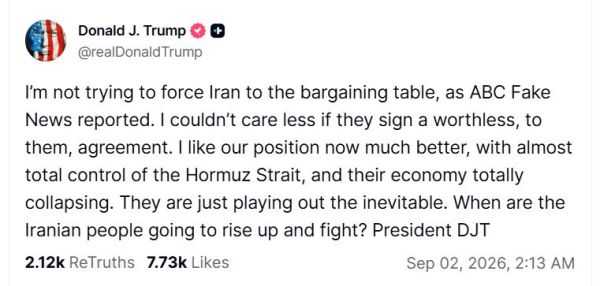
Trump said Tehran was “just playing out the inevitable” and questioned when the Iranian people would “rise up and fight”.
UN Secretary-General Antonio Guterres called for renewed negotiations, saying the return of military strikes between the United States and Iran made “maximum containment” essential.
He said earlier diplomacy had appeared close to a breakthrough and urged both sides to resume talks.
Guterres also called for freedom of navigation to be fully restored in the Strait of Hormuz and Bab al-Mandab, warning that disruption to the key maritime routes could affect global energy supplies and trade.
Shipping data and official US accounts offered contrasting pictures of traffic through the Strait of Hormuz.
According to preliminary Kpler data, only four commodity vessels transited the strait on Tuesday, well below the 10-day average of around 13. The vessels included a very large crude carrier, a Panamax tanker, a Kamsarmax carrier and an intermediate tanker, with three exiting the strait and one entering. The figures could change because vessels travelling with their transponders switched off would not appear in the data.
The low number followed preliminary Kpler data showing five commodity vessels passing through Hormuz on Monday, with no liquid tankers recorded.
That contrasted with US Energy Secretary Chris Wright’s statement that 17 million barrels of oil transited the waterway on Monday, which he said was the highest level of crude flows since the conflict disrupted shipping. Wright has previously said more oil was moving through Hormuz than vessel-tracking companies were recording.
Axios, meanwhile, reported that around 40 ships passed through the strait on Tuesday, carrying millions of barrels of oil, while US forces intercepted several anti-ship cruise missiles and drones launched towards commercial vessels. None reached their targets, according to US officials.
Elsewhere, two Israeli air strikes targeted the vicinity of the southern Lebanese towns of Kfar Rumman and Arab Salim, Al Jazeera reported.
The strikes followed an incident in northern Israel, where the Israeli military said interceptors had been launched towards a suspicious aerial target believed to have crossed from Lebanese territory.
The military said warning sirens sounded in northern Israel and that the results of the interception were under review. No injuries were reported.