Long before Arsenal turned down Aston Villa’s steep valuation of Morgan Rogers, or before the club made it clear that they had ambitious plans involving Vinicius Junior and Julian Alvarez, there was another message that effectively shaped their entire summer. Just as importantly, it also influenced the current mood around the club.
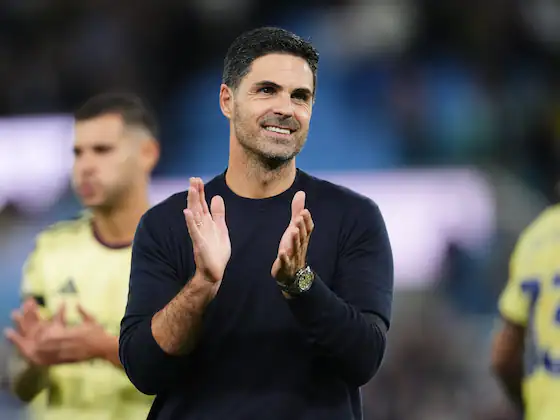
That came from Mikel Arteta’s emphatic appeal as he sat in Budapest’s Puskas Arena after ending up on the losing side as a Champions League finalist.
“We will have to start making some very important decisions if we want to reach another level,” the Basque said. “We are going to have to show that ambition because we are more than capable of doing it, but it is going to demand us to be very ambitious, very fast and very smart.”
That was naturally interpreted as a coded call for a marquee signing to raise Arsenal’s attack, but they did not quite manage it.
They did not land that “absolute quality”, even though the club did show ambition and also completed some smart business.
That has created a few different ways of looking at the squad, depending on where the judgement comes from. Above all, there is the argument that Arsenal should have acted like champions and really stamped their authority over the rest of the Premier League.
They did secure part of that objective.
The defence remains the strongest in the world, strengthened further by Ezri Konsa, while the midfield now offers perhaps the fullest range of combinations possible.
Vinicius Junior signed a contract extension at Real Madrid instead of joining Arsenal.
Taken together, people both inside and outside the club insist this is comfortably the best squad in world football.
But it is still not a complete squad.
The attack is thinner than it was before.
As one source puts it, it cannot be seen as a good window when you lose three Premier League-ready forwards and bring in only one unproven attacker, Christos Tzolis.
There has been plenty of discussion about how this places “a microscope” on sporting director Andrea Berta, especially given some scepticism over the Italian’s methods at previous rival clubs.
Again, though, that partly depends on perspective.
Julian Alvarez was not willing to entertain a move to Arsenal.
Some insiders argue that the failure to deliver on the one main target this summer was, in part, a consequence of successfully achieving everything last summer. Back then, they built the deep squad that was required and that ultimately won them the title.
This summer, Arsenal needed to make sales. And in attack, they needed to strike big.
Berta’s “wheeler dealer”, “spinning plates” way of handling targets is now under criticism, but sources say there are two relevant ways of viewing that.
One is that the “spinning plates” approach helped bring in Konsa and Bruno Guimaraes, with the latter already being described as transformative.
Another is that the same approach was, rightly, not used in the chase for that left-sided forward.
Arsenal knew there was only a very small group of players who would truly meet what they needed, and most of them were at Spain’s biggest clubs. For them, the only suitable course was to try to pull off the most eye-catching deals.
Andrea Berta, Arsenal sporting director, was seen watching on at the London Stadium.
Arsenal believed they had Vinicius, until Real Madrid tabled a contract offer that very few had anticipated. In the end, Florentino Perez could not afford the loss of face that would have come with losing such a player.
Even those critical of Berta would accept that in such situations, it is better to wait and remain disciplined. Sometimes it is worse to sign the wrong player simply for the sake of doing so, especially in a market where prices have been unusually high.
Some would take that further and say it was the toughest assignment any sporting director could have had. It is not comparable to Tottenham Hotspur or Chelsea, who still had plenty of room for growth.
Against that, others would point to one of the Chelsea players Arsenal will face this weekend, namely Rogers. Football often has a way of throwing up these timely sub-plots.
One line of thinking is that Arsenal waited too long, allowing the asking price to rise along with Elliot Anderson’s, while they were also distracted by the more fanciful pursuit of Vinicius.
Chelsea outbid Arsenal in the race to sign Morgan Rogers.
The explanation from within the club is that this was not about waiting, but about respecting a World Cup campaign, while Chelsea arrived with a valuation Arsenal were never going to match.
If much of that is understandable, right up to the pursuit of stars, what is less easy to explain is the overall effect on the attack.
Even figures inside the club cannot understand how the forward line now has less depth than last year while also offering less pace. They argue that the sales which led to this reflected a more haphazard approach late in the window. Or, as one source sharply put it, it was “all over the place”.
Others within the club would argue that chances to sell had to be taken for players who were not going to feature as much, and that there was a longer-term issue around Gabriel Martinelli beyond simply selling him late in the window. The Brazilian has spoken in the past about leaving.
Tzolis was signed to replace Leandro Trossard, but Arsenal wanted more to address the left-wing position.
Arteta and his staff will now look towards coaching solutions. While Eberechi Eze will now adapt more to the left-sided role originally intended for him, his use there will also bring a tweak in the formation, with Riccardo Calafiori and Piero Hincapie pushing on the outside. That could already be seen in Bukayo Saka’s goal against Aston Villa.
Saka and Noni Madueke can also play on the left, while Mikel Merino has now fully learned the centre-forward role. And the World Cup winner is now fit.
If part of Arteta’s desire for an “x-factor” forward came from the fact that too many of last season’s matches were decided by fine margins, that was largely because most of the first-choice attack was unavailable.
Kai Havertz, Martin Odegaard and Saka all missed long stretches of the season.
The hope is that things will now be different, and that the trio playing regularly will alter perceptions in that area. One note of caution, however, is whether Arteta himself has truly evolved from the climax of last season when it comes to training intensity and the use of players; whether he fully recognises the need to keep things lighter in a congested schedule, or whether he will continue to field his strongest sides as often as possible.
Arteta is trying to be inventive with his solutions after not signing an elite left winger.
If it reaches that point, Arsenal are likely to do business in January. Bournemouth’s Eli Junior Kroupi will almost certainly be an option. The situations involving Alvarez and perhaps even Vinicius could by then have changed.
The very mention of January only reminds some inside the club that they should have moved for Antoine Semenyo earlier this year. He wanted to join, at what would have been a relatively modest price. It would have solved plenty of problems, and there is some regret about that.
Arteta is understood to have taken note of how Manchester City simply moved decisively and got it done.
He still has his champions in excellent condition, and fittingly remains one of the few managers who still follows classic principles of genuine squad building. That advantage is clearly tied to Arteta’s own standing as the longest-serving manager, in the rare position of having complete control.
It is just that, after successfully building the best squad, one major failure has been felt more sharply than almost anything else.