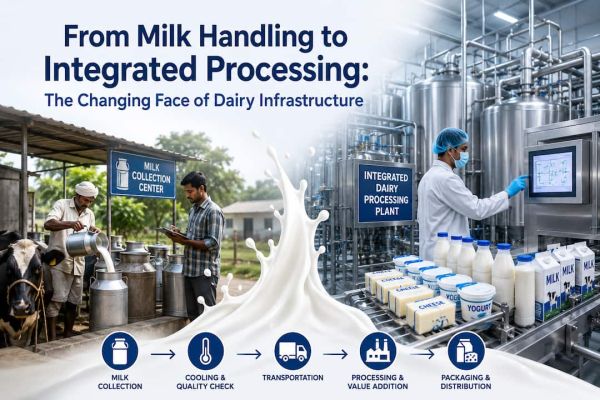
Not long ago, the daily routine inside a dairy processing plant was relatively straightforward. Milk arrived from local farms, got cooled down, went through pasteurisation, and was packed for distribution. Most facilities were built strictly to handle this basic workflow, and their physical infrastructure reflected those simple priorities.
Over time, the industry's requirements have changed considerably.
Many dairy businesses now produce a wider range of products than they did in the past, requiring more advanced processing facilities. Modern dairy processing facilities commonly manufacture products such as paneer, curd, butter, ghee, and khoa alongside liquid milk, and you will see a wide range of dairy products under one roof—from regional essentials like paneer, curd, and khoa, to staples like butter and ghee. Because each of these products demands its own distinct manufacturing timeline, temperature control, and handling process, running a dairy plant has become considerably more complex than it used to be.
As these processing requirements grew, the philosophy behind planning a dairy plant had to evolve too. Today, successful manufacturers and operators no longer look at a facility as just a collection of standalone machines. Instead, they focus heavily on how every single part of the building works together.
Infrastructure is the Process
A modern processing plant is far more than just a concrete shell that houses heavy machinery. In reality, the physical building itself has a direct influence on production efficiency.
The layout of a processing facility plays a critical role in operational efficiency. The exact positioning of processing equipment, the intricate routing of stainless-steel pipelines, the placement of storage tanks, and even the daily foot traffic of workers all directly impact everyday operations. When these elements are mapped out carefully, production flows naturally from one stage to the next, maintenance access becomes more efficient, and operational delays are minimised.
For many expanding dairy businesses, infrastructure is no longer just something built around the production line—it has become a core part of the process itself.
Designing for a Diverse Menu
The growing consumer demand for value-added dairy products is the main force changing how these facilities are engineered.
A plant that only processes liquid milk requires a completely different structural footprint than one designed to churn out curd, paneer, and ghee simultaneously. Each new product brings its own set of strict hygiene protocols, unique processing sequences, and environmental conditions.
Because of this, experienced processors know that simply buying a new machine and installing additional equipment without reviewing the overall plant layout is rarely effective. Before expanding their product line, they have to review the entire layout of the facility. The relationship between different processing stages, available floor space, utility lines, and daily workflow has become just as critical as the machinery itself. This shift has driven the industry toward integrated processing systems, where every single operation is planned as a piece of a larger, unified environment.
Engineering Beyond the Machine
This evolution has naturally forced dairy equipment manufacturers to change the way they do business.
Historically, equipment manufacturers primarily focused on supplying individual machines: build a machine to spec and ship it out. Today, a project rarely starts on the factory floor. Instead, it begins with detailed planning discussions about total production capacity, complex plant layouts, utility planning, and leaving room for future expansions.
One example within this segment is NK Dairy Equipments LLP. Established back in 2005, the firm has spent over two decades manufacturing dairy processing equipment and developing integrated plant solutions for the industry.
Their evolution mirrors the wider shift happening across the entire Indian dairy sector. Dairy processors increasingly seek manufacturers that can support integrated processing requirements alongside equipment supply in favour of manufacturing partners who understand integrated processing infrastructure and plant-level engineering.
The Power of Practical Design
A processing plant has to operate reliably 365 days a year. Achieving that level of consistency depends on practical engineering decisions that extend well beyond equipment selection and the use of high-quality materials.
Leaving enough room for a mechanic to service a valve, planning pipeline slopes correctly to prevent stagnation, placing heavy processing equipment near required utilities, and integrating automated Clean-in-Place (CIP) systems are the details that support reliable day-to-day operations. These small, practical choices are often invisible to people outside the industry, but they influence daily production margins more than anything else.
A well-thought-out layout simplifies routine labour, ensures hygienic processing practices and allows a business to scale up its operations later without having to undertake major structural modifications or completely redo the plumbing.
Meeting Global Frameworks
These certifications indicate compliance with recognised manufacturing and export-related requirements that a manufacturing partner can operate reliably within the strict safety and quality frameworks required by the global food processing industry
Looking Ahead
The continued development of India's dairy industry is inextricably linked to the technological leaps made in its processing infrastructure. As consumer tastes continue to evolve and production methods become more sophisticated, the engineering side of the industry will keep adapting to meet those new pressures.
Companies such as NK Dairy Equipments LLP are part of this broader industrial landscape. Their role reflects the broader shift toward integrated processing infrastructure within the dairy industry, but in their ability to design.