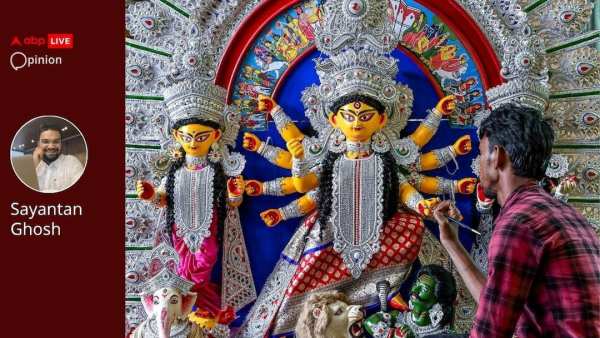
Durga Puja is barely six weeks away, and Kolkata is already restless in a way that has little to do with pandal-hopping schedules. The festival is West Bengal's biggest cultural event, but it has never been only about devotion or family reunions. It runs on sponsorship money, donation drives, local bragging rights and, above all, control of neighbourhoods. Every big puja committee doubles as a local power centre, and whoever runs it effectively runs the ward for the rest of the year. That is why, four months into its first term in the state, the Bharatiya Janata Party's handling of Durga Puja has become a live political story.
The party that spent over a decade accusing the Trinamool Congress of turning the festival into a tool of patronage is now finding itself asked the same question. From court battles over puja committee elections to a Vishwa Hindu Parishad campaign on food and ritual, and even a killing linked to a fight over committee control, the season has exposed how badly the BJP wants these clubs, and how uneasily that desire sits with the party's own public promises. It also raises an uncomfortable mirror question for a party that built its Bengal campaign on the charge that Trinamool had turned faith into a franchise.
Puja patronage in Bengal did not begin with the BJP. Congress leaders ran committees decades ago, the Left kept a formal distance while its cadres quietly stayed involved through local clubs, and the Trinamool Congress built an entire model of governance around inaugurations, grants and puja-linked goodwill. What is different now is the speed and visibility of the scramble.
At Deshapriya Park in south Kolkata, the existing committee alleged that a group linked to the BJP tried to take it over and intimidate its members, a dispute serious enough to draw in state finance minister Swapan Dasgupta, who asked both sides to keep politics out of the puja. In Baranagar, a committee office-bearer said BJP-linked figures pressured him to hand over bank documents.
In Baruipur, a turf fight between rival BJP factions over a new puja committee turned fatal, leaving a party worker dead and exposing the scale of the stakes. At the 108-year-old Bagbazar Sarbojanin puja, the election for secretary ended in a 33-33 tie under court-appointed observers, with one candidate alleging bias and a woman alleging unrest on polling day, pushing the matter into the Calcutta High Court.
None of these disputes alone prove a plan. Together, they suggest a party that promised restraint is struggling to enforce it on its own ranks, at the first Durga Puja since the change of government, when every committee tussle is being read locally as a test of who really runs the neighbourhood now.
The timing explains a great deal. The Kolkata Municipal Corporation election is expected soon after the immersion, likely in November or December, and the BJP knows that Kolkata has been Trinamool's most secure fortress for two decades, built ward by ward on the back of councillors who doubled as puja patrons.
Every ward has its marquee puja, and the local leader attached to it usually controls far more than festival logistics, from local hiring to petty disputes to police access. The BJP's landslide victory in this year's assembly election, ending fifteen years of Trinamool rule with a turnout above ninety per cent, was driven less by a deep-rooted city organisation than by anti-incumbency against Mamata Banerjee.
That distinction matters for December. A wave vote for the assembly does not automatically translate into ward-level machinery, and the BJP knows a smooth run at the civic poll depends on having its own people embedded in the puja networks that Trinamool spent years cultivating.
The scale of the task is worth spelling out. Trinamool has run Kolkata Municipal Corporation with an overwhelming majority since 2021, while the BJP holds only a handful of the corporation's one hundred and forty four seats, and former Mayor Firhad Hakim, like several of his colleagues, has long doubled as a puja patron. Without similar groundwork, the party risks winning a state government while losing the city that anchors it.
Bengal's politics has never really been about which party holds Writers' Buildings alone. It runs on party societies, local clubs and neighbourhood committees that outlast election cycles, and whoever controls these networks controls the ward regardless of the scoreboard in Kolkata. The Left Front never formally owned Durga Puja committees, staying true to its avowedly secular posture, but its cadres held real sway over clubs in working-class neighbourhoods for over three decades.
When the Left collapsed, Trinamool absorbed much of that same infrastructure, turning puja committees into an extension of the party machine, complete with grants, welfare doles and photo-ready inaugurations. The BJP is now attempting the identical manoeuvre, chasing not devotion but the underlying network of volunteers, sponsors and local fixers that a puja committee represents.
Durga Puja works so well for this purpose because it is the one occasion when an entire neighbourhood, across class and often across community lines, funnels its energy and money through a single committee. Capture that committee, and you capture the area's default point of contact for almost anything, months after the goddess has gone home. A party society built over two decades of festivals, marriages, funerals and small favours does not change hands merely because an election result changes the government at Nabanna, it changes hands street by street, committee by committee, which is the slow and messy process now playing out across Kolkata's wards.
There is a second, less transactional layer to this fight, and it runs through ideology rather than logistics. Durga Puja is Bengal's biggest Hindu festival, and the BJP's Hindutva politics has never hidden its ambitions here. The Vishwa Hindu Parishad's recent push, urging organisers to keep non-vegetarian food out of pandal premises and to preserve what it calls the traditional, motherly form of the idol against theme-based experimentation, drew sharp criticism from the CPI(M) and an uneasy clarification from the VHP itself once the backlash grew.
The organisation has also argued that Durga Puja should be led by Sanatani Hindus, even as it maintains that people of other faiths remain welcome to visit the pandals, a distinction that sits awkwardly with a festival long organised across community lines, including by Muslim artisans and committees in old Kolkata neighbourhoods. State BJP president Shamik Bhattacharya has publicly distanced the party from committee capture, insisting the festival belongs to the people and not to politics.
But a Hindutva organisation setting terms for how Bengal's most pluralistic festival should look and taste is itself a form of narrative control, regardless of what the party's official line says. Durga Puja has always resisted a single script, with theme pandals ranging from mythology to current affairs and with Muslim artisans and organisers deeply embedded in its history, particularly around old Kolkata neighbourhoods like Kidderpore. Whether that plural character survives four more years of a BJP government, and one more Puja season before the civic vote, may end up saying more about the state's political future than the assembly result itself.
Sayantan Ghosh teaches journalism at St. Xavier’s College (Autonomous), Kolkata. He is on X as @sayantan_gh.