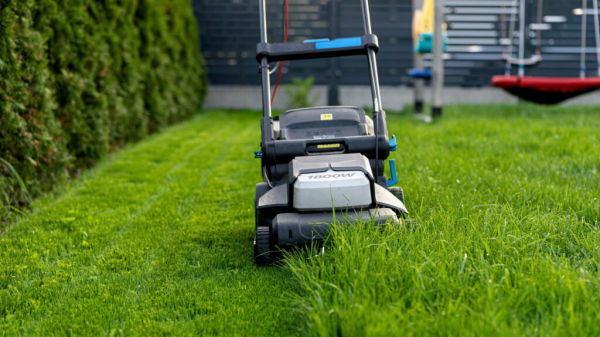
Electric lawn mowers have improved a lot in recent years. With battery-powered models now dominating the market, you are free from the hassle of cord management and maneuvering around them. Electric mowers are generally cheaper in the long run, quieter to operate, and don’t require extensive maintenance, making them a suitable choice for homeowners who prioritize convenience and comfort. However, they are still not the best option for everyone. Despite all these benefits, there are many who still prefer gas mowers, and they have valid reasons for that choice.
The biggest problem with electric lawn mowers, even the ones from top-rated brands, is the same thing that makes them incredibly convenient: the battery. As is the case with any battery-powered device, an electric lawn mower will ultimately run out of power. So, you may find yourself charging it before you have finished mowing the entire lawn. Besides, battery care and the eventual replacement may seem like a hassle to someone not used to it. At the same time, electric lawn mowers feel underpowered, which makes their use slightly unsuitable in lawns with tall and tough grass. And they don’t tend to perform that well in extreme weather conditions, like very high heat.
While an electric lawn mower can be the perfect choice for the right yard, it’s certainly not for everyone. So, it’s important that you understand the drawbacks, as this helps make an informed decision.
Not the best choice for huge lawns
One of the biggest drawbacks of electric lawn mowers is that they can’t run for hours at a stretch. Most regular models will deliver 30 minutes to an hour of runtime. This may not be a problem for around a quarter to half an acre, but for huge lawns and fields, you will be forced to either recharge the batteries in between, which adds a significant delay, or get spare batteries, which adds to the overall expense. Either way, it’s a problem, and something you didn’t have to think about with gas lawn mowers. In case you plan to recharge the batteries midway, be prepared for some downtime.
Also, the terrain type may impact runtime. For instance, slopes and tough grass or weeds may slow you down. This means you may not be able to cover as big an area as you may have initially anticipated. So, if you need a lawn mower that can deliver consistent performance for a long time, gas-powered ones may be a better option. Similarly, for someone running a lawn-mowing service, electric mowers are not usually the ideal choice.
Electric lawn mowers can feel comparatively underpowered
For the longest time, electric lawn mowers were weaker than their gas counterparts. But they have improved with time, and newer models can now deliver sufficient power for the average yard. However, if we look at pure numbers, most electric lawn mowers are still no match for an average gas mower. On average, gas mowers have a torque rating of 4-8 lb-ft, while a basic battery-powered mower tops out at 2.5-3 lb-ft if we calculate the torque based on the power rating and RPM. This may not be noticeable in a pre-trimmed lawn, but in more demanding conditions, where the grass is taller, tougher, and denser, the difference becomes more obvious.
Similarly, an average electric lawn mower may struggle if your lawn has slightly challenging terrain, say steep slopes or dips. In such cases, gas lawn mowers are the better choice. You can, of course, find more powerful electric lawn mowers, i.e., models with a higher torque rating, but those are comparatively expensive.
Not suitable for extreme weather conditions
Another major disadvantage of electric lawn mowers is that they don’t do that well in extreme weather conditions. And there’s little you can do about it since the issue relates to the battery which powers the entire mower. The problem is that extreme temperatures are detrimental to the batteries in electric lawn mowers. Most companies recommend the safe temperature range for charging, storing, and operating batteries.
Also, lawn mowers with sealed lead-acid (SLA) batteries have their own unique problems and require more attention and care. For instance, if you don’t plan to use the lawn mower for extended periods, you may have to store the battery in a fully charged condition to prevent degradation.
Apart from that, operating electric lawn mowers while it’s raining or when the grass is wet is risky. While mowing wet grass is something you shouldn’t do with a push mower, or any other type of lawn mower for that matter, doing so with an electric mower presents additional risks. Corded models, too, aren’t safe for the same reasons. Even if the electric mower offers splash resistance, you ideally shouldn’t take the risk.
Battery replacement can be expensive
Like any other battery-powered device, your lawn mower’s battery will last a finite period. With the right care and handling, it could last anywhere between three and five years, but you will ultimately be forced to replace it. For affordable lawn mower models, battery replacement costs can be as low as $250-300, while for more powerful option, they can go as high as $1000-1500. That’s an expense some people initially overlook, but you can’t avoid it. Also, if you plan to keep a spare battery to extend the mower’s runtime, you will have to factor the cost of the additional battery into the initial purchase.
Electric lawn mowers are undoubtedly low maintenance and, as a result, the maintenance costs are also low. But you can’t ignore the periodic battery replacement, which in itself is a sizable expense. Battery prices will, of course, vary from one model to another and between manufacturers, but the expense is always there.
Corded models can be a hassle
You may be inclined towards corded lawn mowers as they are usually cheaper, can help minimize some of the involved costs, and extend runtime, but there are disadvantages to using them too. That’s the reason cordless, battery-powered models dominate the market. The most obvious downside is that corded mowers don’t generally work on much bigger lawns, unless you have multiple power sockets spread throughout the space. The maximum distance you can cover is limited by the length of the power cord.
Additionally, you will have to keep track of the cable as you move around, as even minor damage to it may increase the risks or render the mower unusable. Trees, plants, and shrubs will also add to the inconvenience. So, while a corded electric lawn mower may work for a few, most are better off with a battery-powered model or gas mower, depending on whether they prioritize convenience and cost or sheer power, respectively. Either way, there are limitations, some trivial enough to be safely ignored, while others have to be factored in before you buy one.