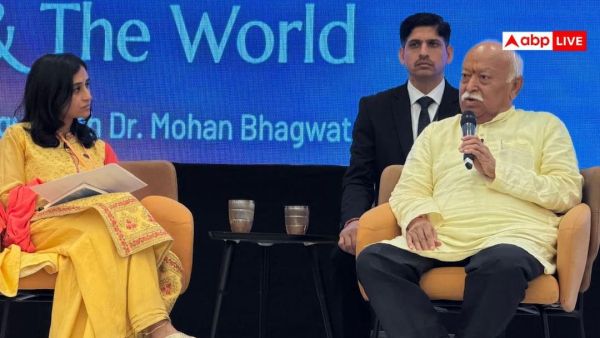
Rashtriya Swayamsevak Sangh (RSS) chief Mohan Bhagwat said anyone who works honestly and selflessly for the welfare of society can be considered a volunteer, even without any formal association with the organisation, while addressing a community event in London.
Speaking at the ‘Celebration of Oneness’ event, Bhagwat said RSS volunteers are engaged in serving society across different fields, including politics, and stressed that the organisation's focus should remain on connecting with people and working for their welfare.
Bhagwat said a person does not necessarily need to communicate with or be formally associated with the RSS to be regarded as a volunteer.
“If you are working honestly and selflessly for the welfare of society, then we consider you to be a volunteer, even if you have no communication or association with us,” he said.
He added that such a person may not work with the RSS or even know what the organisation means, but could still be regarded as a volunteer based on their selfless service to society.
“Today RSS volunteers are serving in every field. Even in politics. In all these fields we are connecting with people. Serving them sincerely. Where no one is working, we are working,” Bhagwat said.
Bhagwat also stressed the importance of social organisation and unity, saying the RSS should focus on aspects that bring people together rather than those that divide them.
“The work of organising Hindu society should be completed before the seventh generation. Now RSS is accepted everywhere. Even our opponents understand the usefulness of our work, and then such a society will take care of everything else. We should emphasise what unites us, not what divides us,” he said.
The RSS chief said the concept of “Hindu” encompasses different schools of thought and forms of worship, describing diversity as a natural feature and unity as the underlying truth.
“When we say Hindu, it is not a religion, it is not a worship. There may be Hindu religions,” he said, adding that different schools of thought had emerged from Bharat Varsha, ranging from atheism to polytheism.
He said followers of different paths could pursue their respective beliefs without seeking to convert one another.
“I tread my path; I will reach the same goal. You also come through your path, and you will reach the same goal. We need not convert each other,” Bhagwat said.
Explaining the RSS's understanding of Hindu Rashtra, Bhagwat said its purpose was to communicate to the world that diversity is natural and unity is the truth.
He distinguished the concept of a Rashtra from a nation state, saying a nation state brings people together through factors such as language, governance or a shared purpose, with rules enforced by the state.
According to Bhagwat, in the concept of Rashtra, the state or ruler is not the primary component and comes later. “First, there is a purpose,” he said.
He said the purpose of Hindu Rashtra was “to give this truth to the world that diversity is a natural, unity is truth, this benefits the world”.
The ‘Celebration of Oneness’ was held in London as part of the RSS centenary celebrations and its overseas outreach programme. The event brought together community leaders for a civilisational dialogue.
The programme was initiated by Hindu Swayamsevak Sangh UK, with support from Integral and several UK-based community organisations.
Bhagwat's visit to London was the final leg of a 17-day tour covering the United States, Canada and Britain. The tour marked his first major international visit during the RSS centenary year.
Before London, Bhagwat attended programmes in New York and Toronto. He had also participated in a multi-faith leaders' meeting in New York on Aug. 29, where 175 participants representing different denominations and religions were present.
The London programme focused on sharing the RSS experience of selfless service and social harmony, along with its civilisational vision of “Vasudhaiva Kutumbakam”, the world is one family.
The RSS, founded in 1925, is observing its centenary year with overseas engagements centred on themes including social harmony, family values, environmental responsibility, self-reliance and civic responsibility.
(With inputs from agencies)