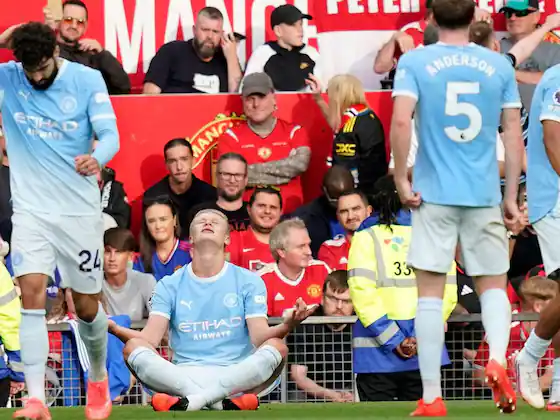
The first Manchester derby of the 2026/27 season is done, and it was almost a relief to be able to concentrate on the football itself after Manchester City emerged as deserved 1-0 winners.
What a novelty it was not to be swallowed up entirely by arguments over VAR and what offside even means any more after a match that was, if anything, almost too short of controversy.
Manchester United can and will protest about the City goal, but they were also exceptionally poor. It is one thing to believe a match has been taken away from you because a major call went in the opposition’s favour; this one began slipping away from United when a major call actually went for them.
1. An early-season derby always feels bigger than it probably should. It always seems to carry extra significance, extra substance, because of what it may reveal about how the rest of a long campaign could unfold for the teams involved.
That was especially true here because everything this match suggested merely reinforced what many already suspected about both sides. For Manchester United, that is grim reading. They were desperately poor, and Michael Carrick may soon find himself with very little room left to push back against doubts over the passion of a team that failed this examination in that department and in just about every other basic one too.
For City, meanwhile, a fourth victory in four underlines the beginnings of a title challenge, with the very real pre-season and post-Pep doubts around the team and manager now gradually fading.
They had won their latest Premier League and Champions League matches without playing especially well. Here, however, they were outstanding in adversity, and the 10 men fully deserved this huge result.
2. The broader conversation around this game, though, will not centre on how either side played but on two refereeing decisions. We may as well admit we want it both ways: lamenting the fact that officiating calls dominate the discussion while also allowing them to dominate our own conclusions. The elephant in the room is simply too big to ignore.
We are not entirely comfortable with either decision. City have every reason to feel deeply aggrieved by the circumstances surrounding Phil Foden’s first-half red card. United, in turn, are fully entitled to be furious about the City winner.
3. The strange thing is that, even though the two major and controversial decisions appeared to hand one benefit to each team, there was never any feeling that things had somehow evened themselves out.
In the end, both decisions worked in City’s favour. That says everything about how badly United failed.
4. Take them one at a time. Looking at the sequence of events in Foden’s clash with Bruno Fernandes, ‘red card for Foden, nothing for Fernandes’ feels close to the least comprehensible outcome available.
The facts are straightforward. Bruno fouls Foden by kicking him in the shin. Then, while Foden is on the turf, he kicks him up the backside. Crucially, that second kick is a distinct action and not part of the original foul.
Foden, with both pride and backside bruised, reacts foolishly with a swiping kick towards Bruno’s midriff. At that point Bruno throws himself to the ground in what looked like dramatic, and surely fabricated, agony.
Only Michael Oliver will know how much that final detail influenced his very swift decision to produce the red card, but it is hard to believe it had no bearing when Bruno somehow escaped the entire episode without punishment.
VAR supported Oliver’s call and pointed to Foden’s kick as a ‘secondary action’. It is difficult to feel too sorry for a player of Foden’s experience allowing himself to be so easily provoked by such a well-known irritant, and there is only so much sympathy one can have for the defence of ‘But he started it’... but the problem is that, in this case, he did.
Bruno did start it. Bruno was the initial aggressor, even among the so-called ‘secondary actions’.
As Will Ford has already pointed out, football has a peculiar habit of punishing actions from the ground more harshly than similar acts committed while standing. In open play there may be a reasonable discussion around control and intent, but that logic seems to carry over far less convincingly into this sort of post-foul nonsense.
Bruno’s second kick, the one aimed at Foden’s backside, was the strongest and most deliberately nasty action of the lot. It was also very clearly a ‘secondary action’.
It is hard to understand how the final judgement can be that the lighter retaliatory kick merits a red card while the earlier and more violent secondary act is treated as not deserving any punishment at all.
5. Then there is the goal. To begin with, there is a routine VAR element to all this, because it seems fairly clear the assistant referee, quite understandably, thought both Erling Haaland and Enzo Fernandez were offside, which would have made the subjective issue of the latter’s involvement irrelevant.
But once it became clear that Haaland was actually being played onside by Patrick Dorgu’s outstretched toe, the focus shifted to the subjective element.
And here, we think, lies the fundamental weakness of VAR, one that can never truly be solved. The entire system is built on the false promise that every decision has an objective right answer and an objective wrong one.
Every time a call arrives that exposes the weakness of that idea, the response is to rewrite and redefine the laws yet again in the mistaken belief that more precise wording will somehow create clearer and more universally acceptable outcomes. It will not, because huge parts of football’s laws rest on foundations that are inevitably and necessarily subjective.
6. The battle between the rival schools of officiating thought can never be decisively won. We all demand consistency until what we really want is common sense. Then we demand common sense until what we really want is consistency. So it has always been.
But on the specific issue of interfering with play and offside, it increasingly feels as though common sense, even at the apparent cost of consistency, was the better route. There was something to be said for the old definition of interference being little more than ‘I know it when I see it’. Attempts to codify every precise action that counts as interfering with play have only narrowed the definition and opened the door to some absurd outcomes.
7. Even with all that said, this particular goal still feels remarkably simple. It should not have stood. Even within the tightly drawn modern definition of an ‘interfering’ offside offence, it is difficult to see how Enzo Fernandez throwing himself at the ball for a full-length diving header, narrowly missing it, while commanding the full attention of Lisandro Martinez and at least some of Senne Lammens’ attention, does not fall squarely within the wording of the current law.
A player will be penalised if they are… Clearly attempting to play a ball which is close when this action impacts on an opponent
Fernandez’s movement appears to match that description so completely that footage of this very incident could be inserted into a PowerPoint presentation as the textbook example of what that clause is intended to cover.
There is room for argument around the red card, but there appears to be none here. United will surely get an apology from Pro Ref, which no doubt will make them feel ever so much better.
8. What United should at least be thankful for is that the post-match attention and fallout will be directed almost entirely towards those two major controversial calls. That means far less scrutiny than would otherwise have been placed on United’s football. And from pretty much the moment Foden went off, that football was mostly dreadful.
That was especially frustrating because, by the time of the red card, they were probably marginally ahead on points after a few cautious opening passages.
City had produced a brief but intense burst of attacking pressure in the opening minutes and United had weathered it, first finding a foothold and then gaining a degree of control over the next half-hour.
Then the red card ruined them.
9. In terms of how it changes a match, a red card shown to an attacking player is often the most interesting kind. It is the most interesting precisely because it creates the fewest knock-on effects. Neither side needs to tear up its shape, method or tactics completely; they simply need to adjust them to exploit the advantage or reduce the disadvantage.
City merely shifted from 4-2-3-1 to 4-2-2-1. The £200m double pivot in midfield dropped back a few yards, perhaps, and the full-backs and wide players tucked in narrower. There was nothing dramatic, but it was highly significant.
That modest enforced tweak from City had a numbing effect on United, whose threat from wide areas is limited even at the best of times. None of United’s front three are naturally touchline-hugging wide men, and the side’s main creative driving force is, of course, the resolutely central Bruno.
10. What the numerical disadvantage allowed City to do, something that might have looked excessively negative with 11 men but proved brilliantly effective with 10, was choke off the central spaces United wanted to use.
City now had the perfect excuse to compress that middle third, reduce the spaces between Fernanderson and the back four, and bring the full-backs in much closer to the centre-backs.
That left United a blunter and less convincing attacking side against 10 men than they had been against 11, while still allowing City to keep three genuine counter-attacking threats on the pitch in Haaland, Rayan Cherki, later Iliman Ndiaye, and Antoine Semenyo. It all worked perfectly for Enzo Maresca, who no longer looks like a man facing an impossible job.
And yes, we called the Fernandez-Anderson partnership ‘Fernanderson’. Do with that what you will.
11. Both of them were magnificent on their Manchester derby debuts. Fernandez was excellent, but Anderson in particular stood out.
This was not only his first Manchester derby appearance, but his first proper senior derby of any kind, having never faced Sunderland while at Newcastle nor Derby while with Nottingham Forest.
You would never have known it. He hurled himself into the contest with everything you could ask from a derby midfielder. Crunching tackles. Early reducers in those unofficially accepted opening exchanges where yellow cards seem to be off limits. And, ultimately, the calm, hard-edged control of a game full of fraying tempers and abandoned plans that you would normally associate with a seasoned veteran of such occasions.
Fernandez, for his part, brought all his usual diplomatic qualities and was exactly the sort of figure you want around when a match threatens to boil over. The one complaint here with Maresca was his decision to take Fernandez off shortly after his yellow-each altercation with Harry Maguire, just when it looked set to become yet another major talking point in a game apparently crying out for them. Boo. BOOOO!
12. Haaland was outstanding as well once City were reduced to 10 men, embracing the role of chief hold-up specialist with real enthusiasm and then leaning into it even more as City wound down the clock and sealed victory with something close to embarrassing comfort.
What he did in those final minutes was genuinely fascinating. Again and again he would collect the ball around halfway or even deeper, and his objective was simple: carry City as far up the pitch as possible.
But the method mattered. Normally, you would think the best way to do that would be to drive forward as quickly as possible and gain maximum ground in the most efficient way. Haaland did the opposite. It sounds ridiculous to explain it as ‘running less fast than he could have if he had wanted to’, but that is essentially what he did. He advanced upfield by not running at full speed. In doing so he invited tackles, gave team-mates time to get up the pitch and, more than anything else, chipped away at United’s hearts and minds in a way that a simple sprint to the corner flag never could.
All of that came after he had already scored his ninth goal in eight Manchester derbies.
13. In truth, though, City had standout performers all over the pitch. Gianluigi Donnarumma had embarrassingly little to do until he produced a magnificent stoppage-time save to stop Bryan Mbeumo from grabbing a narrative-changing, potentially season-shaping equaliser. Marc Guehi was colossal at the heart of the defence. Everywhere you looked, players in blue were putting in huge shifts.
14. And, unfortunately for United, that stood in sharp contrast to those in red. While City rose to the challenge of being a man short, United crumbled when confronted with their own task against a determined, organised and disciplined 10-man City side.
They fell short technically, tactically and in every other possible way. Most concerning of all, they looked a bit dim. They simply failed to do any of the things you are supposed to do against 10 men. They did not move the ball quickly. They did not switch play from one side to the other. They did not try to stretch a depleted City by making the pitch wide.
What made it all the more maddening was that these were exactly the things United had been doing when City still had 11 players on the field.
It has been a long time since Bruno Fernandes was this anonymous in a big United match. Kobbie Mainoo and Youri Tielemans, or Tielemainoo if you prefer, were clearly and comfortably second best to Fernandez and Anderson, whose transfer fee already seems to be mentioned with rather less smug regularity.
There were long spells when it was genuinely easy to forget Matheus Cunha was even playing. Even now, looking at the teamsheets, it is oddly difficult to accept that he was not actually substituted with around 25 minutes left. Where was he? What exactly was he doing for all that time?
15. The one genuine exception for United was Marcus Rashford, playing in his first Premier League Manchester derby since 2023. In the end he too was dragged down by United’s broader malaise before being replaced late on, but when it was 11 v 11 he was their brightest and most dangerous attacking outlet, and once United were facing only 10 men he was virtually the only player who seemed to have any understanding at all of what the job required.
16. In the end, everything about this game can almost be reduced to one statistic. You could, if you wished, spend the entire week arguing over the red card or the offside goal, and it seems overwhelmingly likely that everyone will do exactly that whether they want to or not. What a relief that VAR arrived to put an end to refereeing controversy forever, eh? Football really had a lucky escape there.
But there we go. We have immediately walked into the same trap ourselves.
No, the number that truly captures this match is that after Foden was sent off in the 35th minute, United did not register a shot on target until the 70th minute, by which stage they were deservedly, if undeniably in baffling fashion, trailing by a goal.
It is not merely that 10-man City still managed to beat United; it is that the whole thing felt so oddly, comfortably predictable.