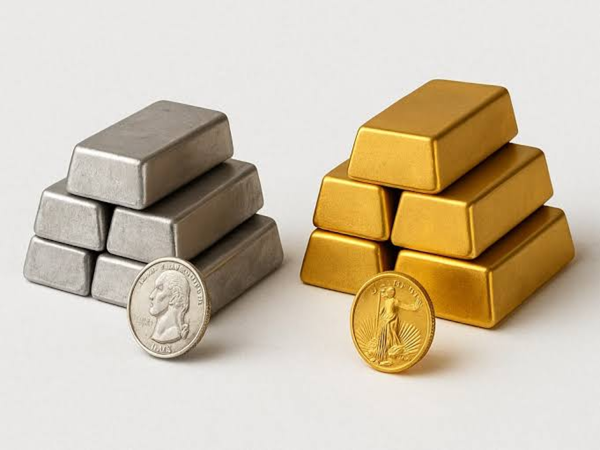
Silver and Gold Prices Under Pressure: Gold and silver prices in the international market saw a decline this Tuesday. Investors were keeping a close watch on high crude oil prices, a strong US dollar, and rising bond yields ahead of the US Federal Reserve's two-day policy meeting.
COMEX gold futures fell 0.28% to $4,339.60 per ounce, while COMEX silver dropped 0.58% to $63.765 per ounce. Spot gold declined 0.15% to $4,291.59 per ounce, and spot silver fell 0.31% to $63.03 per ounce.
These movements follow weakness observed in both precious metals earlier in the week. In the domestic market, gold prices in New Delhi fell by ₹500 to ₹1.55 lakh per 10 grams on Monday (September 14), while the price of silver remained steady at ₹2.34 lakh per kilogram (inclusive of taxes).
Why are gold and silver under pressure?
This pressure on precious metals stems from high crude oil prices, a strong dollar, and rising bond yields.
Renewed geopolitical tensions in West Asia raised concerns regarding oil supplies, causing US crude to rise 1.27% to $102.68 per barrel and Brent crude to climb 1.21% to $106.96 per barrel.
High oil prices can complicate inflation forecasts. If energy costs remain high, central banks may have less room to ease monetary policy. This can impact gold and silver, as neither metal generates interest income.
Meanwhile, the US Dollar Index rose 0.05% to 99.53. A strong dollar generally makes dollar-denominated precious metals more expensive for buyers using other currencies, which can dampen demand.
US Treasury yields have also risen, with the benchmark 10-year yield touching 5% overnight—its highest level since 2023. Rising bond yields increase the "opportunity cost" of holding non-interest-bearing assets like gold.
Why is the Fed's decision significant?
The Federal Open Market Committee is beginning its two-day meeting on Tuesday (September 15). Markets are closely watching the decision on interest rates and the accompanying commentary.
The outlook for interest rates is crucial for bullion (gold and silver) because rates influence both bond yields and the dollar. If the Fed maintains a hawkish stance, the dollar and yields could rise, potentially putting short-term pressure on gold and silver. Conversely, if signals are less hawkish, an easing of pressure on yields and the dollar could provide support to precious metals.
Experts have also identified inflation as a key factor. High energy prices could drive up inflation expectations, potentially influencing the direction of Fed policy.
Could geopolitical tensions provide support to gold?
Geopolitical uncertainty can have a significant impact on bullion.
Renewed tensions in West Asia—including attacks by Iran-backed forces and concerns regarding oil infrastructure—have put investors on alert. Such uncertainty can boost demand for gold, as it is traditionally viewed as a safe-haven asset.
This creates opposing forces affecting the price of gold. High oil prices and inflation concerns could drive up interest rates and bond yields, which is negative for bullion. However, these same geopolitical tensions could boost demand for gold as a hedge against uncertainty.
What about silver?
Like gold, silver is influenced by various macroeconomic factors, but its price can also be affected by industrial demand, given the metal's extensive use in manufacturing and technology.
Consequently, silver may be more sensitive to expectations regarding global economic growth. A strong growth outlook could support industrial demand, whereas concerns about economic activity could put pressure on the metal.
On Monday (September 14), the global spot price of silver fell by approximately 3% to $62.82 per ounce, while in early Asian trading on Tuesday (September 15), the COMEX silver price stood at around $64 per ounce.
What should investors watch out for next?
For the bullion market, the Fed's policy decision and associated commentary will have an immediate impact. Investors will also be monitoring crude oil prices, the movement of the US dollar, and Treasury yields.
Volatility in gold and silver prices is likely to persist as these factors pull prices in opposing directions. A drop in crude oil prices or a less hawkish stance from the Fed...
Disclaimer: This content has been sourced and edited from Money Control. While we have made modifications for clarity and presentation, the original content belongs to its respective authors and website. We do not claim ownership of the content.