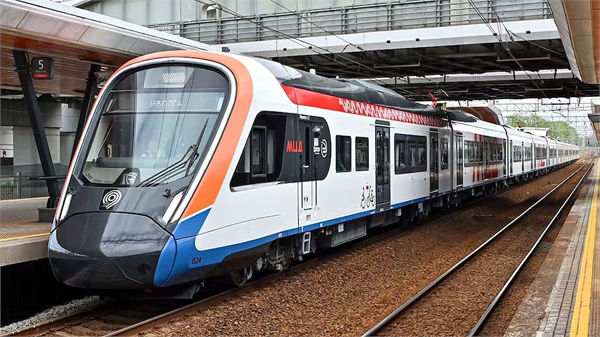
New Delhi. India is moving rapidly towards modernizing its railway system. High-speed train project is included in the priority of the country. Meanwhile, Russian company Transmashholding has introduced its Ivolga high-speed train technology to India. This proposal came up during the INNOPROM.India program.
Ivolga train can run at a speed of 360 kilometers per hour. A set of eight coaches can accommodate 642 passengers. Its age is said to be 30 years. It is possible to use 80% local material. This offer is going to take forward the existing rail cooperation between India and Russia.
Transmashholding is already active in India. The company has signed a deal worth $6.5 billion through a joint venture to manufacture Vande Bharat sleeper trains. Under this, 120 trains are to be made. Based on this experience, Russia now wants to enter the high-speed segment as well. This technology can prove useful in corridors like Mumbai-Ahmedabad.
Features and capabilities of the Ivolga train
Ivolga is a modern electric train developed in Russia. It is designed for urban and intercity services but in the high-speed version its speed can reach up to 360 kilometers per hour. The set of eight cars is sufficient in terms of passenger capacity. Long life and low maintenance costs make it attractive.
The most important thing is 80 percent local content. This will directly benefit the Make in India initiative. Indian industry will gain new capabilities through technology transfer and local production. India is currently focusing on semi-high speed Vande Bharat trains which run at a speed of 160 to 180 kilometers per hour. Projects like Bullet Train are underway for a complete high-speed network.
Japanese Shinkansen technology has been selected for the Mumbai-Ahmedabad corridor. The Russian proposal could increase options in this area. This can be beneficial especially in terms of cost and local manufacturing.
Background of India-Russia Railway Cooperation
There has been a long standing cooperation between India and Russia in the railway sector. Transmash Holding's Vande Bharat Sleeper Project is the latest example of this. Production has started in the factory located in Latur. Indian engineers are also being given training in Russia. This joint venture has strengthened the industrial relations between the two countries.
Now offering advanced technology like Evolga is an extension of this collaboration. It is natural to have this discussion on a platform like INNOPROM.India. Here emphasis is laid on industrial and technical partnership. Russia not only wants to sell ready trains to India but is also ready for joint production and sharing of technology. This will increase India's self-reliance and export capacity can also develop.
Challenges and opportunities
Safety, track infrastructure and signaling systems are of paramount importance in high-speed train projects. Just bringing the train is not enough. The entire corridor has to be made high-speed friendly. The cost is also high. How competitive the Russian offer is compared with Japanese technology remains to be seen. The process can be expedited by learning from the existing Vande Bharat experience.
The Government of India is promoting domestic manufacturing under Make in India and Self-reliant India. The promise of 80 percent local content is positive in this direction. If the deal happens, employment opportunities will increase and technical skills will develop. Apart from Mumbai-Ahmedabad, other possible corridors like Delhi-Varanasi or South India routes can also be considered.
The Russian proposal matches India's high-speed rail goals. After the success of Vande Bharat, now the next step is to have a complete high-speed network. Both countries will benefit from technology transfer and joint production. India will have to negotiate according to its needs. It is necessary to agree on safety standards, costs and deadlines.
This offer can give a new height to the India-Russia strategic partnership in the rail sector. If successful, Indian passengers will be able to enjoy fast and comfortable travel. Also, the domestic industry will become competitive at the global level. Formal discussions on this proposal are expected to move forward in the coming time. Russian technology can write an important chapter in India's railway revolution.