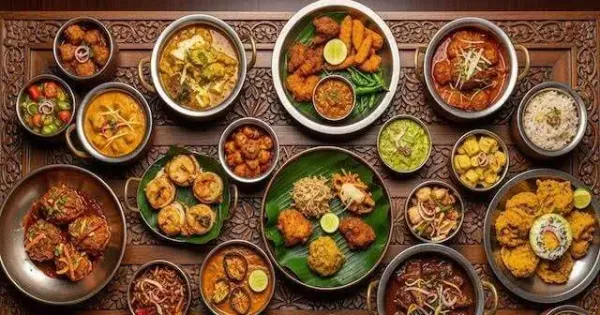
Guests were served entirely vegetarian Indian cuisine at the gala dinner of BRICS Summit 2026 held in New Delhi. The menu included delicious dishes like Khandvi, Paneer Lababdar, Millet Pulao, Khumb Galouti and Jalebi. After this, a social media post by Congress leader Rahul Gandhi gave rise to a new debate on vegetarianism and non-vegetarianism in India.
While discussing the eating habits of Indians, Rahul Gandhi shared the figures of popularity of non-veg food. Union Minister Kiren Rijiju also responded by saying that the foreign guests enjoyed Indian vegetarian cuisine. This discussion was not limited to just BRICS dinner, but the question started arising that what is the 'real food' of India?
Has India always been vegetarian?
According to history, traditions of both vegetarianism and non-vegetarianism have existed in India for a long time. Bones of cattle, sheep, fish and other creatures found in excavations to the Indus Valley Civilization indicate that non-vegetarian food was prevalent at that time. Even during the Vedic period, some historians have mentioned the use of animal food and meat. This makes it clear that it is not right to limit the Indian food tradition to only vegetarianism.
Contribution of Buddhist and Jain traditions
Buddhist and Jain traditions provided an important religious and social basis for vegetarianism in India. Non-violence was given special importance in the teachings of Mahavira and Buddha around the sixth century BC. However, there are various interpretations regarding the diet of Gautam Buddha, so not all claims regarding his food can be considered equivalent.
Non-veg before Mughals
It is also not right to link the story of Indian non-veg dishes only to the Mughal period. The traditions of using meat, fish and other animal products in India are much older. During the Mughal period, Persian and Central Asian cooking merged with Indian spices and local ingredients, popularizing dishes such as biryani, kebab, korma and nihari.
The figures of NFHS-5 (2019-21) are interesting in the context of Rahul Gandhi's claim of eating 80 percent non-veg. About 87 percent of men and 75 percent of women aged 15 to 49 years report eating meat, fish or eggs. However, this does not mean that 80 percent of the country's population eats meat daily.
influence of religion
Food preferences are influenced by religion, region, community, family and local culture, but it is not easy to understand this from religious identity alone. There are Hindu communities in India where non-vegetarianism is common, while many Hindu communities are strict vegetarians.
Vegetarianism and social identity
Over time, vegetarianism has come to be associated with piety and social prestige among some social classes in India. On the other hand, different social perceptions regarding non-vegetarian food have developed in different regions.
identification of original plate
According to food historian Pushpesh Pant, it is not possible to summarize Indian food in any one dish. India's geographical and cultural diversity is also visible in its plate.
political aspects of food preferences
The debate at the BRICS dinner showed that food in India is not just a matter of taste or nutrition, but also intersects with religion, identity, culture and politics.
recognition of diversity
Putting India's food culture in the box of only vegetarian or non-vegetarian belittles its true diversity. Here different states, communities and traditions have developed their own food styles over centuries.