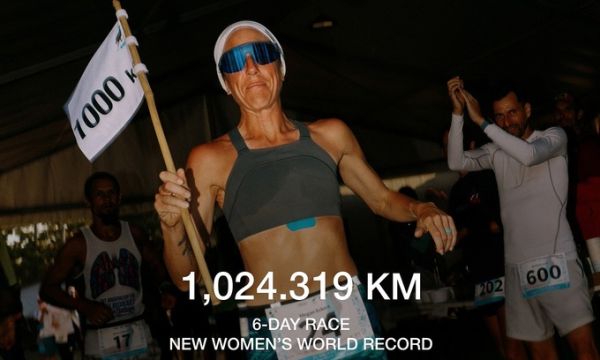
Before competing in the GOMU 6-Day World Championships in Balatonfüred, Hungary, Eckert set two ambitious goals. She aimed to break her own world record of 970.685 km set in France in 2025, alongside the American record of 975.653 km established by Joe Fejes in 2015, according to Marathon Handbook.
Eckert surpassed her personal best after 135 hours and 38 minutes. She then broke the national record just 32 minutes later with nearly eight hours of race time remaining.
The athlete reached the 1,000km mark in 139 hours, 55 minutes and 46 seconds, an unprecedented achievement in the women’s six-day event.
When she completed her run on Wednesday, her total distance was equivalent to 1,140 full laps plus an additional 371 m. According to Ultramarathon Databasean expert directly measured the final partial lap after the race to confirm the total distance of 1,024.319 kilometers.
|
Megan Eckert sets a historic record at the GOMU 6-Day World Championships in Balatonfured, Hungary on Sept. 9, 2026. Photo by Instagram/@_megeckert |
The certified paved course is 898.2m long and was located within a campsite by Lake Balaton, remaining closed to traffic for the event. In six-day competitions, athletes do not race toward a finish line but instead aim to cover the longest possible distance before the 144-hour time limit expires.
The race duration also includes sleeping or resting time. According to iRunFarEckert reportedly slept every two hours with 15-minute power naps and very few long breaks. Over the course of the six days, she maintained an average speed of 7.11 km per hour.
Data indicates that Eckert struggled during the fifth day of the competition. After 108 hours, she had covered 796.6 km, but it took until the 123rd hour to reach 885.1 km.
Her speed during this period dropped below 5.95 km per hour.
However, Eckert successfully picked up her pace again on the final day. Ultramarathon Database recorded her breaking the previous national record at 3:40 a.m. (local time) on Wednesday while walking, following a night that included several long breaks where a single lap took her nearly 39 minutes.
Eckert won the event overall and even finished ahead of all male competitors. Norwegian athlete Simen Holvik finished second with 940.415 km, trailing Eckert by nearly 84 km, while Croatian runner Mario Celikovic took third place with 861,373 km. The gap between Eckert and the runner-up was even greater than the distance between second and third place.
In the women’s category, Japanese runner Tomomi Bitoh finished second with 802.092 km, trailing the champion by 222 kilometers.
Records and controversies
For over three decades, the women’s six-day record was held by New Zealand’s Sandra Barwick, who ran 883.631 km in Australia in November 1990.
This milestone stood for over 33 years before Camille Herron set a new benchmark of 901.764 km at an event in California in March 2024.
The recognition of later records has become complicated. Danish runner Stine Rex covered 913.606 km in August 2024, but her result was not officially ratified.
A year later, Rex competed again and covered 928.577 km. This result was officially recognized even though the six-day performance occurred during a 10-day race.
This result currently remains the best women’s six-day performance listed by the International Association of Ultrarunners (IAU). Meanwhile, Eckert’s previous 970.685km performance from early 2025 remains on the organization’s pending list with a note citing the need for additional data and clarification.
 |
|
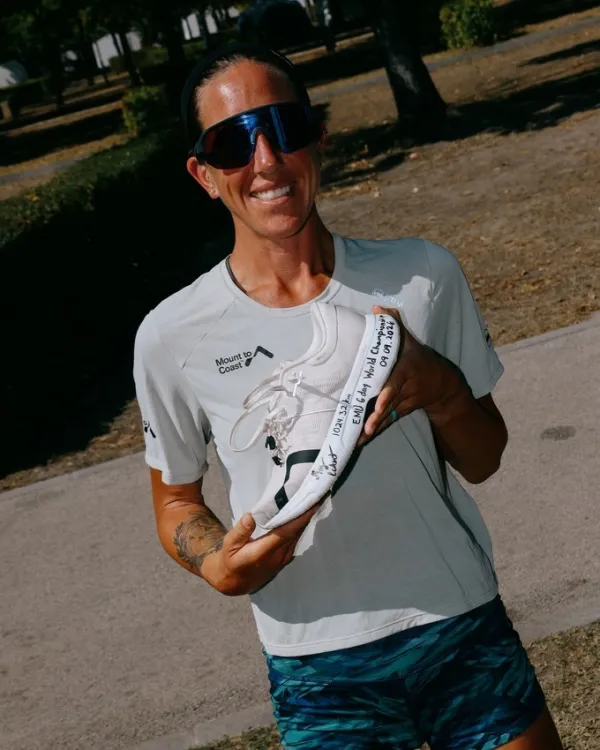
Megan Eckert wrote her world record on her shoes after the run. Photo by Instagram/@_megeckert |
The Global Organization of Multi-Day Ultramarathoners (GOMU), which organized this year’s event, was founded in 2021 partly to recognize multi-day running achievements that the IAU had not acknowledged. This organization has recognized Eckert’s 2025 performance.
Regardless of the system used, the women’s six-day performance benchmark has improved by around 140 km compared to Barwick’s long-standing record. This gain has occurred since March 2024.
Closing in on men’s record
Prior to Eckert’s historic run, only male athletes had successfully broken the 1,000km mark in six days.
Ivan Zaborsky achieved a distance of 1,047.554 km in 2025, a mark currently recognized by GOMU as the best record. Belgian runner Matthieu Bonne covered 1,045.519 km at the same event in 2024.
Eckert is only behind the men by about 23 km, a distance that would have taken her around three hours and 15 minutes to cover.
The 40-year-old Eckert currently works as a mathematics and special education teacher at a middle school in Santa Fe, New Mexico. She only began competing in multi-day races in June 2024, when she won an event held on a 443m indoor track in Milwaukee.
GOMU will make the official ruling regarding Eckert’s distance in Hungary in the coming weeks, while IAU is still requesting clarification on data regarding her previous performance.