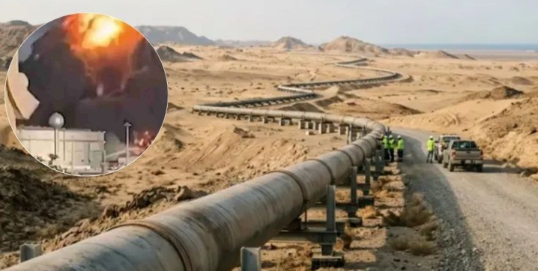
Oil Pipeline Shut Down: Saudi Arabia has closed its East-West oil pipeline after the drone attack. Pumping stations connected to the pipeline caught fire and some people were injured in the drone attack.
Saudi Drone Attack: Riyadh. Saudi Arabia has temporarily closed its East-West oil pipeline after the drone attack. Several pumping stations connected to the pipeline caught fire in the attacks on Thursday. There is also news of some people being injured in this incident. After the closure of the Strait of Hormuz, this pipeline became very important for Saudi. Through this, about 50 lakh barrels of oil were being sent daily.
The Saudi Energy Ministry said on Friday that several attacks had been carried out on the pipeline. After the attack, security and technical teams have been sent to the spot. These teams are assessing the damage and working to secure the pipeline. At present it is not clear who is behind the attack. No country or organization has yet taken responsibility for this.
According to US officials, the attackers targeted pumping stations near the pipeline. With the help of these stations, oil is sent further in the pipeline. Satellite images taken on Friday showed heavy damage caused by a fire at a station. In the second picture, black smoke was seen rising from the station. However, the actual damage caused to the pipeline is not yet known. The date of its restart has also not been decided.
The Saudi Foreign Ministry said several drone attacks were carried out on the pipeline in the Riyadh and Medina areas. Saudi claims that these drones came from Iraq. Riyadh has decided not to retaliate for now. According to Saudi, this decision was taken after the appeal of the Iraqi Prime Minister. Saudi wants Iraq to take concrete steps to stop such attacks from its soil.
The Iraqi government has also condemned the attack. Iraqi officials have said they will investigate the matter. The government said that it will not allow its land and airspace to be used to attack other countries. Earlier, Saudi had demanded Iraq to take action to stop such attacks.
Most of Saudi Arabia’s crude oil is produced in the eastern part of the country. Under normal circumstances, a large part of it is sent to other countries by sea route. For this, oil tankers have to pass through the Strait of Hormuz while leaving the Persian Gulf. Saudi Arabia increased the use of the East-West Pipeline when the Hormuz route was closed after the Iran war.
The East-West Pipeline connects Saudi’s eastern oil fields to Yanbu port on the west coast. Due to this arrangement, oil does not need to pass through the Strait of Hormuz. After the closure of Hormuz, Saudi was sending about 5 million barrels of oil daily to Yanbu through this pipeline. From there the oil can be transported to international markets through sea vessels.
After Hormuz, now the Red Sea sea route is also under pressure. Yemen’s Houthi rebels have claimed control around the Bab el-Mandeb Strait. He has also said that Saudi ships will not be allowed to pass through this route. Houthi military spokesman Yahya Sarri claimed that Saudi-backed forces had lost control of Perim Island, located in the middle of the Bab al-Mandeb.
Bab al-Mandeb is an important route for maritime trade between Asia and Europe. Ships loaded with oil also reach Europe and other markets via the Red Sea. In such a situation, increasing tension on both the major sea routes of Hormuz and Red Sea may increase concerns for global oil supply. An attack on Saudi’s vital pipeline could worsen the crisis.