
More and more employees in the UAE are registering for the Gen AI courses to grow in their professional careers and stay competitive in the job market as nearly half of workforce will require upskilling by 2030.
Importantly, industry executives say that companies are also spending heavily on upskilling their employees’ AI skills to align them with the evolving needs of the workplace due to new technologies.
“One of the big trends that we're certainly seeing, and this is true both in the UAE and across the Gulf and really around the world, is the incredible interest in Gen AI. So far this year, we are seeing an average globally of 14 enrollments per minute in Gen AI content, up from eight per minute a year ago and one per minute in 2023. Interest just continues to really skyrocket in Gen AI content, and that's true, certainly, also here in the UAE. We've 131,000 enrollments in Gen AI-related content in the UAE. That's more than doubled over the past year, coming from learners here in the UAE,” said Greg Hart, Global CEO of Coursera.
Stay up to date with the latest news. Follow KT on WhatsApp Channels.
Greg Hart, Global CEO Coursera
Overall, more than 3 million enrollments from the UAE have been registered with Coursera and 165,000 in the third quarter of 2025.
Across the Middle East and North Africa, there are about 12.1 million registered learners, and that's grown at 18 per cent year over year, and so slightly faster growth here in the Emirates than across the region.
Amidst rising demand, Coursera’s catalogue of Gen AI-focused content has more than doubled over the past year to over 1,100 courses.
In an interview with Khaleej Times, Greg Hart pointed out that employees now need to know how to apply AI in their jobs.
“What we're seeing is that AI is really transforming, not necessarily an entire job, but aspects of the job, specific tasks can now be done by AI, so that, in turn, it frees up time and resource to enable a given worker to then move on to some higher level task,” he said during his recent visit to UAE for Coursera Connect conference.
“If AI is doing the more mundane things and very effectively, that frees up time from that employee to then spend on other things,” he said, adding that employees can use augmentation AI tools to do their jobs more effectively.
Over half of UAE workforce need upskillingAbinav Raja, managing director, Ramco Systems, said AI has changed a lot, and people will see a lot of companies focusing on the speed of implementation, and that makes it much easier for people to try new products as well.
Sandesh Bilagi, chief operating officer of Ramco Systems, said the public sector is leading the AI drive in the UAE, and the private sector is also spending massively on AI.
He ruled out any impact of AI on job losses in the UAE and the region.
“I don't think AI is going to impact the way we do work. It might change. Temporarily, people will fear about their jobs, but I don't think people should worry about that,” said Bilagi.
He stressed that companies across different sectors are spending on enhancing the upskilling of their staff for AI.
“Companies here in the UAE and region are asking not about how to reduce the workforce, but how to make their life better and give them the tools so that they are able to perform better. That is consistently what I have heard in this region,” Bilagi told Khaleej Times during an interview.
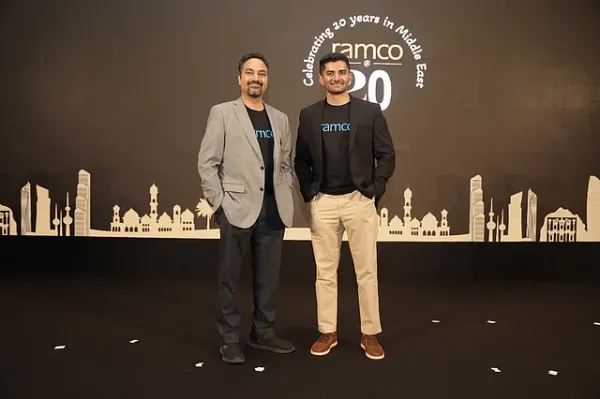
Sandesh Bilagi (left) and Abinav Raja
Greg Hart also confirmed that the UAE employers are absolutely pushing for upskilling.
“The UAE is actually really leaning into the opportunity that technology represents to really transform the country and the economy. With initiatives like UAE AI strategy 2031, those are really focused on making sure that the country and the Emirates can shape a very future-ready workforce,” he said.
According to a World Economic Forum report, by 2030, 46 per cent of the UAE workforce is going to need retraining, because their core skills are going to change.
UAE: 6 in 10 employees use AI in daily jobs as country tops global adoption Why UAE employees who refuse to upskill risk falling behind in modern workplace