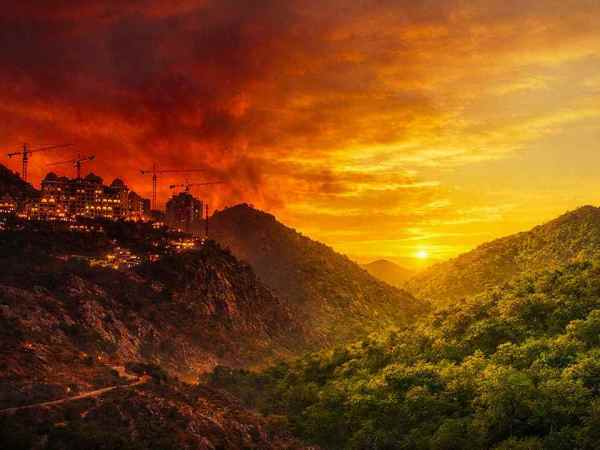
Aravalli Hills: The Supreme Court of India has temporarily paused its own earlier decision related to the definition of the Aravalli Hills, signalling a cautious re-examination of environmental and regulatory concerns linked to one of the country’s oldest mountain systems. The move reflects the court’s recognition that the issue involves complex ecological, geographical, and policy dimensions that require deeper scientific scrutiny before any long-term decisions are enforced.
In November, the Supreme Court of India had accepted a definition of the Aravalli Hills and the Aravalli Range proposed by the Union Environment Ministry. This definition was intended to bring uniformity and clarity for regulating mining activities across states where the Aravalli range extends. However, the acceptance of this definition raised serious concerns among environmentalists and civil society groups, as it potentially opened large parts of the Aravalli region to regulated mining.
Recognising these implications, the court has now kept its November 20 order in abeyance, stating that further clarifications are essential before such a sensitive definition is implemented on the ground.
The court observed that the environmental impact of the recommendations made by the earlier committee had not been adequately assessed. It pointed out that the panel which suggested the revised definition was largely composed of bureaucrats, with limited representation from independent environmental and geological experts. This raised questions about whether the recommendations fully captured the ecological complexity of the Aravalli system.
According to the court, decisions affecting fragile ecosystems must be informed by scientific evidence and environmental expertise rather than administrative convenience alone. The potential consequences of mining activity, even when regulated, were seen as too significant to be evaluated without a rigorous expert review.
The matter was heard by a bench comprising Chief Justice of India Surya Kant, Justice J.K. Maheshwari, and Justice A.G. Masih. While staying the earlier ruling, the bench stressed the importance of an objective and independent assessment of the Aravalli range.
The judges questioned whether limiting the definition of the Aravalli Hills to a narrow 500-metre belt could create what they described as a structural paradox. Such a restricted definition, they noted, might shrink conservation zones while simultaneously expanding areas where mining could be permitted, undermining the very objective of environmental protection.
A key concern raised by the court related to how geographical gaps between hill formations should be treated under environmental norms. The bench referred to scenarios where two hill formations, each over 100 metres in height, are separated by distances of around 700 metres. It asked whether such gaps should be excluded from the Aravalli definition and, if so, whether that exclusion could encourage mining in ecologically connected landscapes.
The court also sought clarity on whether the revised definition had inadvertently widened the scope of areas classified as non-Aravalli, thereby making them eligible for mining activities. These questions highlighted the need to preserve ecological continuity rather than viewing hill formations in isolation.
Emphasising the need for scientific guidance, the Chief Justice proposed the constitution of a high-powered expert committee comprising domain specialists. This committee will analyse the earlier report and evaluate its environmental and regulatory implications in detail. The court made it clear that future decisions must be guided by credible scientific assessments and a holistic understanding of the Aravalli ecosystem.
If significant regulatory gaps are identified during this review, the court indicated that a comprehensive reassessment may be necessary to address existing shortcomings and prevent long-term ecological damage.
The Supreme Court has issued notices to the Union government and the four states through which the Aravalli range passes—Rajasthan, Gujarat, Delhi, and Haryana—seeking their responses in the suo motu proceedings. The court underlined that a fair and independent evaluation is required before either the earlier committee’s recommendations or the court’s own judgment can be implemented.
The court’s decision has also drawn political reactions. Congress leader Jairam Ramesh welcomed the move to keep the earlier order on hold until January 21, describing it as a setback to attempts at redefining an ecologically sensitive region without adequate safeguards.
The case has gained national attention amid protests and public debate, underscoring the broader tension between development needs and environmental conservation. The Aravalli Hills play a critical role in preventing desertification, regulating climate, and supporting biodiversity in north-western India, making their protection a matter of long-term national interest.
By pausing its earlier order, the Supreme Court has signalled that environmental governance must be rooted in scientific integrity and precaution. The outcome of the expert committee’s review is expected to shape future policy on mining regulation and conservation in the Aravalli region, setting an important precedent for how India balances economic activity with ecological preservation.