AAP and BJP: The political atmosphere in Delhi once again turned confrontational after the suspension of two government officers brought the issue of administrative authority back into the spotlight. The incident reignited a long-running debate over who truly controls the bureaucracy in the national capital, highlighting unresolved tensions between elected representatives and the central government’s administrative framework.
The controversy began with the suspension of the Sub-Registrar of Kapashera and the Tehsildar of Mehrauli. These actions were officially confirmed through a note issued by the Chief Minister’s Office. The suspensions followed multiple complaints alleging negligence and irregularities in official duties. According to the statement released, the government emphasized that corruption and administrative misconduct would not be tolerated under any circumstances.
However, what appeared to be a routine disciplinary move quickly escalated into a political argument, as opposition leaders questioned the legal and constitutional validity of the decision.
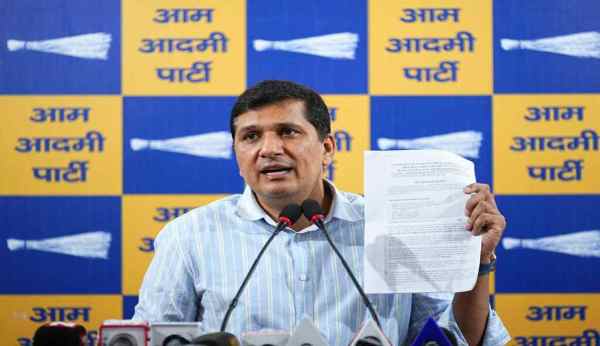
Saurabh Bharadwaj, a senior leader of the Aam Aadmi Party, publicly challenged the decision, asking whether the current Delhi government actually possessed the power to suspend officers. His remarks were directed at Chief Minister Rekha Gupta and her administration.
Bharadwaj argued that during AAP’s tenure in Delhi, the elected government was repeatedly told it did not have direct authority over bureaucratic suspensions. Instead, such decisions were routed through the National Capital Civil Service Authority and ultimately approved by the Lieutenant Governor, who represents the central government.
To strengthen his argument, Bharadwaj referred to the role of the National Capital Civil Service Authority, commonly known as NCCSA. Under this system, recommendations related to transfers, postings, and disciplinary actions of officers were forwarded to the Lieutenant Governor for final approval. According to AAP leaders, this structure effectively limited the powers of the elected Delhi government, even when it enjoyed a clear public mandate.
Bharadwaj sarcastically questioned whether the rules had changed overnight, suggesting that inconsistent application of authority undermines democratic governance in the capital.
In response, Chief Minister Rekha Gupta defended the suspensions, stating that her government is committed to administrative integrity. She asserted that any officer found guilty of negligence or corruption cannot continue in public service. Her remarks were framed as part of a broader effort to improve governance standards and restore public trust in government institutions.
Supporters of the decision argue that decisive action against erring officials sends a strong message and reflects political will to address systemic problems within the bureaucracy.
The dispute is not an isolated incident but part of a larger and ongoing struggle over administrative control in Delhi. The Bharatiya Janata Party-led central government and AAP have clashed repeatedly over governance rights in the capital. This conflict intensified during AAP’s eleven-year rule, which ended after the 2025 Delhi election.
Key disagreements have centered on who has the final say over civil servants, a question that has gone through legal battles, ordinances, and public confrontations. Each episode has added to political polarization, often resulting in governance delays and public confusion.
Adding fuel to the fire, Bharadwaj shared earlier media reports and official statements on social media platform X. One such reference was a 2016 report quoting the Ministry of Home Affairs stating that the then Chief Minister Arvind Kejriwal did not have the authority to suspend Delhi government officials.
By resurfacing these statements, Bharadwaj attempted to highlight what he described as a double standard in the interpretation of constitutional powers, questioning whether opposition leaders are now expected to remind ruling ministers of their own legal positions.
The latest clash has broader implications beyond the suspension of two officers. It underscores unresolved constitutional ambiguities surrounding Delhi’s special status and raises concerns about administrative stability. Frequent political confrontations risk diverting attention from public service delivery, urban development, and citizen welfare.
As both sides continue to trade accusations, the central question remains unanswered: where does real administrative authority lie in the national capital? Until there is a definitive and consistently applied framework, similar disputes are likely to recur.