
Whenever Mughal history is discussed, along with the magnificent palaces, gardens, crafts and wars, one more thing comes to the fore again and again. That is the personal life of the kings and their hobbies. Alcohol is also often mentioned among these hobbies. But this question is interesting that which Mughal emperors were fond of alcohol?
Let us know who was the biggest lover of alcohol among Jahangir, Humayun and Shahjahan? What place did the special liquor coming from Kashmir-Iran have in his life?
Humayun is often described as a soft-hearted, dreamer and king who believed in the stars. It is found in contemporary sources that Humayun occasionally drank alcohol, but more than that he was engrossed in opium and astrological beliefs. His daily routine was determined by the movements of the stars; Due to being cut off from reality at times, his rule was considered weak.

Mughal emperor Humayun.
It is rare to find such concrete and oft-repeated statements about Humayun that alcohol was the center point of his life. Unlike Babur's Baburnama, there are few detailed personal comments on Humayun's drinking habit. Later historians also remember Humayun mostly as a weak ruler and not as a lover of alcohol. Therefore, if we look at the scale of comparison, Humayun used to drink alcohol, but it would be an exaggeration to call him the biggest drunkard king.
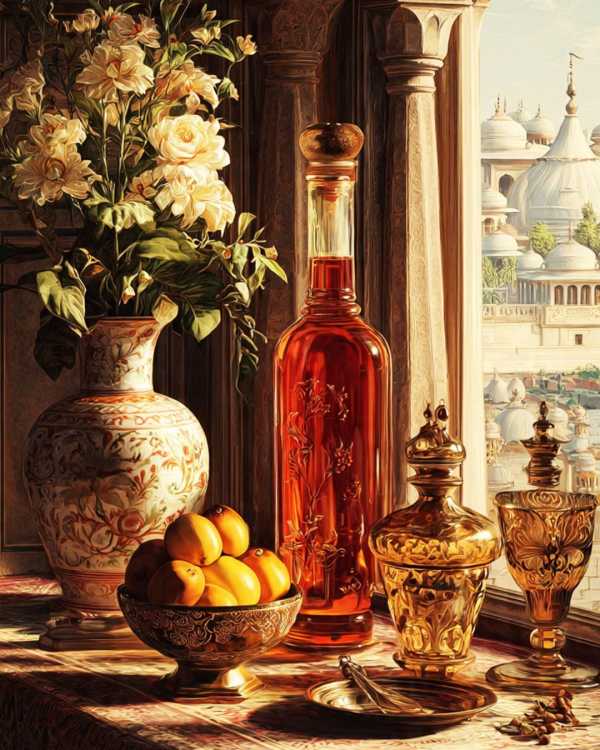
During the Mughal era, liquor used to come from Iran.
People mostly know Shahjahan for the Taj Mahal, but if we talk about his personal nature, he was completely opposite to Jahangir. Shahjahan had seen the consequences of his father Jahangir's drunken habits. Devastation to health, negative impact on politics, drug culture in the court etc. In order to bring stability to the country and to show the rule as strong and disciplined, Shahjahan mostly kept himself away from alcohol or at least showed such attitude in public.

Mughal emperor Shahjahan.
Due to his proximity to fakirs, Sufi saints, construction of mosques and places of worship, visible discipline of fasting prayers etc., his image was established as a more religious king. In the descriptions written by European travelers of the same period, the enjoyment of alcohol in Shahjahan's court is less visible than the openness of Jahangir. Overall, far from calling Shahjahan a drunkard, he is often presented as a sober and pious king. That's why it is lagging behind in this comparison.
As soon as Jahangir's name comes up, his autobiography Tuzuk-e-Jahangiri emerges as the biggest proof. Jahangir has clearly written in his book that he had become addicted to alcohol from an early age. He himself has recorded how many cups he drank daily, when he tried to reduce it, how his health deteriorated. This makes him different from other kings, because his record is not just a hearsay, but is recorded from his own pen.

Mughal emperor Jahangir.
For the Mughal court, alcohol was not just an intoxicant but also a kind of cultural and political symbol. The rare variety of liquor produced in the cool valleys of Kashmir and the fine wines coming from Iran were especially Jahangir's favourites. The Mughals had a deep relationship with the Persian world. Along with Iranian wine, Iranian music, poetry and court culture also got mixed in the courts of Delhi and Agra.
During his visit to Kashmir, Jahangir praised its climate, gardens and wine. Miniature painting, gardening, depiction of animals and birds, scientific curiosity, all developed during the reign of Jahangir. Liquor gatherings were not only a place for fun, but also a place for artistic and intellectual conversation, where poets, painters and scholars participated. In many paintings, Jahangir himself is shown holding a cup in his hand, or sitting in a gathering of wine. This indicates that his wine-loving image was also captured by contemporary artists. Jahangir's drinking was not a limited hobby; This gradually turned into physical dependence.
He tried many times to give up or reduce alcohol, and even tried to replace it with opium, but was not completely successful. From a modern point of view, it clearly seems to be a case of addiction, due to which his body, nature and decision-making ability might have been affected.

Importing wine from Iran was also a way to strengthen relations with Iranian merchants and rulers.
As soon as the name of liquor came up in the Mughal courts, intoxication or fun was not the only issue; It was also related to the international politics and prestige of that time. Iran was famous for high quality wine and liquor at that time. Importing wine from Iran was also a way to strengthen relations with Iranian merchants and rulers. For emperors like Jahangir, drinking Iranian wine was not just a matter of choice, but also a way of declaring that their court was an important part of the Persian cultural world. The local liquor of Kashmir used to reach the Mughal court. Kashmiri gardens, spectacles and winds were especially attractive for Jahangir. The taste of the liquor associated with these seemed different to him.
Going to Kashmir, gathering in the air there and tasting the local liquor, all this was a part of the royal picnic for him. It was a common practice to celebrate Eid, Nowruz, victory celebrations, royal deaths or treaties, on all these occasions with open flow of liquor. The wine brought from Kashmir and Iran in royal cups, precious goblets and jeweled jars gave an exotic, sophisticated flavor to the gatherings.
Now if we briefly compare the three emperors, Humayun used to consume both alcohol and opium, but alcohol did not become the central identity of his character. Most of the discussion focuses on his political failure, exile and return, and not on alcohol. Shahjahan was a relatively restrained, religious and disciplined emperor. Absence from alcohol, and more strict discipline in the court than Jahangir. Jahangir himself admits in his autobiography that he was addicted to alcohol for a long time.
Mention of the taste of liquor of Kashmir and Iran, details of gatherings, effects on health, all are very clearly recorded. Contemporary writers, European travelers and later historians have all remembered Jahangir as a wine-loving emperor. Therefore, if the question is who was the biggest lover of alcohol, Jahangir, Humayun or Shahjahan, then based on historical evidence, autobiographical evidence and contemporary accounts, the answer is clear, Jahangir can be considered the greatest alcohol lover among these three emperors.


