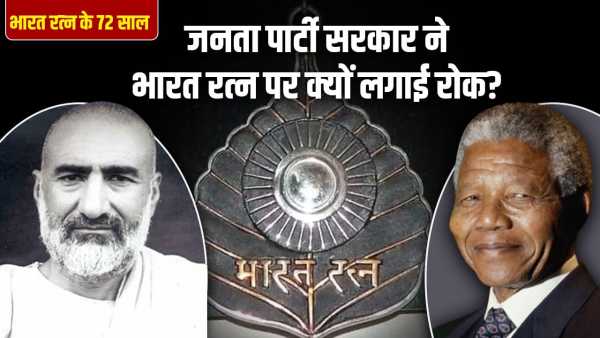
Foreign personalities have also been awarded Bharat Ratna, these included Abdul Ghaffar Khan of Pakistan and Nelson Mandela of South Africa.
Bharat Ratna, also known as Bharat Ratna or Jewel of India, is India's highest civilian award. It was started not through the Constitution of India or any bill, but through a notification by the then President Rajendra Prasad on 2 January 1954. Its purpose was to honor those individuals who have rendered exceptional service to the nation. Initially this honor was limited to art, literature, science and public services, but later it was extended to every field of human endeavour.
Let us understand, on the pretext of 72nd anniversary of Bharat Ratna, why the Janata Party government stopped it and the Congress started it again? How and why did it start? How many foreigners received this award and why? What are the rules and qualifications for giving it? You will also know how many celebrities have received this highest civilian honor of India till now?
After independence, India was a newly formed democratic republic, where along with national reconstruction and building of institutions, there was also a question of how to honor those who had made extraordinary contributions to the country. In the Nehru era, the idea came forward that like the western countries, India too should have the highest civilian honour, but its Indianness and simplicity should remain. It is in this background that Bharat Ratna was established in 1954. It was not just a medal or fame, but also a message that India gives the highest status to its scientists, thinkers, artists and public leaders.
Ordinary citizens cannot directly propose anyone's name for Bharat Ratna.
The Government of India announced its launch in the year 1954 and at the same time it was announced to give Bharat Ratna award to three personalities of the country. This award was given in the year 1955. These awards were given to the last Governor-General of independent India and eminent statesman C. Rajagopalachari, philosopher, thinker, and later President of India Dr. Sarvepalli Radhakrishnan and Nobel Prize-winning scientist Dr. C.V. Gave to Raman. These three represent the ideology where knowledge, science and public service got equal importance.
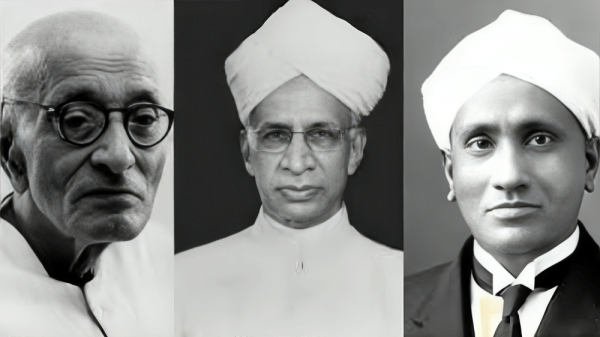
Politician C. Rajagopalachari, former President Dr. Sarvepalli Radhakrishnan and Nobel Prize-winning scientist Dr. C.V. Raman.
Bharat Ratna's journey was not uneventful. In 1977, when the Janata Party government came to power under the leadership of Morarji Desai, it discontinued all national civilian awards including Bharat Ratna. All these awards remained suspended from 13 July 1977 to 25 January 1980. An important argument of the Janata Party leadership was that such honors are contrary to the spirit of Gandhian simplicity and that government titles create a kind of elite class in a democratic society.
Some people also considered them to be an extension of the mentality of the colonial honor system. The Janata Party government also admitted that the distribution of awards could be biased under the influence of political power. Therefore, the approach was taken that no civilian titles should be awarded and all high civilian awards including Bharat Ratna were suspended.
After the fall of the Janata Party government, the Congress government was formed again in 1980 under the leadership of Indira Gandhi. The new government's view was that if awards are given in a transparent and balanced manner, it will not only be an honor to individuals but also a medium to establish national ideals. Then Bharat Ratna and Padma awards were restarted with a new notification. There were two main ideas behind this restart.
One - public recognition of national contribution so that the society can be inspired and two - the message should be sent at the international level that India recognizes its great contributors at the highest level. Later, in the early 1990s, some questions were raised regarding the validity of these awards, so they had to be stopped again between 1992 and 1995, but after they were given constitutional recognition by the Supreme Court in December 1995, the awards were again issued regularly.
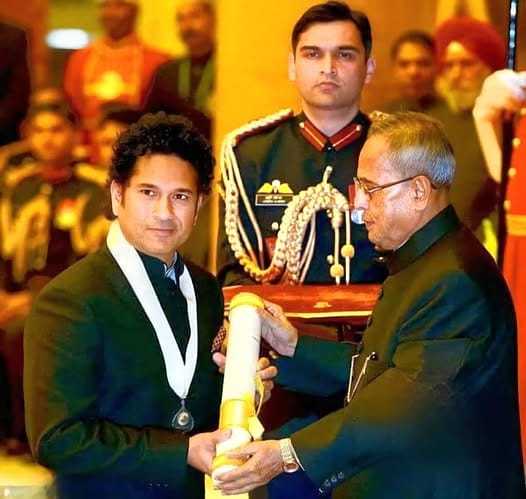
Former cricketer Sachin Tendulkar received the Bharat Ratna award in the year 2014.
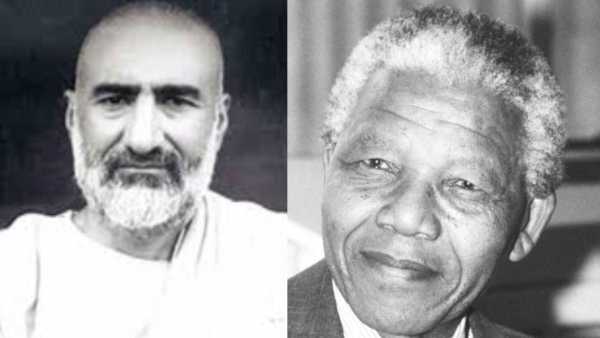
Abdul Ghaffar Khan of Pakistan and Nelson Mandela of South Africa received this honour.
It is not necessary to be an Indian citizen for Bharat Ratna. Till now two foreign nationals have received this honour. However, Mother Teresa of Albanian origin was also given Bharat Ratna in the year 1980. It is another matter that he had taken Indian citizenship, hence he cannot be called a foreigner.
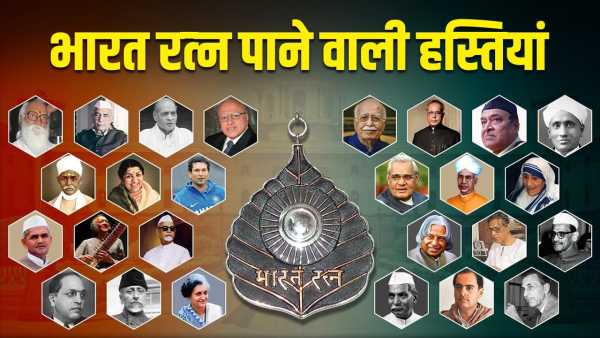
The journey of Bharat Ratna has been a long one from the year 1954 to 2024. According to the notification of the Government of India, till now 53 personalities have been given Bharat Ratna. Among these, there are a large number of people who have received this important honor posthumously. 2024 was especially notable for this honor when five people were awarded Bharat Ratna in the same year. Of these, except senior BJP leader Lal Krishna Advani, the remaining four – Karpoori Thakur, PV Nursingh Rao, Chaudhary Charan Singh and MS Swaminathan were given this honor posthumously. These latest honors also show that today's governments are not just limiting themselves to the heroes of the independence movement or the leaders of the early decades, but are also giving the highest honor to personalities who have contributed to agriculture, economy, social justice and modern politics.
Bharat Ratna is not just a medal or a government honour, but a symbol that tells what values and ideals modern India considers supreme. Today, when Bharat Ratna is being given to people in various fields, from scientists to farmers' saviors, from sportspersons to social workers, this award underlines the breadth of Indian democracy which is not limited to any one class, ideology or profession, but honors the flourishing of the entire national life.