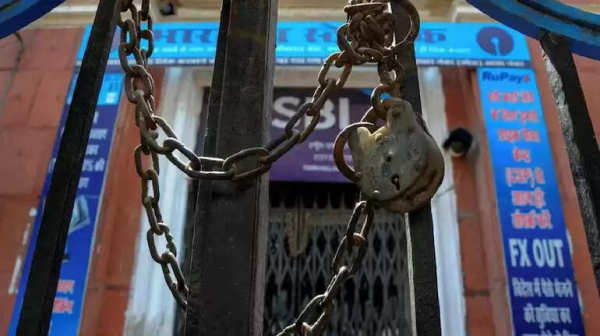
Banking services across India may face disruption on January 27, 2026, as bank employees have announced a nationwide strike to press for long-pending demands, including the implementation of a five-day working week. The strike call has been given by the United Forum of Bank Unions (UFBU), a joint body representing all major bank employee unions in the country.
The proposed strike is expected to impact both public sector and private sector banks, potentially affecting routine banking operations across the nation.
The primary demand of bank unions is to introduce a Monday-to-Friday working system, making all Saturdays official holidays. At present, banks remain closed only on the second and fourth Saturdays, while branches operate on the remaining two Saturdays each month.
Bank unions argue that this structure is outdated and places unnecessary pressure on employees, especially when most financial and government institutions already follow a five-day work schedule.
The strike was officially announced through a circular issued on January 4, 2026, by the All India Bank Officers’ Confederation (AIBOC). The circular stated that despite repeated discussions and assurances, the government has not taken concrete steps to resolve key issues that were agreed upon earlier.
Union leaders pointed out that during the salary revision agreement in March 2024, a consensus was reached between the Indian Banks’ Association (IBA) and bank unions regarding the five-day work week. However, the proposal has yet to be implemented.
To strengthen their case, unions have clarified that bank employees are willing to work an additional 40 minutes daily from Monday to Friday if a five-day work system is introduced. This adjustment, they say, would ensure that total weekly working hours remain unchanged.
UFBU has emphasized that institutions such as the Reserve Bank of India (RBI), LIC, GIC, stock exchanges, money markets, and central and state government offices already function five days a week. According to unions, banks are being unfairly excluded despite playing a critical role in the economy.
Over the past several months, bank unions have intensified their campaign through protests, meetings, and digital outreach. A recent social media campaign on platform X (formerly Twitter) reportedly received over 1.88 million impressions, with more than 300,000 posts, indicating widespread public attention.
Despite this momentum, unions claim that the government has remained non-committal, prompting them to resort to industrial action.
If the strike proceeds as planned on January 27, customers may face inconvenience due to the suspension of branch-level services. The following services are likely to be affected:
Cash deposits and withdrawals
Cheque clearance
Demand drafts
Passbook updates
Counter-based services
However, digital banking services such as net banking, mobile apps, UPI payments, and ATMs are expected to remain operational, though minor disruptions cannot be ruled out.
Customers are advised to complete essential banking tasks before January 27 to avoid inconvenience. Businesses and individuals relying on cheque-based transactions should plan ahead, as clearing operations may be delayed.
The outcome of this strike could play a crucial role in determining whether India’s banking sector finally shifts to a five-day working week.