American Express Global Business Travel Consulting forecasts that strong demand could push business class fares up by 7.4% for Asia–Middle East routes.
Asia–Europe might expect a hike of 4.8%, and the increase is pegged at 3.4% for Asia–Australia routes.
|
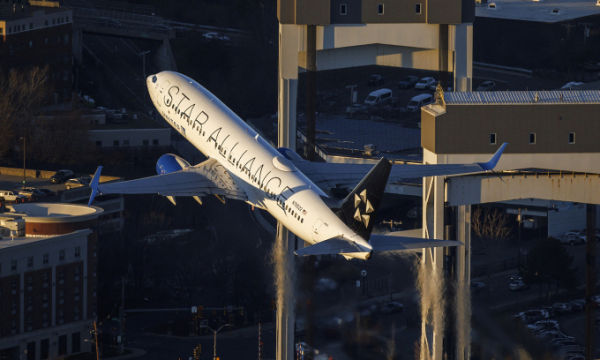
A United Boeing 737 with the ”Star Alliance” livery takes off from Runway 33 and soars over the suburban area at Boston Logan International Airport in Boston, MA, on December 22, 2025. Photo by NurPhoto via AFP |
The high-demand India–Singapore route might experience a notable increase, the consulting company said.
Air passenger traffic between India and Singapore reached a historic peak in 2024, crossing 5.5 million passengers, according to data from Singapore Changi Airport.
“We’re also anticipating price rises in business class on Singapore-US. From 2026, flights departing Singapore will be required to use sustainable aviation fuel,” American Express Global Business Travel Consulting added.
Linus Bauer, founder of aviation consultancy BAA & Partners, projects Asia-Pacific passenger traffic to rise moderately by 4% to 6%, or 150 million to 200 million passengers, to about 3.8 billion passengers, according to The Business Times.
He expects 2026 to be characterized by a more mature pricing environment, with economy fares gradually easing while premium yields remain relatively resilient.
In high-density, price-sensitive markets – particularly within South-east Asia, South Asia and Oceania – average economy fares are projected to be 5% to 10% lower than in 2025, due to increased narrow-body capacity and a larger market share for budget carriers, he added.
By contrast, yields for premium cabins in business and first class are expected to remain stable or improve modestly by 2% to 5%, supported by stronger premium leisure demand and a recovery in corporate travel, he said.
Transportation and supply chain management professor Rico Merkert from the University of Sydney said that inflationary pressures, including higher airport and labour costs, will weigh on airlines, which are likely to pass these costs on to passengers.
“Higher air fares may be the result of this, unless the price of jet fuel can remain low, for which there is a good chance.”
Still, the continued expansion of budget airlines and new entrants into the low-cost segment should help keep air travel in the Asia-Pacific region affordable in 2026, he added.