
Listen to this article in summarized format
Loading...
××
Subscribe to

Unlock AI Briefing and Premium Content
Subscribe NowWhat's Included
- Exclusive Stories
- Daily ePaper Access
- Smart Market Tools
- Curated Investment Ideas
- Ad-lite Experience
Subscription


India is increasingly witnessing entrepreneurs and senior startup leaders who have built large businesses in the consumer internet space now taking on more complex, longer-gestation bets. The focus is shifting to sectors such as aerospace, robotics, artificial intelligence, infrastructure, advanced manufacturing and analytics.
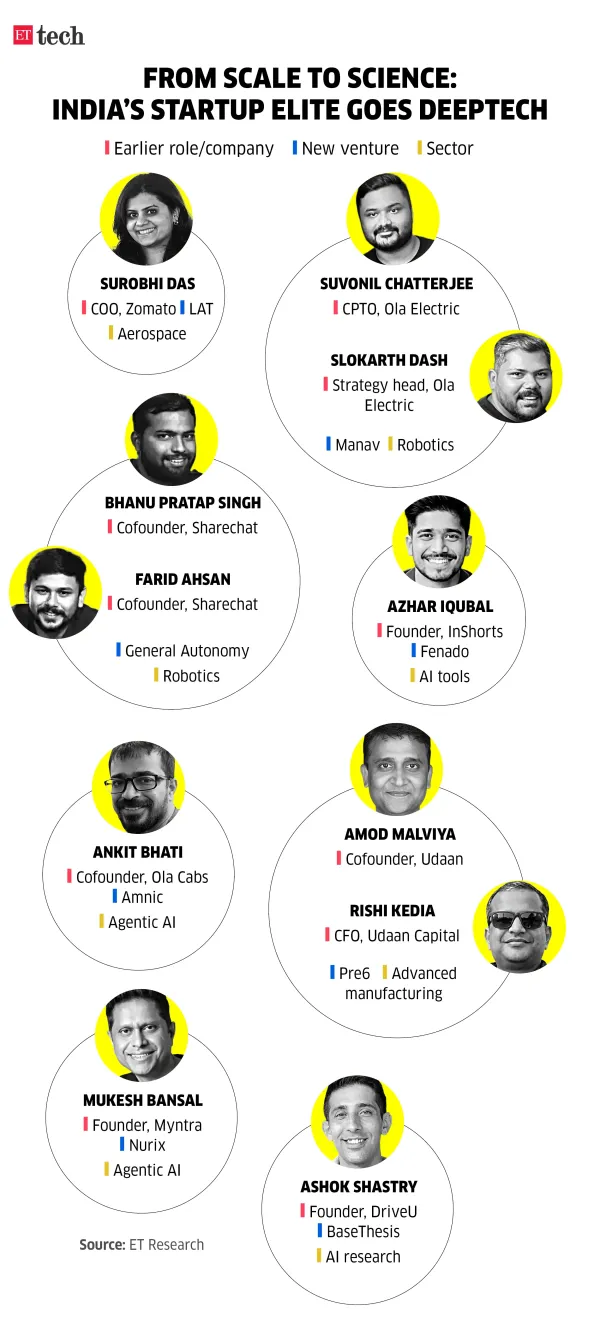
Long-time Bhavish Aggarwal aide Suvonil Chatterjee, who was chief technology and product officer at Ola Electric, left to team up with his former Ola colleague Slokarth Dash to launch a robotics startup, Manav. The startup focused on industrial use-cases is building prototype machines. Manav is currently bootstrapped and fully funded by Chatterjee and Dash.
Farid Ahsan and Bhanu Pratap Singh, cofounders of vernacular social media platform Sharechat, are also building in the robotics space with their new startup, General Autonomy.
Udaan cofounder Amod Malviya has launched Pre6, an AI-led advanced manufacturing startup, alongside another former senior executive from the company. Malviya was among the first few employees at ecommerce company Flipkart, joining it in 2010. He rose through the ranks of Flipkart's engineering and tech teams to become chief technology officer in 2014.
Venture capital investors said the trend will grow as the startup ecosystem matures.
While second- or third-time founders do get an initial foot in the door when it comes to fundraising, investors said deeptech businesses still take time to come alive. The journey remains equally hard, whether the founder has built a unicorn before or is a first-time entrepreneur straight out of college, they said.
Ashok Shastry, founder of on-demand chauffeur service platform DriveU, stepped down from his company last year and launched BaseThesis, an AI lab and launch studio.
“When you think in decades, the answer often points to solving fundamental problems and many of those fall under deeptech. That’s why you see founders from fintech, or consumer internet moving into areas like aerospace, robotics or longevity,” said Arpit Agarwal, partner at Blume Ventures.
Despite the initial advantage for second-time founders, science does not become easier, he said. The timelines, risks and uncertainty remain the same.
Zomato founder Deepinder Goyal is also self-funding multiple deeptech ventures, including longevity research startup Continue with about $25 million and aerospace venture LAT—cofounded with former Zomato executive Surobhi Das—with around $20 million.
InShorts cofounder Azhar Iqubal and Ola Cabs cofounder Ankit Bhati have started out ventures in the agentic AI space.
“Building and scaling consumer internet companies has given these founders and senior executives access to large pools of wealth and deep networks spanning investors, suppliers and global entrepreneurs. While India produces ample deeptech talent from top institutes, investors tend to back experienced operators they believe have a higher probability of execution,” said an early-stage investor who has backed startups in this space.
“The value unlock from these consumer internet ventures will turn out to be the key to how India’s deeptech ecosystem evolves,” he added.
These established startup executives are pivoting to new research-driven areas at a time when experts and policymakers are flagging a lack of complex and innovative tech products from India.
Commerce minister Piyush Goyal, speaking at the government’s flagship Startup Mahakumbh event last year, had cited concerns over Indian founders focusing on sectors such as quick commerce, consumer brands and betting apps, even as Chinese entrepreneurs pushed ahead in areas such as AI foundation models, chips and deeptech.
Prior experience
While Manav has yet to raise capital from external investors, General Autonomy has secured $3 million in seed money from IndiaQuotient and Elevation Capital. Both founders of General Autonomy are alumni of IIT-Kanpur, having studied disciplines such as electrical engineering and material science.
That said, the consumer internet experience many of these founders bring has proved useful in navigating these new ventures.
“Consumer internet teaches you customer obsession…being customer-literate, designing onboarding, rapid product iteration, and building distribution. Those skills transfer very well,” Manav founder Chatterjee said. “Deeptech also needs deep distribution and India is still building that capability. Many of India’s scaled internet companies have built far stronger distribution muscle than most deeptech firms. That customer DNA helps us stay close to users, understand pain points in depth, and craft superior experiences even when the product is complex.”
Manav is building a humanoid platform, and has developed a fully functional prototype in less than six months, he said.
“It can walk, pick up objects and perform tasks. On the AI side, we are building foundational models for highly dexterous manipulation actions, required in industrial environments,” Chatterjee said. “Our research is building the data engine to capture contact-rich interactions, because physical AI does not have an internet-scale dataset to learn from. In deeptech, research cannot be bolted on later…and it has to be a founder function from day zero.”
Ashish Taneja, founder of GrowX, a venture firm focused on deeptech investments, said if a founder built a successful enterprise before, that experience definitely matters. “You understand how to hire teams, raise capital and build organisations. That is fundamentally important.”
High-quality founders who want to build something resilient and differentiated will gravitate towards this space, he added.
GrowX has backed startups such as Pixxel, Bellatrix Aerospace, Lightspeed Photonics and CynLr.
Agarwal of Blume added that while the firm is seeing some second-time founders explore deeptech and AI, the shift is still limited. “We have backed second-time founders, but I wish more seasoned founders would take this jump.” Many founders continue to stay within the comfort zone of consumer internet, which is not wrong, he said, adding that deeptech demands a very different mindset. “This is also why Blume has not done many repeat-founder investments in deeptech so far.”
Ashwin Raghuram, partner at Bharat Innovation Fund, said the trend will continue. “Almost every solution will become more powerful with AI enablement, and some will be fully AI-native.” However, he pointed out that the portion of entrepreneurs in India, who have gone through a full entrepreneurial journey of scaling, raising capital, exiting or taking their companies public, is a small number compared with the US.
Long-time Bhavish Aggarwal aide Suvonil Chatterjee, who was chief technology and product officer at Ola Electric, left to team up with his former Ola colleague Slokarth Dash to launch a robotics startup, Manav. The startup focused on industrial use-cases is building prototype machines. Manav is currently bootstrapped and fully funded by Chatterjee and Dash.
Farid Ahsan and Bhanu Pratap Singh, cofounders of vernacular social media platform Sharechat, are also building in the robotics space with their new startup, General Autonomy.
Udaan cofounder Amod Malviya has launched Pre6, an AI-led advanced manufacturing startup, alongside another former senior executive from the company. Malviya was among the first few employees at ecommerce company Flipkart, joining it in 2010. He rose through the ranks of Flipkart's engineering and tech teams to become chief technology officer in 2014.
Venture capital investors said the trend will grow as the startup ecosystem matures.
While second- or third-time founders do get an initial foot in the door when it comes to fundraising, investors said deeptech businesses still take time to come alive. The journey remains equally hard, whether the founder has built a unicorn before or is a first-time entrepreneur straight out of college, they said.
Ashok Shastry, founder of on-demand chauffeur service platform DriveU, stepped down from his company last year and launched BaseThesis, an AI lab and launch studio.
“When you think in decades, the answer often points to solving fundamental problems and many of those fall under deeptech. That’s why you see founders from fintech, or consumer internet moving into areas like aerospace, robotics or longevity,” said Arpit Agarwal, partner at Blume Ventures.
Despite the initial advantage for second-time founders, science does not become easier, he said. The timelines, risks and uncertainty remain the same.
Zomato founder Deepinder Goyal is also self-funding multiple deeptech ventures, including longevity research startup Continue with about $25 million and aerospace venture LAT—cofounded with former Zomato executive Surobhi Das—with around $20 million.
InShorts cofounder Azhar Iqubal and Ola Cabs cofounder Ankit Bhati have started out ventures in the agentic AI space.
“Building and scaling consumer internet companies has given these founders and senior executives access to large pools of wealth and deep networks spanning investors, suppliers and global entrepreneurs. While India produces ample deeptech talent from top institutes, investors tend to back experienced operators they believe have a higher probability of execution,” said an early-stage investor who has backed startups in this space.
“The value unlock from these consumer internet ventures will turn out to be the key to how India’s deeptech ecosystem evolves,” he added.
These established startup executives are pivoting to new research-driven areas at a time when experts and policymakers are flagging a lack of complex and innovative tech products from India.
Commerce minister Piyush Goyal, speaking at the government’s flagship Startup Mahakumbh event last year, had cited concerns over Indian founders focusing on sectors such as quick commerce, consumer brands and betting apps, even as Chinese entrepreneurs pushed ahead in areas such as AI foundation models, chips and deeptech.
Prior experience
While Manav has yet to raise capital from external investors, General Autonomy has secured $3 million in seed money from IndiaQuotient and Elevation Capital. Both founders of General Autonomy are alumni of IIT-Kanpur, having studied disciplines such as electrical engineering and material science.
That said, the consumer internet experience many of these founders bring has proved useful in navigating these new ventures.
“Consumer internet teaches you customer obsession…being customer-literate, designing onboarding, rapid product iteration, and building distribution. Those skills transfer very well,” Manav founder Chatterjee said. “Deeptech also needs deep distribution and India is still building that capability. Many of India’s scaled internet companies have built far stronger distribution muscle than most deeptech firms. That customer DNA helps us stay close to users, understand pain points in depth, and craft superior experiences even when the product is complex.”
Manav is building a humanoid platform, and has developed a fully functional prototype in less than six months, he said.
“It can walk, pick up objects and perform tasks. On the AI side, we are building foundational models for highly dexterous manipulation actions, required in industrial environments,” Chatterjee said. “Our research is building the data engine to capture contact-rich interactions, because physical AI does not have an internet-scale dataset to learn from. In deeptech, research cannot be bolted on later…and it has to be a founder function from day zero.”
Ashish Taneja, founder of GrowX, a venture firm focused on deeptech investments, said if a founder built a successful enterprise before, that experience definitely matters. “You understand how to hire teams, raise capital and build organisations. That is fundamentally important.”
High-quality founders who want to build something resilient and differentiated will gravitate towards this space, he added.
GrowX has backed startups such as Pixxel, Bellatrix Aerospace, Lightspeed Photonics and CynLr.
Agarwal of Blume added that while the firm is seeing some second-time founders explore deeptech and AI, the shift is still limited. “We have backed second-time founders, but I wish more seasoned founders would take this jump.” Many founders continue to stay within the comfort zone of consumer internet, which is not wrong, he said, adding that deeptech demands a very different mindset. “This is also why Blume has not done many repeat-founder investments in deeptech so far.”
Ashwin Raghuram, partner at Bharat Innovation Fund, said the trend will continue. “Almost every solution will become more powerful with AI enablement, and some will be fully AI-native.” However, he pointed out that the portion of entrepreneurs in India, who have gone through a full entrepreneurial journey of scaling, raising capital, exiting or taking their companies public, is a small number compared with the US.