Dr. Tina Shah: an Indian American, entered political politics after working in critical care units for years, treating patients whose situations worsened due to delayed or refused medication.
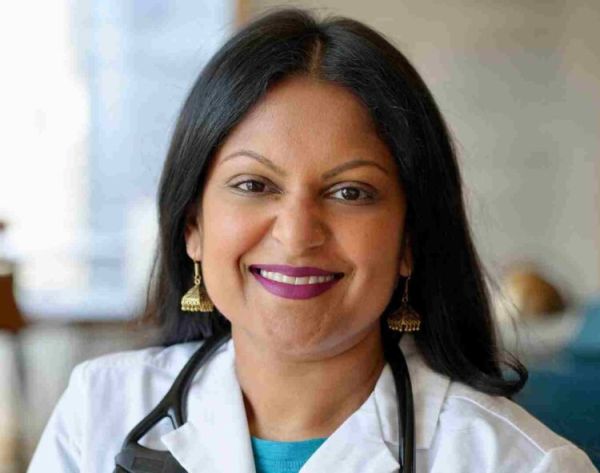
Shah is now one of many Democrats and the sole Indian American running for the party’s nomination in the 7th Congressional District of New Jersey. She claims that policies made in Washington directly caused the systemic shortcomings she saw in hospitals.
Shah said, “I never thought I would run for office.” In an exclusive interview with IANS, she said, “But every time I practice, I see somebody coming in because they couldn’t afford their medicines or the insurance company denied that MRI that they needed.”
Shah, a doctor with triple board certification in critical care, pulmonary medicine, and internal medicine, says she decided to run after seeing systematic failures at the bedside for years. “We need to improve our healthcare system because it is inadequate in the United States,” she said.
Shah contends that recent legislative changes have made things worse for patients, especially those with less money. She cited Medicaid coverage reductions and the elimination of insurance subsidies for those buying plans via the exchanges established by the Affordable Care Act.
“Starting this year, the most vulnerable people do not have health insurance,” she said, adding that Congress has not taken anything to control the exorbitant cost of prescription drugs or stop insurance rejections.
She said that she is still troubled by one instance. Before a change in insurance necessitated prior authorization for inhalers, a patient with asthma had been stable for over ten years. After the patient ran out of medicine and was brought to the intensive care unit (ICU) on a ventilator, the request was turned down. Shah said, “This shouldn’t happen.”
Her advocacy work in New Jersey, where she joined physicians, nurses, and patients in a grassroots effort to prevent state-regulated insurance firms from refusing necessary treatment, was prompted by this incident.
Shah said that by collaborating with lawmakers, the endeavor created sufficient public pressure to compel action. She added that comparable safeguards are required throughout the country. “Now, if you have insurance in New Jersey that the state regulates, you will actually not have this situation where essential care gets denied,” she said.
Shah has worked in key policy positions over three White House administrations in addition to his clinical practice. She assisted in spearheading the federal government’s first approach to addressing clinician burnout while serving as a senior adviser to the US Surgeon General. She was appointed the first National Director of Clinician Wellbeing at the Department of Veterans Affairs, where she worked to enhance electronic medical records and increase veterans’ access to primary care.
Later, she entered the commercial sector and became the first chief clinical officer of an artificial intelligence business with a healthcare emphasis. There, she aimed to reduce administrative responsibilities so that doctors could spend more time with patients.
Shah has voiced harsh criticism of President Donald Trump’s approach to healthcare. She cited the dismissal of scientific professionals from government agencies and reductions in funding for medical research as evidence that “he has no concrete policy other than to dismantle the things that are working.” She questioned, “If we don’t invest in cutting-edge science and research, how are we supposed to maintain our position as the superpower?”
Shah acknowledged that Trump has made an attempt to negotiate reduced prescription pricing, but he claimed that the results have been modest. “A cost of a medicine that’s still more than $1,000 a month is still too much,” she said, noting that consumers are confused about whether to buy prescription drugs due to tariff uncertainties.
Shah’s status as a second-generation Indian American also influences her candidacy. She traced her family’s history back to parents who made significant educational investments for their kids after moving to North America in search of better opportunities. “The fact that our community is so strong and we support one another is one of the best things about being Indian,” she remarked.
Shah said that despite the Indian American community’s size and economic clout in New Jersey, legislative representation has fallen behind. She cited the need for additional voices in Congress, citing topics like the battle over H-1B visas and an increase in hate crimes. “To represent the difficulties we face, we must ensure that we have strong voices in Congress,” she said.
“There’s no place for hate like that,” Shah said in reference to hate crimes and immigration enforcement, adding that everyone must be treated equally under the law and given due process.
The 7th District of New Jersey is one of the few seats required to change the House, she said, and it is crucial to Democratic attempts to retake the majority. Shah has been vocal in her criticism of Tom Kean Jr., the Republican incumbent, calling him a professional politician who has no connection to the people. She said, “I’m going to beat him and I’m calling him out.”
Early fundraising success has been claimed by her campaign. Shah raised $1,017,000, surpassing the $1 million milestone, according to an announcement from her team on Tuesday. The campaign was characterized as centered on reducing family expenditures, defending reproductive rights, and increasing access to healthcare.
Shah said that juggling campaigning and medicine has been difficult, but she claims that practicing keeps her grounded. “I talk to people in my district every day while I’m practicing, and I understand their challenges,” she added. “As a physician, I am prepared to assist them.”
Shah would be the first Indian American to serve as New Jersey’s congressional representative if elected. She contends that the tiny number of seats held by Indian Americans in the House now does not accurately represent the size or power of the community.
Expected to be one of the most carefully watched House contests in the nation, with national ramifications for control of Congress, is New Jersey’s 7th Congressional District, which contains a number of suburban districts with a sizable Indian American population.