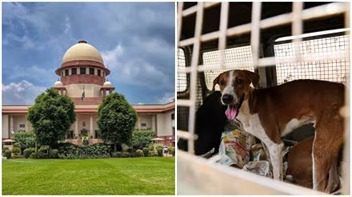
SC: On Thursday, the Supreme Court will resume its hearing on the stray dog case. It is expected to look more closely at the issue and the states’ and union territories’ (UTs’) level of compliance.
The worrisome increase in dog bite incidences nationwide and the ineffective implementation of the Animal Birth Control (ABC) Rules by municipal authorities and local bodies alarmed the Supreme Court earlier on Wednesday.
In the suo motu case on managing stray dogs in public areas, a bench of Justices Vikram Nath, Sandeep Mehta, and N.V. Anjaria noted that people and children were being bitten and that lives were being lost as a result of ongoing inactivity.We are aware that these things are taking place. The bench headed by Justice Nath said, “Children and adults are getting bitten, people are dying.” Two judges had been engaged in animal-related traffic accidents in the last 20 days alone.
The supreme court declared that stray animals on the roadways were a significant contributor to accidents in addition to being a nuisance.It is an issue when they are running on the road. roads with moving cars on them. It just isn’t biting,” it said.
Senior advocate and amicus curiae Gaurav Agarwal told the bench, which was presided over by Justice Nath, that the National Highways Authority of India (NHAI) has created a Standard Operating Procedure (SOP) and identified roughly 1,400 kilometers of highway segments that are vulnerable in accordance with previous orders from the Supreme Court.
He did, however, note that state governments would need to work together to execute it, which would include building shelters and hiring staff for ABC centers.
A number of significant states, including Madhya Pradesh, Uttar Pradesh, Tamil Nadu, Karnataka, and Punjab, have not yet submitted compliance affidavits, the amicus also told the court.
The Supreme Court will take a strong stance on non-compliance, the Justice Nath-led Bench warned.States that have not reacted will face heavy consequences,” it said.
The only long-term answer, according to senior counsel Kapil Sibal, who spoke on behalf of animal welfare organizations, is population control by vaccination and sterilization. He cautioned that the issue would become worse if dogs were arbitrarily removed from their areas.
Sibal used the well recognized CSVR (Capture, Sterilise, Vaccinate and Release) paradigm to support his claim that improper relocation might result in dog conflicts, territorial vacuums, and an increase in the transmission of rabies.
The highest court reacted harshly when Sibal said that humans have to “live with animals.” “You’re fortunate. The Justice Nath-led Bench said, “People are getting bitten, kids are getting bitten,” emphasizing that institutions like courts, schools, and hospitals were on a different level and had to keep stray animals out of their buildings.
The Supreme Court asked how dogs could be permitted in areas where children, patients, and people with impairments could have unrestricted access.
Speaking on behalf of the government, Solicitor General (SG) Tushar Mehta proposed that gated community welfare associations be given the power to vote on whether or not to allow stray animals on their property. He also stated that residents’ rights and safety should always come first, even if they have a strong animal welfare ethic.