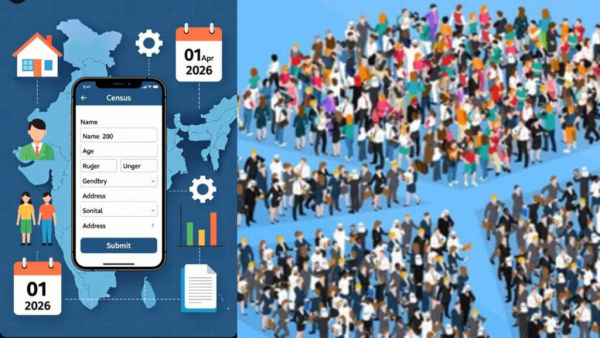
New Delhi:India’s census system has moved towards a historic change. The Union Home Ministry has issued an official notification regarding the first phase of Census 2027. Under this, the first phase of the country’s first completely digital census will be conducted between April 1, 2026 and September 30, 2026.
This phase will be to the listing process of houses and residences, which each state and union territory will complete within their respective stipulated period of 30 days. In this comprehensive campaign, about 30 lakh workers will do data collection work at the ground level.
According to the notification, the first phase of Census 2027 will be to ‘House Listing Operations’ i.e. preparation of list of houses and residences. This process will be completed between 1 April 2026 and 30 September 2026. Every state and union territory will be given 30 days time for this.
This time, citizens will also be given the facility of self-enumeration in the census. This option will be activated exactly 15 days before the start of door-to-door listing. Citizens will be able to enter their information themselves through mobile app or online portal.
The 2021 census was postponed due to the Covid pandemic. Now this census will be completed in two phases.
The reference date for population census has been fixed at midnight of March 1, 2027. However, for snow covered areas this date has been kept as September 2026.
This will be India’s first completely digital census. Android and iOS based mobile apps will be used for data collection. Also, real-time monitoring will be done through the Census Management and Monitoring System (CMMS) portal.
About 30 lakh ground employees will be involved in this campaign, most of which will be government teachers.
Last year, the Central Government Cabinet had approved conducting the census at a cost of Rs 11,718 crore. The special thing is that caste information will also be collected during the population census phase, which will happen for the first time in the census of independent India.
According to the government, census data will be shared in a user-friendly manner. Machine-readable data will be made available to various ministries through ‘Census-based Service’ (CaaS). It is being considered as the world’s largest administrative exercise, which will prove to be very important for policy making and development plans.