The belief in fire prevalent in different religions and civilizations of the world always remains a topic of discussion. In modern times, when efforts are being made to look at religion and traditions from a new perspective, the question has become important that which religions consider fire sacred and how similar are their traditions to Hinduism. From the Vedic period to the Persian, Greek, Roman and Asian civilizations, fire has been not only a source of energy but also a symbol of God, a medium of purification and a witness to religious rituals.
Be it the essential role of fire in yagyas, marriages and rituals in Hinduism or the tradition of fire temples in Zoroastrianism, there is a shared cultural heritage behind all these beliefs. Experts believe that fire worship is not just a religious faith, but a deep link in understanding the development of human civilization, moral values and philosophy of life, which connects many religions of the world even today.
hindu religion
- In Hindu religion, Agni has the status of a god.
- The first mantra of the Rigveda is the one that starts from ‘Agnimile Purohitam’
importance of fire
- Yagya, Havan, marriage, housewarming, funeral – fire is considered essential in every rites.
- Agni is considered the messenger between gods and humans.
- In marriage, fire is considered as a witness of seven rounds.
- Fire is considered a symbol of purification and karmaphal.
Relations with other fire-worshipping religions
Hinduism is considered to be the basic inspiration for all fire worshiping traditions.
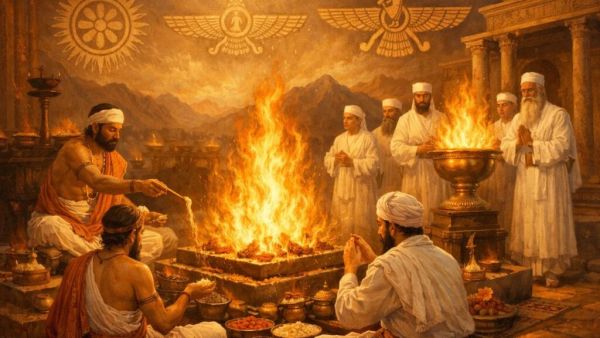
Parsi (Zoroastrianism)
This is considered to be the most famous fire worshiping religion.
core beliefs
- Fire is considered a symbol of purity of God ‘Ahura Mazda’
- Fire is always ignited in the temples of fire
- Fire is worshiped but it is not considered God
Similarity to Hinduism
- Yajna like Agni tradition
- Considering fire as a symbol of purity and truth
- Many words are similar in Sanskrit and Avesta language.
- Both religions are considered to be to the Indo-Iranian tradition.
Vedic-Iranian (Ancient Aryan religion)
Shared religious framework that predates Hinduism and Zoroastrianism.
Properties
- Worship of Agni and Soma
- sacrificial tradition
- invocation of gods through fire
Similarity to Hinduism
- This tradition later developed in Hinduism.
- The concept of Agni Dev came from here
ancient greece religion
- Fire was considered sacred in Greek civilization.
- Jude Dev from Agni
- Hestia – Goddess of the home and sacred fire
- The sacred fire used to burn in temples and homes.
Similarity to Hinduism
- tradition of home fire
- Considering fire as the power to protect family and society.
roman religion
Roman civilization influenced by Greek tradition.
core beliefs
- Goddess Vesta – Goddess of Sacred Fire
- Perpetual protection of fire through the Vestal Virgins
Similarity to Hinduism
- tradition of unbroken fire
- Considering fire as a symbol of stability of state and society.
Shintoism (Japan)
Not a complete fire worshiper but considering fire as a sacred element.
place of fire
- Fire ritual for purification
- Agni Devata Kagutsuchi
Similarity to Hinduism
- Purification of the fire
- worship of natural elements
Ancient Slavic and Nordic traditions
Even in the primitive civilizations of Europe, fire was considered sacred.
Properties
- considering fire as a symbol of life and safety
- use of fire in rituals
Similarity to Hinduism
- Divine elements to the fire
- Role of fire in social and religious rituals