Border Connection With Tanot Mata Temple: Whenever there is mention of 'Border', the biggest war film in the history of Indian cinema, along with the direction of JP Dutta and the roar of Sunny Deol, the soil of the Thar desert comes before the eyes, which has been watered with the blood of heroes. Now the trailer of 'Border 2' has again created the same excitement. Recently, a new version of the film's iconic song 'Sandesh Aate Hain' was launched near Tanot Mata Temple in Jaisalmer. This is the same temple which is worshiped by the Indian Army and Border Security Force (BSF) as the 'Goddess of War'. Let us know the history of this temple, which is more exciting and surprising than any film script.
About 120 kilometers away from Jaisalmer city, where the roads start ending and only the sea of sand and barbed wire are visible, the temple of Maa Tanot is situated there. This temple falls just before the last post of India-Pakistan border. Beyond this, only army bunkers, patrolling soldiers and the silence of the border are heard. Tanot Mata is considered to be the real incarnation of Hinglaj Mata of Rajasthan.
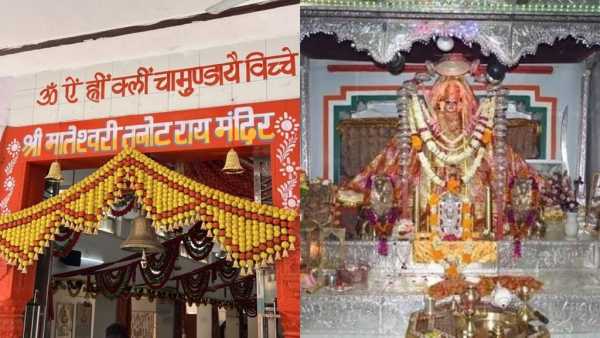
Kalpana Bhati, a military mother who came to take darshan of Tanot Maa, told that Bhati Rajput king Tanu Rao had established this temple in the 800th century. Not only Rajputs, people of Charan community also consider mother as their 'Kuldevi'. But till 1965, this temple was only the center of faith of the local people, the world came to know of its 'power' when the cannons started thundering on the border.
During the Indo-Pak war of 1965, Pakistan launched a massive attack on the Rajasthan border. The aim of Pakistani Army was to capture Jaisalmer via Tanot. Because Tanot was very important strategically. Reports say that the Pakistani Army fired about 3000 artillery shells targeting this temple and the surrounding area. At that time, the soldiers deployed there and the people living in the nearby village were taking shelter in the temple premises itself. The surprising thing was that about 450 shells fell in the courtyard of the temple, but not a single one of them exploded. Not even a single brick of the temple moved. The soldiers saw it with their own eyes and were stunned. Even today, those 'live bombs' are kept in the temple museum, which devotees can see closely. After this incident, Tanot Mata got fame as 'Goddess of War'.
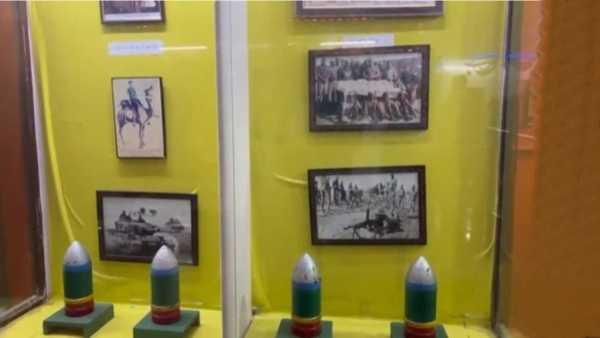
There is evidence of live bomb in the museum of Tanot Mata temple.
History repeated itself in the 1971 war also. The famous battle of Longewala, on which the entire 'Border' The film has been made about the battle that was fought just a short distance away from Tanot. That night, when the entire regiment of Pakistani tanks tried to enter the Indian border, they got stuck in the sand dunes in such a way that it became impossible to move. Soldiers believe that it was due to the influence of Maa Tanot that a handful of Indian soldiers forced the entire enemy tank regiment to kneel. After the victory, the Indian Army constructed a 'Vijay Stambh' in the temple complex, which even today fills every Indian's heart with pride.
In ancient times, there was a practice of sacrificing a goat before going on war to worship the power of the Goddess. Dharmendra This practice has been shown in the last film 'Ikkis'. Even in this area of Jaisalmer, army soldiers and local people used to sacrifice goats to pray for victory in the war. But, with time this tradition was changed. Now there is no killing of living beings here. Now devotees and youth bring goats, their ears are slightly 'pierced' and they are released in the name of the Goddess. These goats roam freely in the entire area and no one causes any harm to them. This tradition is a unique combination of reverence and kindness to animals. Apart from this, white handkerchiefs with red border are also tied here after the fulfillment of the vow.
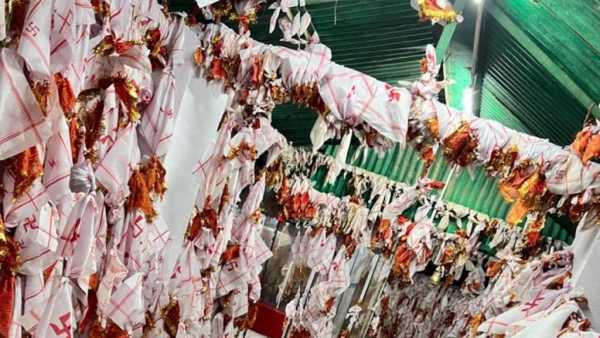
When the vow is fulfilled, white handkerchiefs with red border are tied.
The most special thing about Tanot Mata Temple is that its arrangements are not handled by any trust or pundit, but by the Border Security Force. Here the morning and evening aarti is performed by the soldiers in uniform with full military discipline. A flame keeps burning continuously in the temple. For the soldiers, paying obeisance here is not just a religious act but also like an 'energy booster' before going on duty. Even a Brigadier Shahnawaz Khan of Pakistan, impressed by the mother's miracle, had offered a silver umbrella here.
When we talked to a female security guard on duty about the miraculous temple of Mata, she said that science says that perhaps those shells were old or there was moisture in their fuse, or the soft sand of the desert absorbed their impact. But the debaters ask, can 3000 shells worth 3000 be bad? Is it possible to have similar technological coincidences in two different wars (1965 and 1971)? Because where science gives up, faith begins. Even today the soldiers here believe that their mother will stand with them in difficult times. This is not just a temple, it is a symbol of India's self-respect and the indomitable courage of its soldiers. Coming to the doorstep of Tanot Mata, every citizen realizes that our borders are protected not only with weapons, but also with an unbreakable faith. “The citizens are dependent on our army and the army is dependent on the mother.”
If you also want to visit the court of this 'Goddess of War' and have her darshan, then it is a 2-hour journey from Jaisalmer by taxi or your own car. The mobile network is very weak here, so carry an off-line map. Nearby is the Longewala War Memorial, which narrates the stories of bravery of our army even without talking.