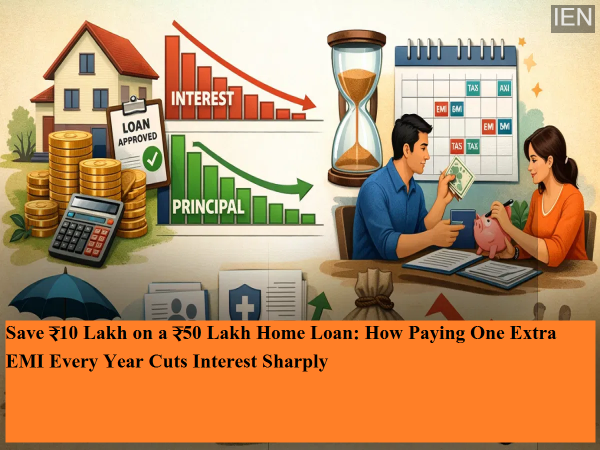
Taking a home loan is often the biggest financial decision of a person’s life. While buying a house fulfills a long-cherished dream, the long tenure of a home loan means you usually end up paying much more in interest than the original loan amount. Loans taken for 20, 25, or even 30 years can significantly increase the total repayment burden.
However, with a small but smart strategy, you can save lakhs of rupees in interest and also close your loan several years earlier. One of the most effective methods is paying just one extra EMI every year. Let us understand this with clear numbers and simple calculations.
Let’s assume the following standard home loan scenario:
Loan amount: ₹50,00,000
Loan tenure: 20 years
Interest rate: 8.5% (fixed for illustration)
Monthly EMI: ₹43,391
Under this structure:
Total interest paid over 20 years: ₹54,13,879
Total amount paid to the bank: ₹1,04,13,879
This means you pay more than ₹54 lakh as interest, which is even higher than the principal loan amount of ₹50 lakh. In simple words, you end up paying over ₹1.04 crore for a ₹50 lakh loan.
In the initial years of a home loan, a major portion of each EMI goes towards interest, while only a small amount reduces the principal. This is because interest is calculated on the outstanding loan amount, which is highest at the beginning.
As a result, even after paying EMIs regularly for several years, the loan balance reduces slowly. This is where early prepayment makes a huge difference.
Now let’s look at what happens if you make a small change.
Loan starts in January 2026
From the second year (February 2027), you pay one additional EMI every year
Extra EMI amount: ₹43,391
Interest rate remains at 8.5%
Interest saved: Approximately ₹10.3 lakh
Loan tenure reduced: Several years shorter than 20 years
This means that by paying just one extra EMI annually, you can save over ₹10 lakh in interest alone, along with the benefit of becoming debt-free much earlier.
The best time to prepay a home loan is during the initial years. Since interest dominates EMIs at the beginning, any reduction in principal at this stage drastically reduces the future interest calculation.
Using bonuses, salary hikes, incentives, or tax refunds for early prepayment delivers maximum benefit compared to making extra payments in the later years of the loan.
Yes. Prepayment reduces the outstanding principal, so it benefits all types of home loans, including:
Fixed interest rate loans
Repo-linked loans
MCLR-based floating rate loans
However, keep these points in mind:
Floating rate loans usually come with no prepayment penalty
Fixed rate loans may have prepayment charges, so always check loan terms before making extra payments
The earlier you prepay, the greater the interest savings—regardless of loan type.
Yes, prepayment is not automatic. You can make extra EMI payments through:
Net banking
Visiting the bank branch
Standing instructions
Make sure to clearly instruct the bank that the extra payment should reduce the principal and loan tenure, not the EMI amount. Reducing tenure results in much higher interest savings than reducing EMI.
Most banks allow penalty-free prepayment for floating rate loans, but annual extra EMI payments need to be done manually.
Before committing to extra EMIs, ensure your financial foundation is strong:
Maintain at least 6 months’ emergency fund
Have adequate term life insurance and health insurance
Continue essential long-term investments
Once these are in place, use bonuses, salary increments, or tax refunds for yearly prepayment. Even cutting down small unnecessary expenses can help you arrange funds for one extra EMI annually.
This approach is safe, disciplined, and highly effective in reducing long-term financial stress.
A home loan does not have to remain a 20–30 year burden. With a simple habit of paying one extra EMI every year, you can save over ₹10 lakh in interest and shorten your loan tenure significantly.
It is a small step with a powerful impact—helping you own your home faster and keep more of your hard-earned money.