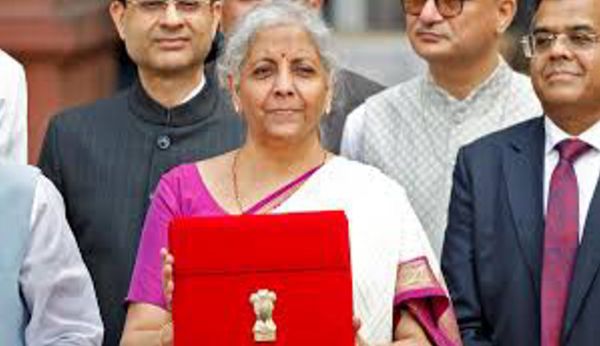
Indian Budget 2024 Analysis: Finance Minister Nirmala Sitharaman has officially presented the full budget for the fiscal year 2024-25, marking the first major economic roadmap of the Modi government’s third term. While the nation watched with bated breath, the focus remained on (Personal Income Tax Relief) and new provisions for the middle class and salaried professionals. However, beyond the headlines and political debates, the real story lies in the microscopic breakdown of how the government manages its colossal treasury. Understanding the “rupee comes from and rupee goes to” logic is essential for every citizen who wants to grasp the true direction of the Indian economy.
When we look at the government’s total earnings, a significant chunk surprisingly doesn’t come from taxes but from debt. According to the latest data, for every single rupee the government collects, 24 paise are sourced through (Public Borrowings and Liabilities) to fund national development. This heavy reliance on loans allows the administration to invest in massive infrastructure projects that would otherwise be impossible to finance through immediate tax revenue alone. It is a strategic balancing act designed to fuel growth while managing long-term fiscal responsibilities.
In a historic shift, the contribution of individual citizens to the national coffer has reached new heights. For every rupee earned, the government now collects 22 paise specifically from (Individual Income Tax Collections), making it one of the largest pillars of the national economy. This surge reflects an expanding taxpayer base and better compliance across the country. It also places a greater responsibility on the government to ensure that these funds are utilized efficiently to provide better public services and social security to those who contribute the most.
Following closely behind income tax is the revolutionary indirect tax system that has unified the Indian market. The (GST Revenue Growth Trends) show that 18 paise of every rupee collected now come from Goods and Services Tax and other related recoveries. This consistent flow of revenue from consumption indicates a robust domestic market where people are spending on goods and services despite global economic fluctuations. It remains the backbone of the government’s daily operational funds, ensuring that the state machinery keeps running without a hitch.
The industrial sector also plays a massive role in building the nation’s wealth through corporate levies. Approximately 17 paise of the government’s rupee are contributed by (Corporation Tax Revenues), representing the profits shared by India’s business giants. Additionally, the government earns about 9 paise from non-tax sources, such as dividends from public sector undertakings and spectrum auctions. Smaller yet vital amounts also trickle in from Union Excise Duties and Customs, contributing 5 paise and 4 paise respectively to the total financial pool.
Earning money is only half the battle; the real challenge lies in the staggering cost of maintaining the country’s financial health. A massive 20 paise of every rupee the government spends is immediately diverted toward (Interest Payment Obligations) on previous loans. This is the largest single expenditure in the budget, highlighting the high cost of borrowing that the nation must carry. Managing this interest burden is the primary reason why fiscal discipline is so heavily emphasized by economists and global rating agencies like Moody’s.
India’s federal structure thrives on a system of shared wealth, where the central government acts as a distributor of resources. Out of every rupee spent, 22 paise are handed over to various regions as the (States Share of Taxes), ensuring that local governments have the funds needed for regional development. This ensures that the benefits of national tax collection reach every corner of the country, from rural villages to metropolitan hubs, supporting localized education, health, and infrastructure initiatives.
The safety of the nation and the welfare of its most vulnerable citizens are non-negotiable priorities for the current administration. The government allocates 8 paise of every rupee to (National Defence Expenditure) to ensure that the armed forces are equipped with modern technology. Simultaneously, 16 paise are spent on Central Sector Schemes, which are fully funded by the union to drive specific national goals. Another 8 paise go toward Centrally Sponsored Schemes, where the center and states collaborate to uplift the standard of living for the masses.
To keep essential goods affordable for the poor, the government continues to provide significant financial support across various sectors. Approximately 6 paise of every rupee are dedicated to (Government Subsidy Allocation), covering food, fertilizers, and fuel. Furthermore, 4 paise are set aside for pensions for retired government employees, ensuring they live with dignity after years of service. The remaining 8 paise are used for miscellaneous expenditures and the recommendations of the Finance Commission, completing the complex cycle of India’s multi-trillion-dollar economy.