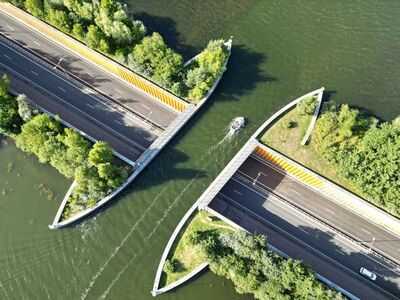
Picture a bridge and the image that no doubt comes to mind is a road spanning a body of water. Less commonly seen is the opposite - a water passageway that sails over a road.
Water bridges are engineering marvels that carry waterways over roads, railways or valleys. One such structure is the Veluwemeer Aqueduct in the Netherlands. Since 2002, the unique structure has ferried small boats over a busy motorway used by an estimated 28,000 cars daily. With walkways on both sides, the navigable aqueduct is also open to pedestrians.
Whilst the four-lane motorway is raised above the water for most of its length, it ducks underneath the surface of the lake where it meets the water bridge. The brilliantly engineered structure prevents water from spilling into the road.
A constant flow of traffic from the N302 motorway zooms underneath the boats that sail across the bridge. At just 25 metres long, the Veluwemeer aqueduct is one of the shortest in the world.
The aqueduct spans a shallow section of Lake Veluwe just three metres deep. Rather than a more traditional structure, planners decided a short aqueduct would be the most efficient and cost effective solution.
A more traditional bridge or tunnel, which would have been 600 metres long, was deemed too expensive to build. A drawbridge or ferry, on the other hand, would have wreaked traffic chaos.
The resulting £45million water bridge was completed from 1998 to 2002.
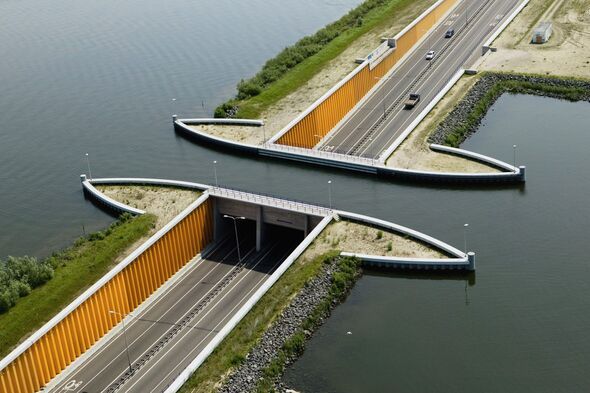
An engineering marvel, it uses 22,000 cubic metres of concrete to support the weight of the water above the road whilst steel sheet piling protects the road from sediment.
Lake Veluwe is part of the Dutch randmeren, a chain of 14 man-made 'bordering lakes' created for water management between the provinces of Flevoland and Gelderlan.
Flevoland was once an inland sea that was drained and converted into land for agriculture in the 20th century.
Though the surrounding area is mainly used for agriculture, Veluwemeer is a popular area for beach-goers and water sports.