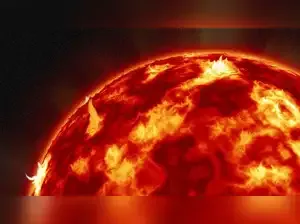
The Sun is anticipated to die in about five billion years, gradually expanding into a huge Red Giant before leaving behind a dense white dwarf. While that is far into the future, astronomers can examine other stars to know what may occur to our solar system.
NASA has offered images of Helix Nebula, a dying star much like our own Sun. Also named the Eye of God Nebula, it is one of the closest dying stars to Earth, situated 650 light-years away. The breathtaking photographs offer insight into the fate of planetary systems around dying stars. They feature blistering winds of rapidly navigating hot gas from the dying star colliding with slower, cooler shells of dust and gas that were expelled earlier in existence. This cosmic interplay of matter results in a stunning visual impact, providing astronomers a clear concept of how stars evolve at the conclusion of their lives.
James Webb Space Telescope Reveals More Detail
NASA spotted these images using the James Webb Space Telescope, giving far more detail than earlier observations by the Hubble and the now-retired Spitzer Space Telescopes. A bright white dwarf, the leftover core of the dying star, located at the core of the nebula, though it is just outside Webb’s frame. These examinations enable scientists to examine stellar death in detail.Life from the Ashes
However, while one thing concludes, new life could evolve from the ashes. “The image reveals how stars recycle their material back into the cosmos, seeding future generations of stars and planets,” NASA stated. This recycling procedure demonstrates how the death of stars leads to the birth of new celestial bodies, perpetuating the cosmic cycle.Recent Sun Discoveries
NASA recently provided never-before-seen footage of the Sun, spotted by staging an “artificial eclipse.” The European Space Agency’s Proba-3 mission utilized a pair of spacecraft orbiting Earth to block the Sun’s bright light, allowing scientists to examine details that were earlier not possible to see. These attempts, combined with Webb’s Helix Nebula imagery, offers us an unprecedented knowledge of both the Sun’s present activity and the final fate awaiting stars like it.FAQs:
Q1. When will the Sun die?Scientists estimate that the Sun will exhaust its fuel and die in about five billion years. It will initially expand into a Red Giant before shrinking into a white dwarf.
Q2. What is a Red Giant?
A Red Giant is a late stage in a star’s life where it expands enormously. Its outer layers become cooler and luminous, often engulfing nearby planets.