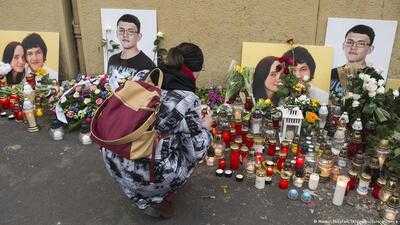
The second retrial in the Jan Kuciak murder case began on January 26. Businessman Marian Kocner again faces charges after the Slovak Supreme Court overturned his previous two acquittals.The murder of Slovak investigative journalist Jan Kuciak and his fiancee Martina Kusnirova returned to court on Monday for the third time. Marian Kocner, the businessman suspected of ordering the killing, has been acquitted on two occasions, but both times the verdicts were overturned by Slovakia's Supreme Court, citing serious flaws in how evidence had been assessed. The families of the couple — who were shot dead in their home in 2018 — are finally hoping for justice, although reaching a verdict is likely to take up to a year or even longer. Learning to live with loss "If I hadn't managed to come to terms with it, we wouldn't be sitting here talking," said Peter Bardy, editor-in-chief of the Slovak news site Aktuality.sk. Jan Kuciak's former boss spoke to DW in the same office where eight years previously he had spoken of his grief and sense of responsibility for his murdered employee. "If I hadn't come to terms with it, I'd have probably ended my life or I would have had to give up the job," he went on. "I was helped a great deal by Jan's parents and Martina's mother. They told me I shouldn't blame myself. They said it couldn't have been prevented. The investigators and police officers who worked on the case told me the same thing," Bardy said. "I've had to learn to live with it and accept that I couldn't have protected him. He was supposed to be protected by the institutions. Jan filed a criminal complaint with the General Prosecutor's Office against Marian Kocner, and it did nothing," he said. Murdered couple not forgotten On the ground floor of the Aktuality.sk offices, a small shrine to Jan and Martina has been replaced by the image of the couple that has become a symbol of the murder. Slovakia hasn't forgotten. But it has moved on. Kuciak's unfinished final story had been on how the Italian drug cartel, the 'Ndrangheta, had managed to infiltrate Slovak business and political circles. Ultimately, however, prosecutors decided Kuciak's killing had nothing to do with the Italian mob. A cold-blooded murder Investigators managed to piece together the sequence of events that led to a former soldier named Miroslav Marcek standing on the doorstep of the couple's house in the town of Velka Maca at 8.21 p.m. on February 21, 2018. Those events are laid out in detail by the Organized Crime and Corruption Reporting Project (OCCRP), an independent, not-for-profit news organization that seeks to expose transnational crime and corruption. It was, for example, involved in the Panama Papers revelations. When Kuciak answered the knock at the door, Marcek raised his Luger pistol — fitted with a silencer — and fired two shots at his chest, killing him instantly. Marcek then noticed Kusnirova in the kitchen. According to the OCCRP, he killed her with a single shot between the eyes. Gunman had associates Waiting for Marcek in a car nearby was his cousin, a former policeman named Tomas Szabo. Szabo had originally agreed to carry out the killing, but couldn't go through with it, so had approached his relative. The court heard that Szabo had been hired by a pizzeria owner in financial difficulties named Zoltan Andrusko. Andrusko — who later turned state's witness — testified that he had been approached by a woman named Alena Zsuzsova, who had offered him €50,000 ($59,000) and another €20,000 in debt relief in exchange for killing Kuciak. Zsuzsova was at the time a fixer for one of Slovakia's richest and most powerful businessmen, Marian Kocner. Who is Marian Kocner? Marian Kocner had been the subject of several stories by Jan Kuciak — stories that Kocner didn't like. Kuciak had filed several complaints to the police, saying that Kocner had threatened him. No action was taken. Marcek confessed in full to pulling the trigger and is serving 25 years in prison. Szabo denied all the charges against him and was also imprisoned for 25 years. Andrusko admitted to being the middleman and was given a reduced sentence of 15 years in return for his testimony. Zsuzsova continues to maintain her innocence. She is serving a 25-year sentence for conspiracy to murder in a separate, unrelated case. Kocner, the alleged mastermind, denies all involvement in Kuciak's killing. He is currently serving a 19-year sentence for serious financial crimes. Retrial begins On Monday, the case returned to the beginning. The retrial will be a full evidentiary hearing with a new panel of judges. The proceedings, which will take place at the Special Criminal Court in Pezinok, just outside Bratislava, are likely to take up to a year. "I have to be hopeful, you know," said investigative journalist Pavla Holcova of the OCCRP, who worked with Jan on the 'Ndrangheta stories. "I don't really want to admit that this could be yet another retrial and then yet another retrial because I think it's dragging on for way too long," she told DW. "I believe in justice. I believe that in Slovakia there is still — in many of the cases — independent justice," Holcova went on. "But I also hope this time that the families could have some kind of closure, because it's really exhausting for them." An opportunity squandered She, like Peter Bardy, said the outrage and protests that followed the murders presented an opportunity for change in Slovakia — an opportunity that was, however, squandered. Robert Fico resigned as prime minister in March 2018 in the wake of the major political crisis sparked by the murder. According to Bardy and Holcova, the initial anger and demand for a fresh start rapidly gave way to disillusionment with the center-right government of Igor Matovic, which was elected in 2020. Matovic's government, which was widely seen as incompetent and chaotic, collapsed during the COVID-19 pandemic, and was replaced by a caretaker cabinet. Meanwhile, the people in power at the time of Kuciak's killing have since risen back to the top. Tibor Gaspar, who resigned as chief of police in the wake of the murders, is now an MP in Prime Minister Robert Fico's Smer party. His son is in charge of Slovakia's domestic intelligence service. The victims' families still blame Gaspar Sr. for failing to act on Kocner's threats to Jan. Robert Kalinak, who resigned as interior minister in 2018 after the Kuciak murder, is now defense minister and deputy prime minister. And Robert Fico, the man who critics say has contributed so much to creating the whole edifice of corruption and cronyism in Slovakia, is back in office. His government, which returned to power in late 2023, has since reduced penalties for fraud offences. It has also dismantled the National Crime Agency — an elite anti-corruption police unit — as well as the Office of the Special Prosecutor, both of which were central to corruption investigations launched after Kuciak's murder. Edited by: Aingeal Flanagan