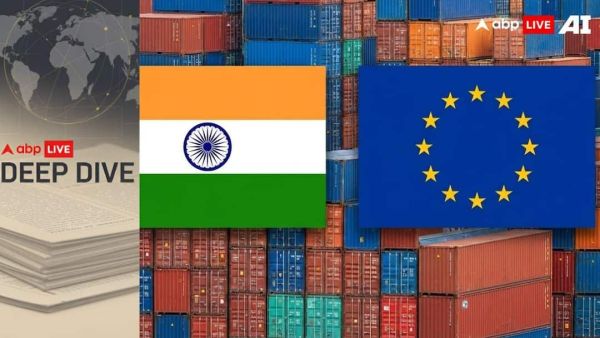
When India and the European Union announced the conclusion of negotiations for their long-awaited free trade agreement, the headline travelled fast across markets, boardrooms and export hubs.
After years of stop-start talks, the world’s fifth-largest economy and the 27-nation European bloc had finally shaken hands on what many are calling India’s most comprehensive trade pact to date.
Yet, as celebratory statements poured in, a quieter question began to surface among exporters, investors and policymakers: how quickly will this agreement actually start working?
For businesses on both sides, the signing is only the beginning. A long legal and political road still lies ahead before tariff cuts, market access and regulatory changes translate into containers moving faster across ports.
India’s bilateral trade in goods with the EU stood at $136.53 billion in 2024-25, with exports of $75.85 billion and imports of $60.68 billion, making the EU India’s largest goods trading partner. The bloc absorbs 17 per cent of India’s total exports, while its own shipments to India account for 9 per cent of its global exports.
Officials have indicated that the pact is expected to come into force early next year. But that timeline depends on a complex chain of approvals in Brussels, Strasbourg and New Delhi.
According to the European Commission, eight formal steps remain before the agreement can enter into force.
First, the negotiated draft texts must be published. This is followed by legal revision and translation into all official EU languages, a painstaking process that ensures every clause carries the same legal meaning across the Union.
Next, the European Commission must formally propose the agreement to the EU Council for signature and conclusion. The Council then adopts the text, after which the agreement is signed by both the EU and India.
The deal must then secure the consent of the European Parliament, a step that often brings intense political scrutiny, sectoral lobbying and public debate.
Only after the Parliament gives its approval does the Council take a final decision allowing the agreement to enter into force. On India’s side, the pact must also be ratified domestically before it becomes operational.
One of the sensitive issues in any modern trade agreement is the fear of third-country goods entering a market by routing through a partner country.
To address this, India and the EU have agreed on detailed rules of origin. These rules ensure that only products that have been significantly processed in India or the EU can benefit from tariff preferences.
This mechanism is designed to prevent a scenario where goods from other countries are merely shipped to India and then re-exported to Europe to take advantage of lower duties.
For exporters, this means compliance documentation, origin certificates and value-add thresholds will matter as much as price competitiveness.
Among Indian exporters, optimism is strongest in labour-intensive sectors.
Aqeel Panaruna, Chairman of Florence Shoe Company and Director at Grand Atlantia Panapakkam SEZ Pvt Ltd, said the EU already remains the largest market for India’s footwear and leather industry, accounting for 44.64 per cent of exports in 2024.
With exports to the EU at $2.25 billion and total sector exports of $5.04 billion, Panaruna said shipments to Europe are projected to reach $6 billion by 2030, while overall exports could touch $14 billion.
In apparel, expectations are even sharper.
AEPC Chairman A Sakthivel said the deal will provide a “significant boost” to garment exports, which are expected to double over the next three years. He noted that Indian apparel exports could grow by 20-25 per cent year-on-year after the FTA becomes operational, compared with the current growth rate of 3.01 per cent in the EU market.
The agreement eliminates tariffs on 100 per cent of apparel tariff lines, offering Indian exporters a level playing field against competitors such as Bangladesh, Turkey and Vietnam, which already enjoy preferential access.
The EU, the world’s largest apparel importer, bought $202.8 billion worth of garments in 2024-25. India’s current market share is only 2.9 per cent, a gap exporters now hope to narrow.
Adding to the chorus of support, Santosh Iyer, MD & CEO, Mercedes-Benz India, said the agreement could have a far-reaching impact on the premium car market.
“A gradual tariff reduction on vehicles and fully liberalised automotive parts are strategically important decisions in the FTA for the automotive industry. The FTA opens up new avenues for customers with improved vehicle allocations, better availability of top-end global models for Indian market, faster access to latest technology and creating a stronger luxury car ecosystem," Iyer noted.
Industry executives say the emphasis on phased tariff cuts and freer movement of auto components could reshape sourcing patterns and deepen India’s integration into global automotive supply chains, while still preserving incentives for domestic manufacturing.
Beyond textiles, the deal opens selective doors in sensitive sectors.
Gulzar Didwania, Partner at Deloitte India, said tariff concessions in wines, spirits and automobiles should be viewed as a strategy for reciprocal access.
“In alcohol, carefully phased liberalisation can help formalise imports. In automobiles, selective opening, particularly for components and EVs, can be leveraged to attract investment, embed technology transfer and strengthen domestic manufacturing ecosystems,” he said.
Trade expert Deep Kapuria, Chairman of Hi-Tech Gears, called it “the mother of all trade deals”.
“This will not only restore India’s tariff benefits, which it had enjoyed for years through GSP, but open new avenues for exports and investment flow, particularly in services, student mobility and digital trade,” Kapuria said.
For all the promise, the next 12 months will test the machinery of trade diplomacy.
Each stage, legal vetting, translation, parliamentary debate and ratification, carries the risk of delay. Past EU trade deals have taken anywhere between 12 and 24 months from political agreement to provisional application.
Exporters, meanwhile, must prepare early. FIEO President SC Ralhan urged companies to enhance product quality, meet regulatory standards and scale up capacity to serve “large, discerning markets across Europe”.
Preferential access is valuable only if firms can meet Europe’s exacting norms on sustainability, traceability and labour standards.
If approvals move smoothly, early next year could mark the beginning of provisional application. That is when tariff reductions would start to bite, contracts would be renegotiated, and supply chains would gradually rewire.