Mumbai: India and the European Union have concluded a long-pending Free Trade Agreement (FTA), giving Indian exporters preferential access to the 27-nation EU market. The deal was announced at the 16th India–EU Summit by Prime Minister Narendra Modi and European Commission President Ursula von der Leyen. Both leaders described it as a landmark partnership that goes beyond trade.
Why the deal matters now?
Negotiations began in 2007, stalled in 2013, and restarted in 2022. Talks gained urgency amid global trade uncertainty, especially after sharp tariff actions by the United States disrupted supply chains. The agreement signals a shift towards closer cooperation between India and the EU in a volatile global environment.
Big win for Indian exports
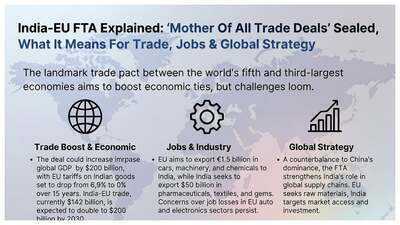
Under the pact, the EU will cut or remove tariffs on about 97 percent of its tariff lines, covering nearly 99.5 percent of India’s exports by value. Over 70 percent of tariff lines will become duty-free immediately once the agreement takes effect. This strongly benefits labour-intensive sectors like textiles, garments, leather, footwear, gems and jewellery, marine products, toys and sports goods. Exports worth around $75 billion are expected to gain.
India–EU Trade Pact: Why The 'Mother Of All Deals' Could Redraw The Global Economic MapIndia opens up, but cautiously
India will reduce or remove duties on around 92 percent of its tariff lines, covering nearly 97.5 percent of EU exports. About half will get immediate relief, while the rest will be phased out over five to ten years. Sensitive areas such as dairy, cereals, poultry and soymeal are excluded to protect farmers.
Autos and sensitive sectors protected
The agreement allows limited, quota-based entry of high-end European cars while encouraging local manufacturing under ‘Make in India’. India has fully protected sensitive agricultural sectors, while products like tea, coffee, spices and certain fruits get better EU access.
India-EU Trade Deal To Boost Investor Confidence In Services Sector: NasscomServices, mobility and jobs
The EU has opened 144 services sectors, including IT, education and professional services. India has opened 102 sectors. The pact also eases temporary movement of professionals, helping Indian IT workers, engineers and consultants work in Europe with clearer rules.
Strategic and economic impact
The EU is India’s largest goods trading partner. Goods trade stood at USD 136.5 billion and services trade at USD 83 billion in 2024-25. The agreement is expected to come into force in 2027 after ratification. Officials say it will boost jobs, MSMEs and India’s long-term growth goals.