If Krishna Died in Dwarka, So How Did His Heart End Up in Jagannath Puri?
Times Life January 29, 2026 08:40 PM
 Krishna’s story does not end with death. In fact, it becomes
stranger, deeper, and more powerful after it. A god leaves his body in Dwarka. That city soon disappears beneath the sea. Yet far away, on the eastern coast of India, a temple rises where people believe Krishna is still alive, still breathing through ritual, still present without a human form.
Krishna’s story does not end with death. In fact, it becomes
stranger, deeper, and more powerful after it. A god leaves his body in Dwarka. That city soon disappears beneath the sea. Yet far away, on the eastern coast of India, a temple rises where people believe Krishna is still alive, still breathing through ritual, still present without a human form.
If Krishna truly died in
Dwarka, why does
Jagannath Temple feel like the place where he never left at all?
This is not just a mythological curiosity. It is a chain of events that links time, geography, scripture, and belief into one continuous story.
1. Krishna’s departure was timed, not sudden
According to traditional Hindu chronology, Krishna left his mortal body in 3102 BCE, on the Amavasya of the month of Bhadrapada. This moment is believed to mark the end of Dwapar Yuga and the beginning of Kali Yuga. Scriptures describe this not as an accident or defeat, but as a conscious withdrawal. Krishna had completed his role on earth. The balance he came to restore had been restored. His leaving signalled that humanity would now have to walk without divine intervention standing visibly beside it.
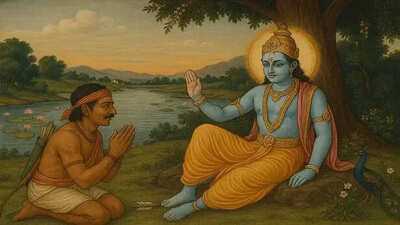
2. The hunter was only the instrument, not the causeKrishna was resting in a forest near Dwarka when a hunter named Jara mistook the sole of his foot for a deer and released an arrow. The detail that often goes unnoticed is that Krishna did not resist fate. He forgave the hunter immediately. Texts emphasise this forgiveness to make one point clear. The arrow did not kill Krishna. Time did. The event fulfilled a curse linked to his earlier incarnation, reinforcing the idea that cosmic law applies to even the divine.
3. A cremation that revealed something eternal
 The Curse of Gandhari on Krishna: How the Yadava Dynasty Met Its End
After Krishna’s passing, his body was cremated according to custom. Yet legends consistently say the fire could not consume everything. One part remained untouched. This part is referred to as Krishna’s heart. Symbolically, it represents consciousness, devotion, and the eternal self. In spiritual philosophy, the heart is not an organ but the seat of awareness. Fire can destroy matter, but not essence.
4. Arjuna faced a duty no scripture prepared him forFor
Arjuna, this was a moment heavier than Kurukshetra. He stood before something sacred that could not be burned, buried, or kept. Choosing surrender over possession, he placed Krishna’s heart into the sea. This act was deeply symbolic. It acknowledged that Krishna no longer belonged to one person, one family, or one city. What followed would not be decided by humans.
5. Dwarka began to disappear after Krishna leftSoon after Krishna’s departure, Dwarka is believed to have started sinking into the sea. Ancient texts describe the sea reclaiming the city stone by stone. Modern underwater discoveries near Dwarka have added weight to this belief. For devotees, the meaning is simple and profound. Dwarka existed because Krishna lived there. Once he left, the city had served its purpose.
6. The sea carried something sacred to Odisha
 The flag of faith
In Odisha, long before grand temples existed, tribal traditions spoke of a mysterious divine wooden form called Darubrahma that appeared on the shore. It was said to radiate power and could not be shaped by ordinary means. Over time, this belief merged with Vedic traditions, leading to the emergence of Jagannath worship. Many believe the sea carried Krishna’s undying essence from Dwarka to these shores, allowing his presence to continue in a new form.
7. Jagannath’s form explains the entire journeyJagannath has no defined hands or feet. His form is intentionally incomplete. This is not artistic limitation but philosophy. Krishna no longer appears as a king of Dwarka or a charioteer of Arjuna. In Jagannath, he becomes presence without form, accessible to all, beyond caste, body, and geography. Dwarka holds the memory of his life. Jagannath holds what could not die.