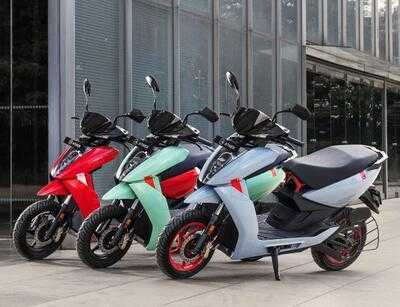
While disclosing a significant improvement in its financial performance for the December quarter, EV major Ather Energy’s management is expecting to see significant headwind in the near future due to volatile commodity and component markets.
“We are preparing for the worst. It’s hard to say how this will evolve, but we think there’s a few percentage points of risk for the rest of the year,” Ather’s CEOTarun Mehta said in the post earnings call.
The company’s manufacturing costs primarily arise from the key raw materials and components — silver, copper, aluminum, electronic components, among others — it procures. Costs of materials required for manufacturing its products accounted for about 70% of its total expenses for Q3 FY26.
The management’s concern mirrors the sharp volatility seen in key raw materials in recent months. Until January 29, silver prices had surged 319% YoY in rupee terms, while gold was up 118%. Even after a steep correction on January 30—around 11% in silver and 4.3% in gold—silver was still up 268% YoY and gold 108% YoY.
Against this backdrop, cofounder Tarun Mehta noted that while battery inputs such as lithium-ion cells remain relatively manageable, near-term cost pressures are more acute on the vehicle side, particularly metals.
“Battery-side inflation is still a bit more manageable, it is the vehicle side that looks a little bonkers right now,” said Mehta.
This might already be reflected in the company’s pricing of its scooters. Ather recently had announced a price hike of up to INR 3,000 on its scooter range effective January 1, 2026.
To further strengthen its supply chain, Ather’s board today approved the incorporation of a wholly-owned subsidiary in Hong Kong.
The new entity will focus on procurement and sourcing activities, aimed at improving operational efficiency and building a more resilient supply chain across the Asia-Pacific (APAC) region.
Besides, the company is also investing in value engineering and product redesigning toreduce dependence on high-cost inputs. Ather’s upcoming EL platform is positioned as a lower-cost, more scalable EV architecture aimed at reducing bill-of-materials costs and limiting exposure to commodity price volatility as volumes scale.
Built on this platform, the EL01 will be the first concept-to-production model — a family-oriented electric scooter expected to launch in India around late 2026, priced in the INR 90,000–1 Lakh range.
Another factor where Ather currently is betting on is the non-vehicle revenue, including software subscriptions (AtherStack Pro), accessories and charging services. As of Q3, non-vehicle revenue accounted for about 14% of the total revenue.
Overall, the E2W major narrowed its Q3 loss by 57% YoY and 45% QoQ to INR 84.6 Cr. Its operating revenue zoomed 50% YoY to INR 953.6 Cr. Including other income of INR 42.1 Cr, total income for the period under review stood at INR 995.7 Cr.
The company claimed that it achieved its highest quarterly revenue in Q3. It attributed the improvement in its financial performance to supply-chain optimisation and manufacturing efficiencies.
Shares of Ather Energy ended today’s trading session 3.01% lower at INR 606.7.
The post Ather Energy Flags Commodity Volatility Risks After A Strong Q3 Performance appeared first on Inc42 Media.