The supergrid is not a standalone project, but a key infrastructure for optimizing the systemic utilization of renewable energy.
By Niken Arumdati, ST, M.Sc
The author is the Secretary of the NTB Province ESDM Service, and an alumnus of Technisce Universiteit Eindhoven (TU/e) Netherlands
The Bali–NTB–NTT cooperation, which has now entered the implementation stage, marks a new chapter in the development of the electricity system in eastern Indonesia. The supergrid that will connect these three provinces is no longer confined to the realm of ideas, but is moving toward realization as a strategic piece of infrastructure. One of the most critical aspects of future electricity supply is the development of a nationally integrated transmission system—known as the supergrid. Through the supergrid, the government is designing a structural solution to address the long-standing mismatch between the locations of new and renewable energy (NRE) potential and major load centers, a key challenge in clean energy development.
Within this policy framework, the supergrid is not only understood as an inter-island transmission network, but also as a system that strengthens connectivity within islands. The planned supergrid transmission will connect islands while simultaneously reinforcing intra-island networks, enabling renewable energy to be transported from its sources often located far from load centers—to areas with the highest electricity demand in an efficient and reliable manner.
At the national level, the primary demand centers are located on Java and Bali, which have long served as hubs of economic activity, industry, and tourism, with rapidly growing electricity needs. Consequently, the development of a supergrid linking eastern Indonesia, including NTB, with Bali and subsequently the Java system represents a strategic step toward more optimal and balanced utilization of NRE potential.
NTB’s readiness to take a leading role in supergrid development and regional connectivity is not a normative claim, but rather a reflection of the policy foundations and practical experience in energy transition that have been built consistently over time. NTB has set a Net Zero Emissions target for 2050 and incorporated it into its regional energy roadmap, identifying the energy sector as one of the main contributors to emissions that must be addressed.
Baca juga: NTB Rich in Critical Mineral Potential for Renewable Energy Development
Accordingly, NTB’s energy development strategy has been aligned with the NTB Sustainable and Enduring (NTB Lestari Berkelanjutan) Program, which places environmental conservation and resource resilience at the core of long-term development, and is reinforced by the NTB Connected Program, which promotes regional connectivity through strategic infrastructure development, including energy and electricity infrastructure.
In terms of potential, NTB holds highly significant advantages. Based on estimates from the Ministry of Energy and Mineral Resources that serve as references in the regional energy roadmap, NTB’s solar energy potential exceeds 19 GWp, with the largest land availability located on Sumbawa Island. Meanwhile, onshore wind energy potential is estimated to exceed 1,500 MW, spread across coastal and hilly areas in southern Lombok and Sumbawa Island.
For hydropower, the combined potential of large and small-scale hydropower plants (PLTA and PLTMH) is estimated at around 120 MW, part of which has already been utilized, while the remainder remains open for development. In addition, NTB has significant bioenergy potential derived from agricultural, livestock, and municipal waste, which has long been a backbone of NRE contributions to the regional energy mix.
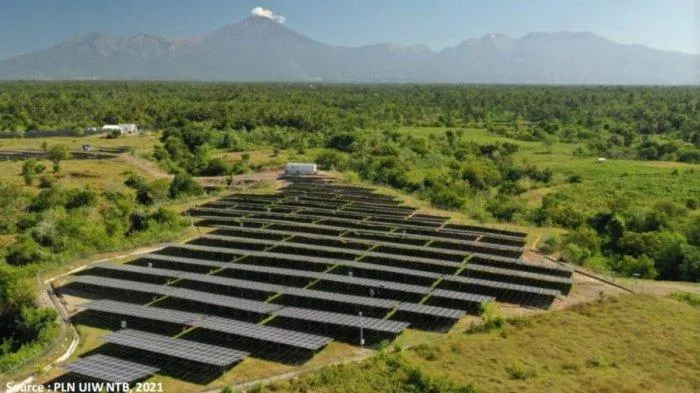
This vast potential has begun to materialize in tangible projects. The 21.6 MWp Lombok On-Grid Solar Power Plant, the 26 MWp Amman Mineral Solar Power Plant which supplies approximately 20 percent of the smelter’s electricity demand and the 314 kWp Medang Island Hybrid Solar Power System with 550 kWh of battery storage that provides 24-hour electricity to small island communities demonstrate that NTB has entered a phase of medium to large scale implementation.
At the same time, on-grid mini-hydropower plants with a total capacity of 18.59 MW, along with biomass co-firing at the Jeranjang and Taliwang coal-fired power plants, illustrate NTB’s capacity to manage the energy transition in a gradual and pragmatic manner.
All of these potentials and achievements underscore that the supergrid is not a standalone project, but a key infrastructure for optimizing the systemic utilization of renewable energy. Planned developments such as solar power plants with battery energy storage systems (2 × 5 MWp and 7.5 MWh) in Sumbawa and Bima, feasibility studies for wind power projects of up to 115 MW, and a 30 MW solar–green hydrogen project targeted for commercial operation in 2029 will only reach their full potential if supported by a strong, flexible, and integrated inter-island transmission network capable of delivering power to major demand centers in Bali and Java.
To ensure the technical and economic feasibility of this interconnection, feasibility studies for interconnection and supergrid development will be supported through the RE-ACT (Renewable Energy – Accelerated Transition) project, implemented by the Global Green Growth Institute (GGGI) in collaboration with the Government of NTB Province and relevant stakeholders. Meanwhile, from the perspective of physical network implementation, the construction of the supergrid will fall under the mandate of PLN as the national transmission system provider and electricity system operator, enabling inter-island integration to be carried out in a gradual, well-planned, and reliable manner.
Challenges undoubtedly remain ahead, ranging from the synchronization of central and regional regulations, certainty in transmission investment schemes, to the readiness of cross-regional system operations. Nevertheless, NTB’s experience in building multi-stakeholder collaboration, leveraging innovative financing schemes, and managing distributed energy systems provides important capital to address these challenges. The supergrid will not only enhance electricity supply reliability, but also serve as an instrument for equitable development and a just energy transition.
With renewable energy potential reaching tens of gigawatts, a strategic position between Bali and NTT, and policy alignment through the NTB Lestari dan Berkelanjutan and NTB Connected programs, NTB possesses strong prerequisites to play a central role in the development of a national supergrid. If managed consistently and inclusively, the supergrid will become the backbone of Indonesia’s future electricity system connecting clean energy sources in eastern Indonesia with demand centers in Bali and Java, while firmly positioning NTB as a strategic hub in the nation’s energy transformation.
This article has been published in an Indonesian version. See original.
Editor: Ismail Zakaria