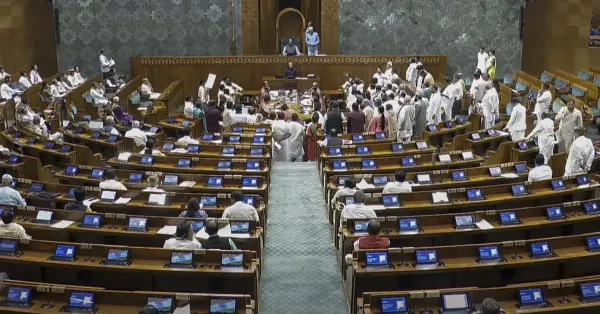
Parliament – The Lok Sabha was thrown into turmoil on Tuesday as fresh disagreements erupted between the opposition and the ruling benches, leading to repeated disruptions and an eventual adjournment of the House. The confrontation began when Leader of the Opposition Rahul Gandhi attempted to cite an article linked to an unpublished memoir attributed to a former Army chief, prompting strong objections from members of the Bharatiya Janata Party.

The disruption unfolded while Rahul Gandhi was speaking on the Motion of Thanks to the President’s address. He sought to revisit an issue that had already been addressed by the Chair a day earlier, drawing immediate resistance from the treasury benches. BJP members objected sharply, arguing that the reference violated parliamentary norms, while Congress lawmakers protested what they described as unfair restrictions on the opposition’s right to speak.
As tempers flared, scenes of disorder followed, including protests by Congress members who tore papers and threw them toward the Speaker’s chair, further escalating the situation inside the House.
Under parliamentary procedure, any document referred to in the House must be formally authenticated by the member concerned and submitted for examination. Presiding over the session, Krishna Prasad Tenneti asked Rahul Gandhi to table the document, assuring him that it would be reviewed before any further discussion.
Despite this assurance, Gandhi insisted on referring to the article, arguing that it involved issues of national security. With neither side willing to step back, the Chair adjourned the proceedings until 3 pm to restore order.
At the heart of the disagreement was a debate over parliamentary protocol. Rahul Gandhi objected to the use of the term “permission,” asserting that as Leader of the Opposition, he should not be restrained from raising matters of importance. Parliamentary Affairs Minister Kiren Rijiju countered that all members, regardless of position, must adhere to rules and speak only with the Speaker’s consent.
The Chair reiterated that a ruling on the matter had already been given on Monday and asked Gandhi to limit his remarks strictly to the President’s address. Rijiju supported the Chair’s position, noting that once a ruling is delivered, the same issue cannot be raised again in the House.
The exchanges grew sharper as Congress leaders accused the government of attempting to suppress dissenting voices. The Chair intervened repeatedly, urging members to maintain decorum and focus on the scheduled discussion. Despite these appeals, interruptions continued, making it impossible to proceed with legislative business.
Eventually, the Chair called the next speaker, but the protests persisted, leading to further adjournments and significant loss of productive time in the Lok Sabha.
Following the adjournment, Rahul Gandhi accused the government of deliberately preventing him from speaking. He claimed that this marked an unprecedented moment in parliamentary history where the Leader of the Opposition was denied an opportunity to respond to the President’s address.
Outside the House, Gandhi addressed reporters and linked the controversy to a recently concluded trade agreement between India and the United States. He alleged that the deal had been finalised under pressure and argued that it adversely affected Indian farmers. His remarks included sharp criticism of the Prime Minister, questioning the timing and implications of the agreement.
Reacting to the opposition’s claims, Kiren Rijiju clarified that Rahul Gandhi was not stopped from speaking but was asked to avoid referencing material that was not permitted under parliamentary rules. He stated that quoting from an unpublished memoir of a former Army chief without proper authorization was against established norms and disrupted the proceedings for all members.
Rijiju emphasized that the government had no objection to the Leader of the Opposition continuing his speech, provided it complied with parliamentary procedures and respected previous rulings of the Chair.
The repeated disruptions resulted in a significant delay in the day’s agenda, underscoring ongoing tensions between the government and the opposition. The episode highlighted the fragile state of parliamentary functioning amid heightened political confrontations and raised questions about the balance between free expression and procedural discipline within India’s highest legislative forum.