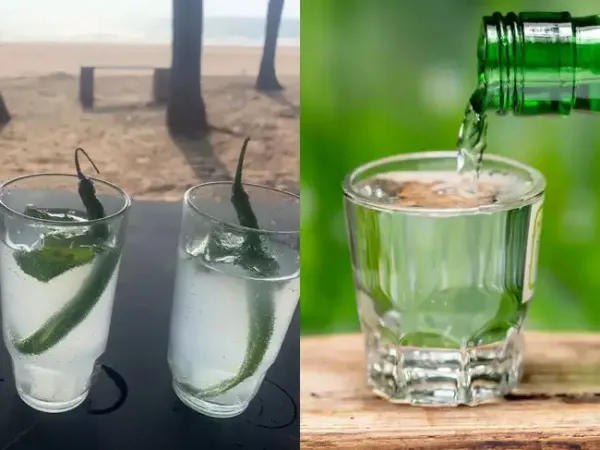
A seasonal danger lurks in Goan refrigerators. From March till the monsoon, you run the risk of reaching for what you think is a cool bottle of water — and then spluttering with shock at the alcoholic burn of urrak . This colourless spirit made from cashew fruit is sold in repurposed mineral water bottles, so nearly everyone in Goa has made this mistake once.
Urrak is little known outside Goa. Toddy to Tequila , Sandhya Mulchandani’s generally wellresearched new book on Indian alcohol, doesn’t mention it. Biula A Cruz e Pereira in One for the Road , her deeply researched book on feni in Goan life, only mentions urrak as one stage towards feni , though notes how it “is said to provide the person with sufficient body heat against cold in the ensuing monsoons”. Given how much urrak is drunk, this means Goans must be radiating heat by the time the rains arrive! In the last weeks of February, cashew fruit start ripening and are collected to be squashed into niro . This fresh juice is sweet but also has, I feel, a slightly wild, tannic note. Niro is naturally fermented for around four days, and then distilled into urrak in a variety of traditional stills, each of which affects the final alcohol level and taste. Mostly, this fresh urrak is around 20% alcohol, and when distilled again, along with some fresh niro , results in feni . This is double the strength, and some of that niro flavour carries over to give feni’s characteristic strong and fruity taste.
Urrak is the first distillation, with no niro added, so the flavour is more balanced and fragrant, rather than feni’s full-on assault. Its much lower strength makes it easier to drink and Goan bartenders love working it into new cocktails. But it’s hard to beat the classic combination of urrak with Limca, lots of ice and a slit green chilli as a warming garnish. Limca is now so hard to find in most places that I wonder if it is mainly sustained by this seasonal surge in consumption from Goa. Urrak’s relatively light alcohol, and the informal way it is made and sold, means that it needs refrigeration. Feni’s greater strength preserves it better and gives it more uses, like the ritual and medicinal uses detailed in Cruz e Pereira’s book. Urrak is just consumed for pleasure.
As it happens, these last few weeks before urrak’s appearance have also seen increased promotion in Goa for Korean soju . This is an interesting coincidence, since soju shares urrak’s mid-range alcohol level. It also comes in different fruit flavours, which increases the resemblance to urrak . Soju was also little-known outside Korea until the early 2000s when, in a notable moment for inter national marketing, alcohol analysts started including non-Western spirits in their data sets. Suddenly, Indian whiskies, like Bagpiper or Filipino rums, like Tanduay, emerged as far larger brands than Western ones. The biggest brand was Jinro’s soju , a place it has retained.
This drew attention to the Korean spirit, but what’s less understood is that today’s soju has little connection to the historic spirit. That was usually strong, like feni , and also had deep connections to Korean history. But after the Korean War (1950-53), the divided peninsula faced severe food shortages, even as South Korea tried to build its industrial base. Hyunhee Park, in Soju: A Global History , explains “the government was compelled to enact the Act Banning the Making of Alcoholic Beverages Using Grains, passed in 1965, which led to the complete suppression of traditional distillation methods”.
Instead, production was handed to large companies that created a new, low-alcohol, fruit-flavoured soju , which has become a global success. It is intriguing to wonder if urrak’s fragrant, low-alcohol appeal could find wider success. Cashews grow across coastal India, potentially providing lots of raw material. Could urrak ever become more than just Goa’s best-kept summer secret?
Urrak is little known outside Goa. Toddy to Tequila , Sandhya Mulchandani’s generally wellresearched new book on Indian alcohol, doesn’t mention it. Biula A Cruz e Pereira in One for the Road , her deeply researched book on feni in Goan life, only mentions urrak as one stage towards feni , though notes how it “is said to provide the person with sufficient body heat against cold in the ensuing monsoons”. Given how much urrak is drunk, this means Goans must be radiating heat by the time the rains arrive! In the last weeks of February, cashew fruit start ripening and are collected to be squashed into niro . This fresh juice is sweet but also has, I feel, a slightly wild, tannic note. Niro is naturally fermented for around four days, and then distilled into urrak in a variety of traditional stills, each of which affects the final alcohol level and taste. Mostly, this fresh urrak is around 20% alcohol, and when distilled again, along with some fresh niro , results in feni . This is double the strength, and some of that niro flavour carries over to give feni’s characteristic strong and fruity taste.
Urrak is the first distillation, with no niro added, so the flavour is more balanced and fragrant, rather than feni’s full-on assault. Its much lower strength makes it easier to drink and Goan bartenders love working it into new cocktails. But it’s hard to beat the classic combination of urrak with Limca, lots of ice and a slit green chilli as a warming garnish. Limca is now so hard to find in most places that I wonder if it is mainly sustained by this seasonal surge in consumption from Goa. Urrak’s relatively light alcohol, and the informal way it is made and sold, means that it needs refrigeration. Feni’s greater strength preserves it better and gives it more uses, like the ritual and medicinal uses detailed in Cruz e Pereira’s book. Urrak is just consumed for pleasure.
As it happens, these last few weeks before urrak’s appearance have also seen increased promotion in Goa for Korean soju . This is an interesting coincidence, since soju shares urrak’s mid-range alcohol level. It also comes in different fruit flavours, which increases the resemblance to urrak . Soju was also little-known outside Korea until the early 2000s when, in a notable moment for inter national marketing, alcohol analysts started including non-Western spirits in their data sets. Suddenly, Indian whiskies, like Bagpiper or Filipino rums, like Tanduay, emerged as far larger brands than Western ones. The biggest brand was Jinro’s soju , a place it has retained.
This drew attention to the Korean spirit, but what’s less understood is that today’s soju has little connection to the historic spirit. That was usually strong, like feni , and also had deep connections to Korean history. But after the Korean War (1950-53), the divided peninsula faced severe food shortages, even as South Korea tried to build its industrial base. Hyunhee Park, in Soju: A Global History , explains “the government was compelled to enact the Act Banning the Making of Alcoholic Beverages Using Grains, passed in 1965, which led to the complete suppression of traditional distillation methods”.
Instead, production was handed to large companies that created a new, low-alcohol, fruit-flavoured soju , which has become a global success. It is intriguing to wonder if urrak’s fragrant, low-alcohol appeal could find wider success. Cashews grow across coastal India, potentially providing lots of raw material. Could urrak ever become more than just Goa’s best-kept summer secret?