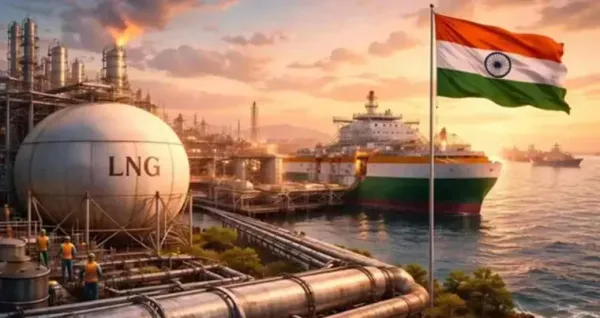
The effect of increasing tension in Gulf countries can now be felt directly in your kitchen. The fear of any obstruction in the Strait of Hormuz, one of the world’s most important energy routes, has increased the volatility in the global gas market.
Middle East Tensions: The impact of increasing tension in Gulf countries is now directly reaching the global energy market and home kitchens. The possibility of any disruption on the Strait of Hormuz, one of the world’s most important energy routes, could have a serious impact on the supply of LNG (Liquefied Natural Gas) and crude oil. As a result, the prices of gas and oil may increase in the international market, making domestic gas and fuel expensive.
Strait of Hormuz: Important route for global energy
The Strait of Hormuz is an important energy corridor in world trade. About 20 million barrels of crude oil and 20 percent of the world’s total LNG trade passes through this route daily. Therefore, any kind of obstruction in this narrow sea route can prove to be a major blow to global energy security.
Recently, Iran’s military unit Islamic Revolutionary Guard Corps (IRGC) has warned that ships passing through the Strait of Hormuz could be targeted. After this announcement, there has been a rise in the prices of LNG and crude oil in the global market.
Impact of LNG crisis on domestic kitchens and vehicles
LNG is not only an important fuel for PNG used in domestic kitchens, but is also an important fuel for CNG used in vehicles. If the supply of LNG is disrupted, it may have a direct impact on the prices of domestic gas and vehicle fuels. Experts believe that if this route is affected even for a few weeks, major instability can be seen in the global energy market. Due to this, the prices of oil based products may also increase along with the rise in the prices of LNG.
India gets about 50-55 percent of its crude oil and LNG needs through the Strait of Hormuz. Especially about 59 percent of the LNG received by India from Qatar and UAE comes through this route. According to S&P Global data, India’s energy dependence on Gulf countries makes it directly vulnerable to the global supply crisis. If this route is closed for a long period, the country’s energy security could be at serious risk.