


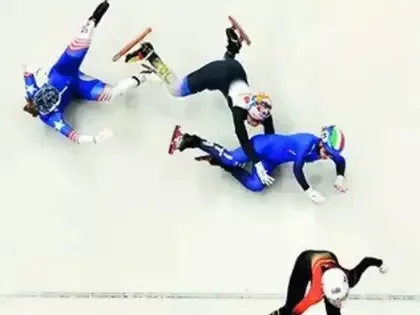
In case you noticed, the Winter Olympics in Italy came to an end on February 22. Tropical contribution, and attention, to the Games was minimal. As in any mega sporting event, some athletes cemented their status as champions, some did not fulfill the pre-Olympic hype (US figure skater Ilia Malinin and US alpine ski racer Lindsey Vonn, for example), and some outperformed as newcomers.
Then there was 'viral' news unrelated to results: a Norwegian biathalon skier's post-race confession about cheating on his girlfriend; Canadian cunning in the normally calm sport of curling - both the men's and women's teams were reportedly involved in the 'inappropriate touching' of the granite curling stone.
As the names suggest, Summer and Winter Olympics are as different as sun and snow, the first obvious difference being the lack of diversity in the Winter Games. They're dominated by European and North American countries. Japan, South Korea, and China make for an Asian presence. India first competed in the Winter Olympics in 1964, and has had a continuous presence since 1998, typically with 1-2 participants.
One difference I didn't expect was the explicit objective of the downhill ski race, one of the games' main attractions. The rulebook of the organising body, FIS (International Ski and Snowboard Federation), states, 'A downhill is characterised by the six components of technique, courage, speed, risk, physical condition and judgement.' This sport is probably the only one to enshrine such a 'test' formally in the rules. And this stated focus on testing courage and risk makes the downhill race thrilling to watch.
The gradients in parts of the downhill run approach a slope of 35-40°. (A typical home staircase has a 30° slope, which doesn't look daunting for everyday use, but for a ski-run is very steep.) Such steepness ensures that speeds of up to 130 kmph are routinely achieved.
Then, there are the event names. Sure, the Summer Games feature events like dressage in equestrian sports; skeet and trap in shooting; and coxless and sculls in rowing. Still, most events such as swimming, diving, boxing, track and field, wrestling sound like activities many can engage in. Even gymnastics has a familiar feel to it.
Out of the 16 sports (each sport has multiple events) in the 2026 Winter Olympics, 10 have the word 'ski', 'skate', 'snowboard', or 'hockey' in their name. Luge, skeleton, and Nordic combined are some that form the other six. There's also curling. It could mean anything from a hairstyle to a gym exercise. As a Winter Olympic sport, it's an activity of sliding big granite disks over a long patch of ice with the goal of stopping them inside a target circle. It's surprisingly quite captivating.
At first glance, Winter Olympics events appear to be more risky as compared to those in the Summer Games (as Lindsey Vonn's crash in the women's downhill ski race would suggest). An analysis of injuries in the Summer and Winter Games, however, doesn't bear out that assumption.
A 2013 article in the British Journal of Sports Medicine, 'Sports Injuries at the Olympics: A Review of Incidence Related Data from Past Games and the Implications for Future Multi-Sport Events' concluded that the rate of injuries is about 10% (percent of total athletes suffering an injury) in the prior edition of each Games. Snowboard cross - a downhill race - led the count in the Winter Games, and football (knee injuries) in the Summer variety.
A possible way to reconcile this data with the presumption of Winter Olympics being more injury-prone is that the time spent actively engaging in the event is far less for the Winter events. For example, skiers and boarders complete one run in about 2 minutes, and compete 2-4 times. So, the total time 'on course' can be a maximum of 10 minutes, whereas in the Summer Games, athletes participate for a much longer time.
Despite the demographic homogeneity, the Winter Olympics are exciting to watch for anyone, irrespective of their own demographics. They are fast and edgy, many outcomes being photo-finishes. And they showcase this novel dimension of humans, a trait not limited only to sporting prowess - to steer over slippery surfaces.
The writer is MD, Resonance Laboratories, Bengaluru
Then there was 'viral' news unrelated to results: a Norwegian biathalon skier's post-race confession about cheating on his girlfriend; Canadian cunning in the normally calm sport of curling - both the men's and women's teams were reportedly involved in the 'inappropriate touching' of the granite curling stone.
As the names suggest, Summer and Winter Olympics are as different as sun and snow, the first obvious difference being the lack of diversity in the Winter Games. They're dominated by European and North American countries. Japan, South Korea, and China make for an Asian presence. India first competed in the Winter Olympics in 1964, and has had a continuous presence since 1998, typically with 1-2 participants.
One difference I didn't expect was the explicit objective of the downhill ski race, one of the games' main attractions. The rulebook of the organising body, FIS (International Ski and Snowboard Federation), states, 'A downhill is characterised by the six components of technique, courage, speed, risk, physical condition and judgement.' This sport is probably the only one to enshrine such a 'test' formally in the rules. And this stated focus on testing courage and risk makes the downhill race thrilling to watch.
The gradients in parts of the downhill run approach a slope of 35-40°. (A typical home staircase has a 30° slope, which doesn't look daunting for everyday use, but for a ski-run is very steep.) Such steepness ensures that speeds of up to 130 kmph are routinely achieved.
Then, there are the event names. Sure, the Summer Games feature events like dressage in equestrian sports; skeet and trap in shooting; and coxless and sculls in rowing. Still, most events such as swimming, diving, boxing, track and field, wrestling sound like activities many can engage in. Even gymnastics has a familiar feel to it.
Out of the 16 sports (each sport has multiple events) in the 2026 Winter Olympics, 10 have the word 'ski', 'skate', 'snowboard', or 'hockey' in their name. Luge, skeleton, and Nordic combined are some that form the other six. There's also curling. It could mean anything from a hairstyle to a gym exercise. As a Winter Olympic sport, it's an activity of sliding big granite disks over a long patch of ice with the goal of stopping them inside a target circle. It's surprisingly quite captivating.
At first glance, Winter Olympics events appear to be more risky as compared to those in the Summer Games (as Lindsey Vonn's crash in the women's downhill ski race would suggest). An analysis of injuries in the Summer and Winter Games, however, doesn't bear out that assumption.
A 2013 article in the British Journal of Sports Medicine, 'Sports Injuries at the Olympics: A Review of Incidence Related Data from Past Games and the Implications for Future Multi-Sport Events' concluded that the rate of injuries is about 10% (percent of total athletes suffering an injury) in the prior edition of each Games. Snowboard cross - a downhill race - led the count in the Winter Games, and football (knee injuries) in the Summer variety.
A possible way to reconcile this data with the presumption of Winter Olympics being more injury-prone is that the time spent actively engaging in the event is far less for the Winter events. For example, skiers and boarders complete one run in about 2 minutes, and compete 2-4 times. So, the total time 'on course' can be a maximum of 10 minutes, whereas in the Summer Games, athletes participate for a much longer time.
Despite the demographic homogeneity, the Winter Olympics are exciting to watch for anyone, irrespective of their own demographics. They are fast and edgy, many outcomes being photo-finishes. And they showcase this novel dimension of humans, a trait not limited only to sporting prowess - to steer over slippery surfaces.
The writer is MD, Resonance Laboratories, Bengaluru
(Disclaimer: The opinions expressed in this column are that of the writer. The facts and opinions expressed here do not reflect the views of www.economictimes.com.)





Tushar Gore
The writer is managing director, Resonance Laboratories, Bengaluru