
In modern hospitals, information has never been more abundant — yet for years, it has also been strangely out of reach. A patient could undergo imaging in one department, lab work in another and specialist consultations across multiple facilities, each generating data that rarely travelled far beyond its origin. Clinicians learned to work around the gaps: repeating tests, chasing reports, or making decisions without the full clinical picture.
That long-standing fragmentation is now being dismantled. Across healthcare systems globally, the electronic health record is undergoing a structural reinvention, shifting from a documentation tool into a connected data environment where imaging, diagnostics, clinical notes and patient history converge in real time.
The implications are profound. When information moves with the patient rather than remaining locked within institutions, decision-making accelerates, duplication falls and care becomes inherently more coordinated. For clinicians, the shift is less about technology and more about visibility — finally seeing the patient as a continuous story rather than a series of isolated encounters. The urgency of this transition was also a central theme at the recent World Health Expo, held from February 9 to 12, 2026, at the Dubai Exhibition Centre, where health leaders highlighted interoperable records and connected data environments as the next phase of system transformation.
Vivek Kanade, Managing Director, Siemens Healthineers, Middle East and Africa.
Building A Unified Patient Record
“So, in Middle East and Africa where we operate, doctors tell us one of their biggest challenges is that patient information is scattered,” says Vivek Kanade, Managing Director, Siemens Healthineers, Middle East and Africa.
“A radiologist sees images in one place. A cardiologist sees test results somewhere else. No one sees the full picture.”
New interoperable platforms are designed precisely to remove that fragmentation. Kanade points to Dubai’s deployment of Siemens Healthineers’ syngo Carbon platform, which enables image and clinical data exchange across hospitals. The effect, he explains, is immediate: clinicians across institutions can access the same patient imaging and records, eliminating the need to repeat exams and enabling faster, more confident decisions.
“Modern healthcare systems are connecting everything: scans, lab results and medical records all together,” he says. “A doctor in Hospital A can see the same patient images as a doctor in Hospital B, so decision-making is faster.”
The continuity becomes especially critical for long-term, multi-specialty conditions such as cardiovascular disease or neurodegenerative disorders, where care pathways span years and providers. When data travels with the patient rather than remaining institution-bound, clinical collaboration shifts from episodic to continuous.
Kanade notes that hospitals implementing connected imaging and data environments are already seeing tangible impact with repeat tests reduced by 15–25% and diagnostic timelines shortened by 20–30%. Beyond cost savings, he argues, the deeper value lies in clinical confidence: decisions made with complete information rather than partial snapshots.
The shift extends well beyond simple system connectivity. The very function of the electronic health record is being redefined — from a static repository of past encounters to a structured, longitudinal model of patient health that evolves over time.
“Historically, EHR systems were built largely to support documentation and billing,” says Claire Westbrook-Keir, General Manager, Aspen Medical for MEA. “Today, modern interoperable architectures operate as longitudinal health platforms, bringing together clinical data, diagnostics, imaging, pharmacy records, wearable inputs and even social determinants of health into one cohesive ecosystem.”
For clinicians, the change is immediately tangible. Instead of reconstructing fragmented histories across departments and facilities, physicians gain a real-time, end-to-end view of the patient journey. Integrated clinical decision support can flag contraindications, identify care gaps and guide evidence-based pathways at the point of care — strengthening both consistency and safety.

Claire Westbrook-Keir, General Manager, Aspen Medical for MEA.
The operational implications are equally significant. Westbrook-Keir notes that interoperability reduces unnecessary duplication of tests, shortens admission-to-treatment timelines and enables more intelligent resource allocation. When data moves fluidly across systems, performance becomes easier to track and workflows more predictable. “For patients, unified digital platforms foster greater transparency and engagement,” she adds. “Secure portals, digital consent processes and remote monitoring capabilities enable individuals to take a more active role in managing their health. Ultimately, this supports a more coordinated, accountable and patient-centred model of care.”
Scaling Trustworthy AI on Unified Health Data
Across healthcare systems, artificial intelligence is already moving into everyday workflows — triaging urgent cases, analysing imaging, predicting deterioration risk and supporting capacity planning. But its reliability depends less on algorithms than on the data architecture beneath them. Fragmented records produce narrow, brittle models; connected data environments allow AI to learn across populations and contexts.
“AI needs good data to work well,” says Kanade, Unified health data environments make this possible by bringing together information from many sources into one connected system.”
He argues that scale and diversity are what make clinical AI dependable. Algorithms trained on billions of imaging data points across geographies capture variations in disease patterns and patient populations that smaller datasets miss. Without unified data, AI remains constrained to local silos and risks blind spots across demographics.
“AI scales effectively when it learns from diverse patients and places,” Kanade says. “Our algorithms train on billions of images, not tens of thousands. But this only works with unified data. When data stays stuck in separate systems, AI becomes narrow and misses genetic differences across populations.”
Trust, he notes, follows directly from visibility. Clinicians are unlikely to rely on AI outputs they cannot contextualise. Connected data environments allow recommendations to be traced back across the patient record, making outputs explainable rather than opaque.
“When data is fragmented, doctors cannot see the full context behind AI recommendations. They rightfully question the results,” he says. “In unified environments, AI insights trace back to specific data points across the patient record. Our tools show their work. Doctors can verify where the answer came from.”
 Doctor using digital health interface with medical icons and shield checkmark symbol, representing healthcare innovation, telemedicine, health insurance, data privacy, and hospital technology.
The practical impact is already visible in imaging workflows. Siemens Healthineers’ AI-RAD Companion platform analyses scans, labels findings and pre-populates reports within seconds. Kanade says performance remains consistent across very different care settings — from major Saudi hospitals to regional clinics in North Africa because the underlying data structures are standardised. Workflow integration, he adds, is what ultimately determines adoption. AI embedded directly into existing clinical systems can prioritise urgent studies or prepare structured reports without forcing clinicians to change how they work. In GCC deployments, this integration-first model has reduced radiology reporting time by up to 50%.
“AI will not replace doctors,” Kanade says. “A radiologist using AI will replace one who does not. Unified data and AI together help existing teams handle 20% to 30% more cases daily without losing accuracy.”
The same architectural principle underpins broader clinical AI adoption, says Westbrook-Keir, In her view, trustworthy AI is less a software achievement than a data and governance one.
“AI in healthcare is only as reliable as the data foundation beneath it,” she says. “Fragmented or poorly structured data leads to biased models and limited clinical trust. Unified health data environments provide the scale, standardisation and governance required for responsible AI deployment.”
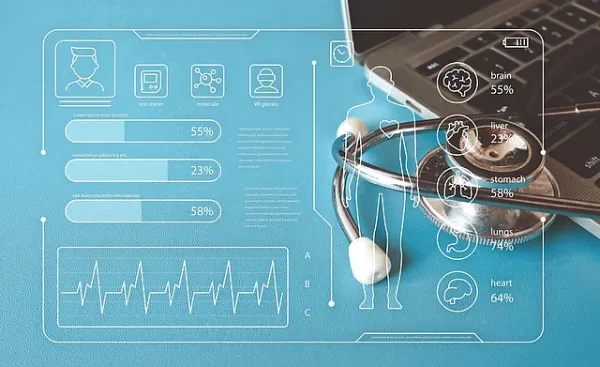
A futuristic Electronic Health Record (EHR) on a virtual interface over a doctor's laptop.
When datasets are harmonised across institutions and coded using consistent clinical ontologies, algorithms can be trained on more representative populations — improving predictive accuracy while reducing unintended bias. Just as critical is traceability: regulated healthcare settings require AI outputs to be explainable and auditable. “Integrated platforms allow for audit trails, model validation and continuous monitoring of algorithm performance against real-world outcomes,” Westbrook-Keir says.
From triage prioritisation to imaging diagnostics and predictive bed management, she argues, AI becomes scalable only when embedded within clinical workflows rather than layered on top as an external tool. That integration preserves human oversight while extending clinical capacity. “Trustworthy AI is therefore not simply a technological achievement,” she says. “It is an architectural one.”
Wiring Healthcare Into A Single Ecosystem
The shift towards unified health data is perhaps most visible at system level — where national platforms are beginning to connect providers, patients and public health authorities into a single digital fabric.
“The UAE is really building a healthcare blueprint for the world,” says Kanade, pointing to Dubai’s NABIDH platform, which now links more than 1,500 healthcare providers and millions of patient records across the emirate.
Through integrations with platforms such as syngo Carbon, imaging and clinical data can now move with patients between facilities rather than remaining locked inside them. “When a patient moves between providers, their images and records follow them instantly,” he says. “That means no repeat scans, no delays and no gaps in care.”
The implications extend well beyond individual treatment episodes. With connected data spanning large populations, health systems gain visibility into disease patterns, risk factors and care outcomes — shifting attention gradually from episodic treatment toward earlier detection and prevention.
For Westbrook-Keir, the deeper significance lies in how national data platforms reshape the structure of the health system itself. “At a national level, they transform health data into a strategic asset,” she says. “Governments and providers gain real-time, evidence-based insights that support faster decision-making, better outcomes and reduced system-wide inefficiencies.”
As hospitals, clinics, insurers and regulators connect through shared data environments, coordination improves and patient journeys become more continuous across emirates and care settings. The same foundations also support AI deployment, virtual care and new preventive models that rely on longitudinal population insight rather than isolated encounters.