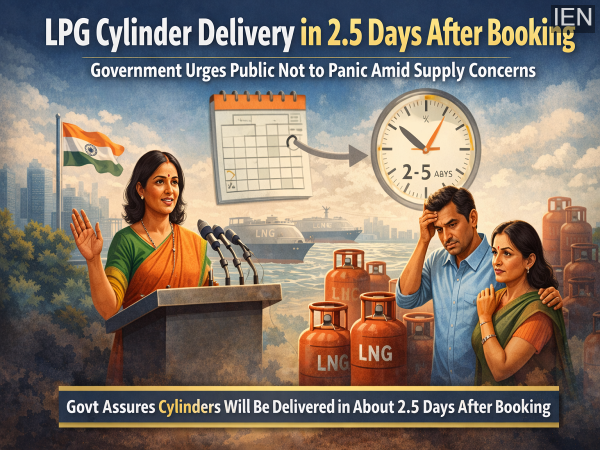
Amid growing concerns about a possible LPG shortage in India, the government has clarified that domestic LPG cylinders will continue to be delivered within about two and a half days after booking. Officials have also urged consumers not to panic or stockpile cylinders unnecessarily, assuring that adequate measures are being taken to maintain supply.
The clarification came during a press briefing on March 11, where Sujata Sharma, Joint Secretary at the Ministry of Petroleum and Natural Gas (MoPNG), addressed recent reports about disruptions in gas supply and rising demand.
According to the government, India’s LPG supply chain remains stable, and the current delivery cycle for domestic cylinders has not changed.
Officials highlighted that despite the recent volatility in global energy markets, LPG prices in India remain lower compared to several neighboring countries. The government also stated that it has absorbed a significant portion of the rising cost of LPG to prevent a sharp increase in consumer prices.
Authorities emphasized that the public should avoid panic booking or hoarding cylinders, as the existing distribution system is capable of meeting demand.
“The normal delivery cycle for domestic LPG is around two and a half days after booking. There is no need for consumers to rush to book cylinders,” Sharma said during the press conference.
The government confirmed that it is closely monitoring the energy supply situation amid ongoing global geopolitical tensions. Officials said proactive steps are being taken to ensure uninterrupted availability of LPG and other fuels.
As part of these efforts, two LNG (Liquefied Natural Gas) cargo shipments are currently on their way to India, which will help strengthen the country’s gas supply.
Authorities noted that these measures are part of a broader strategy to maintain energy security and stabilize supply chains.
Government officials revealed that Indian refineries are currently operating at full capacity to maintain adequate production levels.
Some refineries are even producing beyond their standard operational capacity to ensure there is no disruption in domestic fuel availability.
According to official data:
India’s total gas consumption is around 189 million metric standard cubic meters per day (mmscmd)
About 97.5 mmscmd is produced domestically
The remaining supply is met through imports
However, global disruptions have affected around 47.4 mmscmd of gas supply, largely due to force majeure situations and geopolitical uncertainties.
Despite tensions in global energy markets, officials assured that India’s crude oil supply remains secure.
Sujata Sharma stated that the country has secured crude oil supplies that exceed the typical volume received through the Strait of Hormuz, a key global shipping route for energy exports.
Oil Marketing Companies (OMCs) have also arranged additional crude cargo shipments from multiple countries, helping diversify India’s energy imports.
Currently, about 75 percent of India’s crude oil imports arrive through routes other than the Strait of Hormuz, compared to around 55 percent earlier. This shift is part of the government’s strategy to reduce dependence on a single route.
Anxiety over gas supply increased last week when Qatar announced a halt in production, a decision linked to rising tensions in the Middle East.
Qatar is among the largest suppliers of LNG to India, and the development triggered concerns about potential disruptions in supply.
The situation followed heightened geopolitical tensions in the Gulf region after Iran responded to attacks by the United States and Israel, raising fears of instability in energy-exporting nations.
Union Petroleum Minister Hardeep Singh Puri has also reassured citizens that there is no shortage of LPG for domestic use in India.
He urged consumers to avoid panic buying and emphasized that the government has already taken steps to stabilize supply and protect consumers from rising global energy costs.
To strengthen domestic availability, the government has directed refineries to increase LPG production.
Officials confirmed that domestic LPG output has been increased by about 25 percent, with priority being given to household consumers.
India currently imports around 60 percent of its LPG requirement, and approximately 90 percent of those imports typically pass through the Strait of Hormuz.
By boosting local production and securing additional cargo shipments, authorities aim to ensure uninterrupted supply even during global disruptions.
At present, the price of a domestic LPG cylinder in Delhi is ₹913.
Government officials noted that prices could have been significantly higher if the government had not absorbed part of the increased import cost.
The government reiterated that it will continue to monitor global energy developments and take necessary steps to ensure that LPG remains available and affordable for Indian households.