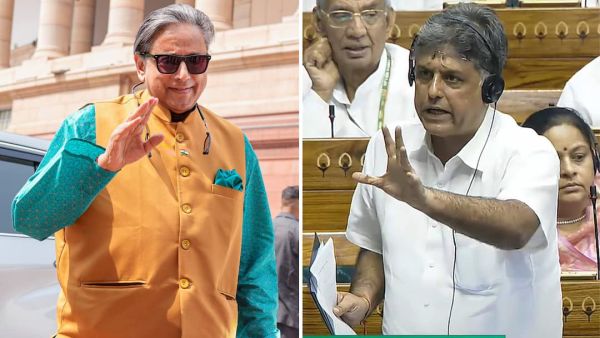
A significant ideological rift has surfaced within the Indian National Congress as senior leaders Manish Tewari and Shashi Tharoor have broken ranks with the party leadership to support the Narendra Modi-led government's cautious handling of the escalating Iran-Israel-US conflict. While the party high command, including Rahul Gandhi, has criticized the Centre's "silence," Tewari and Tharoor argue that India's "strategic autonomy" and national interest must take precedence over moral posturing.
Speaking at a televised event, Congress MP Manish Tewari offered a starkly realistic assessment of India’s role in West Asia. He asserted that India remains a "marginal player" in the region's complex power dynamics and should prioritize the safety of its massive diaspora and its energy security.
According to Tewari, with nearly 4.8 million Indians residing in the Gulf and the critical need for crude oil, natural gas, and fertilizers, the government’s circumspect approach is justified. "Well, it’s not our war... If we are circumspect, I think probably we are doing the right thing, because that is really what strategic autonomy is about," Tewari stated, emphasizing the ability to navigate contradictory global impulses.
Echoing Tewari’s sentiments, Shashi Tharoor defended the government’s restraint in a recent column for The Indian Express. While Tharoor noted that India should have promptly condoled the assassination of Iran’s Supreme Leader Ali Hosseini Khamenei, he argued that silence on the broader war does not equate to an endorsement of military action.
Invoking the legacy of Jawaharlal Nehru, Tharoor redefined non-alignment for a multipolar 2026. He argued that India has too much at stake to take a purely moralistic stance. "India’s silence is not an endorsement of that war. It is a recognition that our national interest requires prudence, not posturing," Tharoor wrote, adding that "Restraint is strength—the strength to balance principle with pragmatism."
These endorsements stand in sharp contrast to the position taken by the Leader of Opposition, Rahul Gandhi. Following the targeted strike on Khamenei, an event that reportedly drained U.S. weapon stockpiles and cost $11 billion in its first week, Gandhi took to X (formerly Twitter) to question the Prime Minister’s "silence" on the death of a head of state.
Gandhi condemned unilateral attacks that violate sovereignty, warning that such actions only worsen the humanitarian crisis facing millions of Indians in the region. The Congress leadership had previously attacked the government for being a "silent spectator" and for the delay in sending official condolences. Notably, Foreign Secretary Vikram Misri eventually signed the condolence book at the Iranian embassy, marking India’s first formal response days after the event.