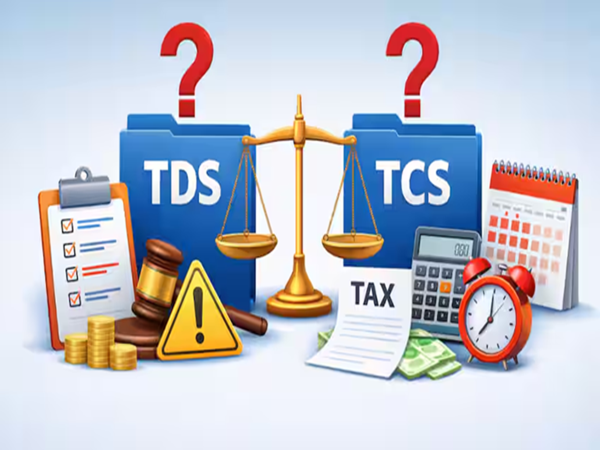
India's tax system is becoming increasingly stringent and digitized. Consequently, regulations such as TDS (Tax Deducted at Source) and TCS (Tax Collected at Source) have become crucial—not only for corporations and large-scale enterprises but also for salaried individuals and small business owners. People often conflate the two; however, the reality is that their functions, governing rules, and associated responsibilities are entirely distinct. Failure to comply with these regulations promptly can result in fines, interest penalties, and even legal proceedings.
What is TDS? Explained in Simple Terms
TDS stands for "Tax Deducted at Source." It implies that whenever a payment is made to you—such as a salary, interest income, rent, or professional fees—the payer deducts the applicable tax at a prescribed rate *before* remitting the remaining balance to you. In essence, the government collects its share upfront to prevent tax evasion.
Question: On which payments is TDS applicable?
Salary
Bank Interest
Rent
Commission/Brokerage
Professional Fees (for CAs, Lawyers, Consultants, etc.)
The rates and thresholds for TDS are determined annually by the government and are enforced under the provisions of the Income Tax Act, 1961.
What is TCS? Understanding the Key Distinction Here
TCS stands for "Tax Collected at Source." Under this mechanism, the *seller* collects the tax from the *buyer* at the time of sale, specifically when certain designated goods or services are transacted. This means that, unlike TDS, the tax is not *deducted* from the payment but is instead *collected* as an additional levy.
Question: On which items is TCS applicable?
Alcoholic Liquor
Tendu Leaves
Scrap Material
Minerals
(In certain specific instances) Cars or High-Value Goods
TCS is enforced under Section 206C of the Income Tax Act, 1961.
Question: What is the major difference between TDS and TCS?**
While both taxes may appear similar on the surface, the rules governing them are fundamentally different.
TDS vs. TCS
On whom/what is it applicable? TDS: On Payments (Income)
TCS: On Sales
Who Deducts/Collects It?
TDS: The Payer
TCS: The Seller of Goods
When Does It Apply?
TDS: At the time of payment or when due
TCS: At the time of selling goods
Return Forms
TDS: 24Q, 26Q, 27Q
TCS: 27EQ
Examples
TDS: Salary, Rent, Interest, etc.
TCS: Liquor, Scrap, Timber, etc.
Disclaimer: This content has been sourced and edited from Zee Business. While we have made modifications for clarity and presentation, the original content belongs to its respective authors and website. We do not claim ownership of the content.