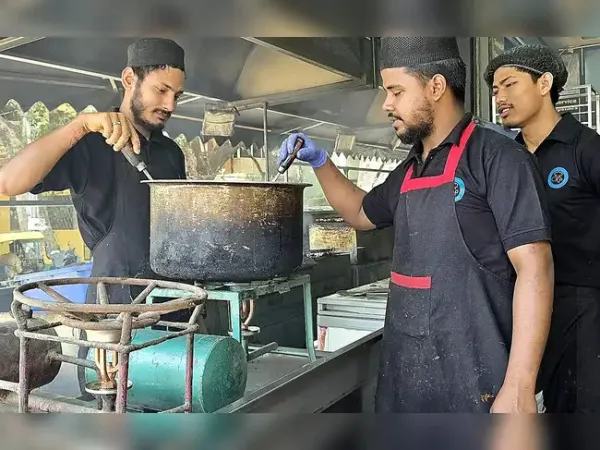
The liquified petroleum gas (LPG) shortage sparked by the ongoing war in West Asia has spurred many companies that operate large manufacturing units in India and feed thousands of workers daily to put in place plans to transition to more energy resilient models at their kitchens, according to facility management firms.
While these companies have not faced any disruptions so far in their operations, because they are sourcing cylinders, using firewood or tweaking their menus, uncertainty over when the situation in West Asia would ease has led them and their facility management vendors to put in place contingency plans.
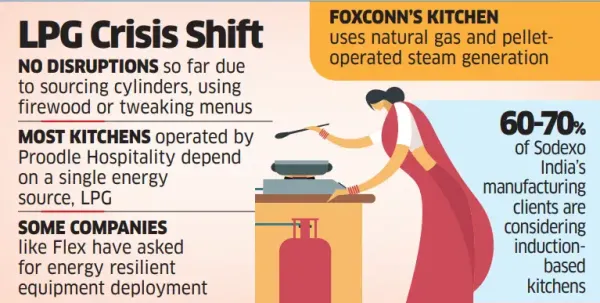
“We have already given our representation to companies for alternative energy equipment for all their kitchens,” Madhan Mohan Raj, chief operating officer at Chennai-based Proodle Hospitality told ET. “Among our manufacturing clients, apart from Foxconn, all the others are dependent only on LPG in their kitchens. Some companies like Flex have already asked us to design and deploy our energy resilient equipment in their kitchens. We have already given our vendors an indication to start manufacturing.”
Proodle Hospitality serves nine large manufacturing units in Tamil Nadu, in particular. Most of the kitchens that it operates for companies such as Samsung and Flex, for instance, have a single energy source - LPG. At Samsung, the company feeds about 6,000 employees and another 5,000 at Flex.
“We are transporting LPG from wherever it is available, across different cities,” Raj said. “So far, we have managed without any disruptions to our operations across our manufacturing units. Neither have we made any changes to our menu. But we have taken proactive steps where we have designed and developed induction and electrical equipment exclusively for our kitchens and have tied up with a partner to manufacture that equipment. This equipment should likely be out of production by this week and we will keep that as a backup wherever it is required if the crisis is going to continue."
Foxconn’s kitchen, designed and run by Proodle Hospitality, has two different energy sources - natural gas and pellet-operated stream generation - and hence has been shielded from the LPG shortage so far, according to Raj. At Foxconn's facility in Sriperumbudur alone, the hospitality company feeds around 40,000 employees at the plant and close to 8,000 employees at the dorm. Although this facility isn’t LPG dependent, vendors providing natural gas at the unit have asked to reduce consumption by around 20%. Hence, the contract electronics manufacturer is increasing the utilisation of its pellet-based steam generating equipment.
“The health and safety of employees is a top priority for Foxconn. Our canteen operations at our campuses in India are operating normally," Foxconn said in a statement.
Queries sent to Samsung and Flex remained unanswered till press time.
The push towards alternative sources of energy at these kitchens is industry-wide and pan-India. Sodexo India, for instance, said that of its 150 manufacturing clients, about 60-70% were now seriously considering revamping their kitchens entirely or at least part of their operations to more induction-oriented equipment.
“Companies will have to modernise their kitchens,” said Mohit Varma, chief operating officer, energy and resources at Sodexo India. “Sodexo has been ahead of the curve… over the past few years we started switching over to induction at various sites that we handle, but there are still numerous sites that are still dependent on LPG. We have seen significant traction from companies in Maharashtra and Gurgaon-Manesar belt that are seriously considering modernising their factory kitchens.”
The quantum of investment that would go into this exercise would depend on the company and the size of the kitchen, he said.
This sentiment was echoed by another executive at a facility management firm who did not wish to be identified. He said that at least 10 large manufacturing clients in Tamil Nadu alone had requested quotations for kitchen modernisation at their factories and that the likely cost of such an exercise was at least Rs 60 lakh. But there are other challenges, too, according to him.
“Even if they place an order now, it takes three to four weeks to deliver the equipment,” the executive said. “The client also has to budget for such an expense. Some clients have a budget, some simply do not. And the larger concern is that the company should be able to give an additional load of electricity. Today, clients who are willing to revamp their kitchens are suffering because they cannot get the additional load."
In the interim, though, elaborate menus have seen some alterations, he said. For breakfast, for instance, if employees were given sambar and chutney, the sambar is being knocked off as chutney does not require gas.
While these companies have not faced any disruptions so far in their operations, because they are sourcing cylinders, using firewood or tweaking their menus, uncertainty over when the situation in West Asia would ease has led them and their facility management vendors to put in place contingency plans.
“We have already given our representation to companies for alternative energy equipment for all their kitchens,” Madhan Mohan Raj, chief operating officer at Chennai-based Proodle Hospitality told ET. “Among our manufacturing clients, apart from Foxconn, all the others are dependent only on LPG in their kitchens. Some companies like Flex have already asked us to design and deploy our energy resilient equipment in their kitchens. We have already given our vendors an indication to start manufacturing.”
Proodle Hospitality serves nine large manufacturing units in Tamil Nadu, in particular. Most of the kitchens that it operates for companies such as Samsung and Flex, for instance, have a single energy source - LPG. At Samsung, the company feeds about 6,000 employees and another 5,000 at Flex.
“We are transporting LPG from wherever it is available, across different cities,” Raj said. “So far, we have managed without any disruptions to our operations across our manufacturing units. Neither have we made any changes to our menu. But we have taken proactive steps where we have designed and developed induction and electrical equipment exclusively for our kitchens and have tied up with a partner to manufacture that equipment. This equipment should likely be out of production by this week and we will keep that as a backup wherever it is required if the crisis is going to continue."
Foxconn’s kitchen, designed and run by Proodle Hospitality, has two different energy sources - natural gas and pellet-operated stream generation - and hence has been shielded from the LPG shortage so far, according to Raj. At Foxconn's facility in Sriperumbudur alone, the hospitality company feeds around 40,000 employees at the plant and close to 8,000 employees at the dorm. Although this facility isn’t LPG dependent, vendors providing natural gas at the unit have asked to reduce consumption by around 20%. Hence, the contract electronics manufacturer is increasing the utilisation of its pellet-based steam generating equipment.
“The health and safety of employees is a top priority for Foxconn. Our canteen operations at our campuses in India are operating normally," Foxconn said in a statement.
Queries sent to Samsung and Flex remained unanswered till press time.
The push towards alternative sources of energy at these kitchens is industry-wide and pan-India. Sodexo India, for instance, said that of its 150 manufacturing clients, about 60-70% were now seriously considering revamping their kitchens entirely or at least part of their operations to more induction-oriented equipment.
“Companies will have to modernise their kitchens,” said Mohit Varma, chief operating officer, energy and resources at Sodexo India. “Sodexo has been ahead of the curve… over the past few years we started switching over to induction at various sites that we handle, but there are still numerous sites that are still dependent on LPG. We have seen significant traction from companies in Maharashtra and Gurgaon-Manesar belt that are seriously considering modernising their factory kitchens.”
The quantum of investment that would go into this exercise would depend on the company and the size of the kitchen, he said.
This sentiment was echoed by another executive at a facility management firm who did not wish to be identified. He said that at least 10 large manufacturing clients in Tamil Nadu alone had requested quotations for kitchen modernisation at their factories and that the likely cost of such an exercise was at least Rs 60 lakh. But there are other challenges, too, according to him.
“Even if they place an order now, it takes three to four weeks to deliver the equipment,” the executive said. “The client also has to budget for such an expense. Some clients have a budget, some simply do not. And the larger concern is that the company should be able to give an additional load of electricity. Today, clients who are willing to revamp their kitchens are suffering because they cannot get the additional load."
In the interim, though, elaborate menus have seen some alterations, he said. For breakfast, for instance, if employees were given sambar and chutney, the sambar is being knocked off as chutney does not require gas.