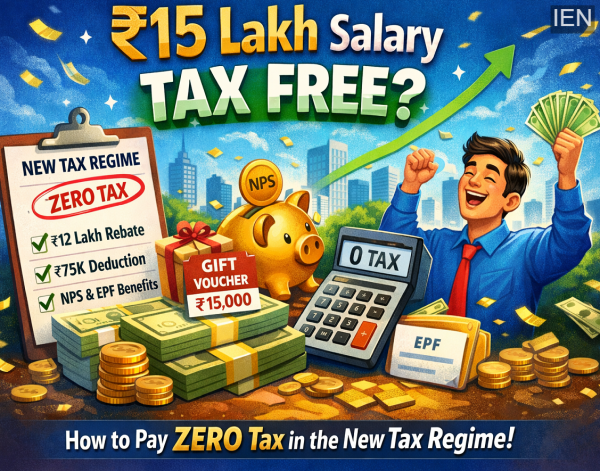
Many salaried individuals assume that a higher income automatically leads to a higher tax burden. However, recent changes under India’s New Tax Regime are reshaping that belief. With smart financial planning and proper salary structuring, it is now possible to legally reduce your tax liability to zero—even if your annual salary is close to ₹15 lakh.
As per the updated framework for FY 2026–27, the New Tax Regime has become the default system. It offers simplified tax slabs and fewer deductions, but when used strategically, it can still provide significant tax savings. Let’s break down how this works in a practical and easy-to-understand way.
One of the biggest highlights of the new system is the tax rebate available on taxable income up to ₹12 lakh. If your net taxable income falls within this limit, your total tax liability becomes zero due to the rebate benefit.
This means that the key is not just your total salary, but how much of it is considered taxable after deductions and exemptions.
Under the new regime, salaried taxpayers are eligible for a standard deduction of ₹75,000. This deduction is applied directly to your income without any conditions.
For example, if your gross salary is ₹12.75 lakh, applying the standard deduction reduces your taxable income to ₹12 lakh—bringing it within the zero-tax bracket.
Starting FY 2026–27, employers can provide up to ₹15,000 annually in the form of gift vouchers or similar benefits. These are not included in taxable income.
By including this benefit, your effective tax-free income can increase further. For instance, a salary of ₹12.75 lakh combined with ₹15,000 in tax-free perks pushes your total compensation to ₹12.90 lakh without increasing your tax burden.
Yes, it is possible—provided your salary is structured efficiently.
Here’s an example of how a ₹14.80 lakh annual CTC (Cost to Company) can still result in zero tax:
Since this taxable income is below ₹12 lakh, the rebate ensures that no tax is payable.
To fully benefit from this strategy, certain conditions must be met:
Here’s a quick look at the revised tax rates under the New Tax Regime:
| Income Range (₹) | Tax Rate |
|---|---|
| 0 – 4 lakh | 0% |
| 4 – 8 lakh | 5% |
| 8 – 12 lakh | 10% |
| 12 – 16 lakh | 15% |
| 16 – 20 lakh | 20% |
| 20 – 24 lakh | 25% |
| Above 24 lakh | 30% |
The New Tax Regime may appear straightforward at first glance, but it offers hidden opportunities for tax savings when used wisely. By combining the standard deduction, employer contributions, and tax-free perks, salaried individuals can significantly reduce their taxable income.
In fact, with proper planning, even those earning close to ₹15 lakh annually can bring their tax liability down to zero. The key lies in understanding the structure, making informed choices, and optimizing available benefits.