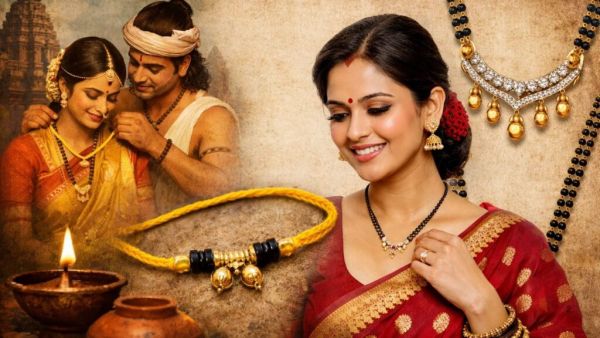
In Indian society, Mangalsutra is considered to be the most special identity of a married Indian woman and her most sacred ornament. Mangalsutra has the same kind of sanctity and recognition as vermilion has. On the auspicious occasion of marriage, the husband makes his wife wear Mangalsutra and the woman wears it throughout her life as long as her husband is alive. It is considered inauspicious to take it off. It is not only a symbol of marital bliss, but also symbolizes the unbreakable bond of husband and wife, security, love and domestic happiness and prosperity.
The tradition of wearing Mangalsutra dates back to the ancient Vedic period, which even today emerges as a clear symbol of the married status of married women across India. But even more important is the history of Mangalsutra as to where it started. Mangalsutra which is worn today is made of black pearl and gold pendant. But years ago there was no trend of wearing gold mangalsutra. It was considered to be a mangalsutra made of yellow thread without gold or decoration.
The story begins in the Vedic period, well before 1500 BC. At that time Mangalsutra meant ‘Mangal’ (auspicious) + ‘Sutra’ (thread) i.e. auspicious thread. It is mentioned in ancient Hindu texts like Manusmriti and Lalita Sahasranama. A yellow thread was tied around the bride’s neck which was prepared by soaking it in turmeric. Turmeric was considered purifying and healing, especially during childbirth. This thread was a symbol of protection from evil powers, evil eye and other men. No gold, no pearls, just a simple, sacred thread. Archaeological evidence also confirms this. Remains of such necklaces have been found in the excavations of Mohenjodaro and Harappa, which are similar to the Mangalsutra of Coorg (South India). But the foundation of the real trend was laid in South India. There is mention in Lalita Sahasranama that Goddess Tripurasundari is wearing Mangalsutra. It means that it was tied around the neck of the goddess by Lord Kameshwar (Shiva) himself.
The trend of wearing gold mangalsutra in India first started in South India. Especially from Tamil Nadu, Andhra Pradesh and Karnataka. Here it is called ‘Thali’ or ‘Thirumangalyam’. There is a clear mention of it in Sangram literature texts of 4th century BC and 6th century – a yellow thread, to which a small gold pendant like the idol of Lakshmi or Radha was attached. In South Indian weddings, the groom ties the thali around his neck after reciting the mantra, and this yellow thread gradually turns into a gold chain. Because in the culture here, marriage was considered the most sacred form of ‘Mangal’. The use of black pearls began after the 6th century during the Arab trade. Black color was added to protect these pearls from the ‘evil eye’, which was a symbol of the evil eye. Then came gold. Women of South India were already fond of gold jewellery, so the trend of using gold chains and pendants instead of threads increased. Even today, gold coins, small pendants and sometimes coral are seen in Tamil thali.
Gradually this trend moved towards north and west. In North India, Mangalsutra is called ‘Mangalsutra’. Gold pendant and chain with black pearl beads. This form became popular about 100-150 years ago (19th-20th century), when gold trade increased during the British period and the economic condition of women improved. A mixture of ‘Thali’ and ‘Mangalsutra’ is also seen in Western India, Maharashtra and Gujarat. A combination of coral and gold in Bengal, while a simple, classic design in Rajasthan-Uttar Pradesh. But the basic trend came from the South where the use of gold first started on a large scale. By the middle of the 20th century it had spread throughout India. Today, it is mandatory to tie Mangalsutra in every Hindu wedding whether it is Delhi, Mumbai, Chennai or Kolkata.
The trend of wearing gold mangalsutra is not just based on fashion but on deep belief. According to astrologers, many gods and goddesses reside in it, Lakshmi, Parvati, Shiva. It is a symbol of the unbreakable bond between husband and wife, fertility and prosperity of the home. The wife does not take it off throughout her life as taking it off is considered inauspicious. In today’s time, designs have changed, some women choose lightweight gold mangalsutra, some add diamonds to it. But the basic idea is the same, which has been coming from the ancient thali of South India.