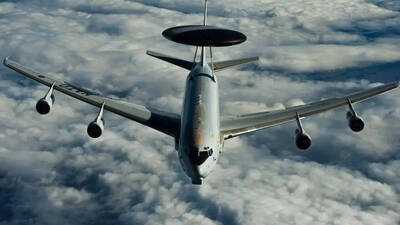
On Friday, a missile attack by Iran targeted the Prince Sultan air base, resulting in damage to an American E-3 Sentry aircraft and injuring approximately a dozen U.S. personnel. This incident highlighted the significance of the aircraft, which is vital for American forces in monitoring and managing aerial operations during conflicts.
The Boeing E-3 Sentry functions as a mobile command-and-control center. It stands out as one of the most advanced airborne warning and control system (AWACS) aircraft, designed to provide commanders with a comprehensive, real-time overview of the battlefield across extensive areas. Rather than being a combat aircraft, it acts as the central nervous system for air operations, operating from high altitudes.
The E-3's development traces back to the late 1960s and early 1970s when the U.S. Air Force sought a radar platform capable of surviving modern combat scenarios while being mobile. Boeing won the contract over McDonnell Douglas, and the aircraft was introduced into service in 1977. Instead of creating a new airframe, Boeing adapted the reliable 707-320 commercial jet, which provided both reliability and range. The E-3 is easily recognizable due to its large rotating radar dome, known as a rotodome, which is mounted on a 14-foot pylon and measures 30 feet in diameter, housing a sophisticated Westinghouse AN/APY-1/2 surveillance radar.
The radar system of the E-3 is remarkable, capable of tracking hundreds of targets simultaneously with a range exceeding 200 miles at lower altitudes and even further at higher elevations. It rotates at six times per minute, ensuring complete 360-degree coverage of the airspace. The radar operates in various modes, including pulse-Doppler, which enables it to detect low-flying aircraft that may be attempting to conceal themselves against the terrain, a challenge for ground-based radar systems.
While the radar capabilities are impressive, the E-3 Sentry serves as a comprehensive airborne battle management center. It can accommodate a crew of 17 to 19 mission specialists, who work alongside the pilots to monitor the tactical situation and maintain constant communication with aircraft, ground forces, and naval units. In a conflict, the E-3 performs numerous essential functions, including early warning of enemy threats, directing friendly interceptors, managing strike operations, coordinating air refueling, and overseeing air traffic in busy conflict zones, all while remaining airborne and mobile.
The loss or temporary incapacitation of an E-3 Sentry is a significant concern. These aircraft are integral to the coordination and execution of American air operations. They not only support missions but also provide coherence to the overall strategy. Any reduction in their operational capability, even for a short period, can create critical gaps in the situational awareness that commanders and pilots rely on.