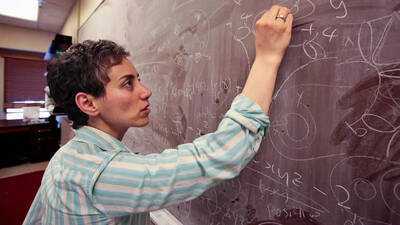
Mathematics can often seem daunting, a sentiment many can relate to, even those who delve into its complex equations and the mysteries they unveil. While the field is not exclusively male-dominated, it is essential to recognize the significant contributions of women in STEM. Among these pioneers, Maryam Mirzakhani stands out as a true trailblazer.
Labeling the history of the prestigious Fields Medal as sexist would be an oversimplification, considering the intricate mathematical knowledge required to appreciate its criteria. However, the absence of female recipients for nearly 80 years since its establishment in 1936 is indeed surprising. Mirzakhani changed that narrative in 2014 when she became the first woman to receive the Fields Medal for her exceptional work in the dynamics and geometry of Riemann surfaces and their moduli spaces. The significance of this achievement extends beyond mathematics, highlighting its societal implications.
Born in Tehran in 1977, Mirzakhani's path to greatness was almost preordained. Her groundbreaking work in hyperbolic geometry, Teichmüller theory, and moduli spaces showcased her unique blend of mathematical prowess and artistic vision. She earned her Bachelor’s degree from Sharif University of Technology in Tehran and later pursued a PhD at Harvard University. Even a life-threatening bus accident in 1998 could not deter her from her passion. In addition to the Fields Medal, her accolades include the Blumenthal Award, Satter Prize, and Clay Research Award. In 2008, she married Jan Vondrak, a fellow academic at Stanford. Sadly, she was diagnosed with breast cancer in 2013 and passed away at the age of 40, leaving behind her husband and daughter.
Mirzakhani's life story is one that could inspire a film. Her dedication not only motivates others to strive for excellence but also challenges the stereotypes that persist in many parts of the world. In contrast to the common stereotypes associated with Iranian women, Mirzakhani's achievements reflect a different narrative. Reports indicate that Iran invests 4% of its GDP in research and development, similar to the United States, ranking it among the top nations in fields like nanotechnology, AI, and pharmaceuticals. With nearly half of the 4.5 million university students being female, the future looks promising. Amidst ongoing geopolitical tensions, it is likely that a new generation of mathematicians, inspired by Mirzakhani, is emerging in classrooms across Iran.