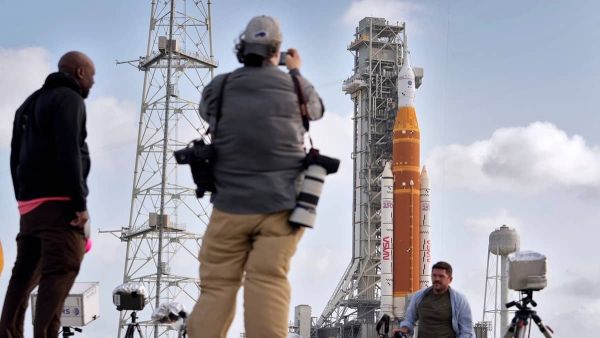
The official countdown for a historic journey to the Moon began on Monday, as NASA commenced the final phase of preparations for a mission that ends a 53-year gap in human lunar exploration. The 32-storey Space Launch System (SLS), standing tall on its Florida launch site, is ready to carry a new generation of explorers toward a destination that has remained unvisited by humans since the final Apollo mission in 1972.
The officials suggested that if all goes according to the sophisticated sequence of events, barring any late-stage complications, Wednesday evening will be the moment humanity finally ventures back toward the Moon.
As per the experts, the mission, known as Artemis II, is not only a technical exercise but a statement of human persistence. 4 astronauts are currently sequestered in final pre-flight routines, preparing to board the Orion capsule for a 10-day odyssey that will take them into Earth’s orbit before a powerful propulsion sequence shoots them toward the Moon.
Notably, the scheduled flight will be a high-speed loop around the Moon, different from the lunar landings of the past. While this mission does not involve a landing, it is a vital trial of the spacecraft’s life-support and navigational capabilities, setting the stage for future missions intended to return humans to the lunar surface.
The journey to this week’s launch witnessed major technical challenges that show the complications of modern space travel. On Monday, Launch Director Charlie Blackwell-Thompson praised the ground teams for their continuous efforts to prepare the vehicle, noting that the mission is currently in “excellent, excellent shape”. Despite a positive weather outlook for Wednesday, the project has faced its share of setbacks. The mission, originally scheduled to fly in February, was delayed due to hydrogen fuel leaks and an obstructed helium line, necessitating a temporary return to the hangar for repairs last month.
The durability of the SLS architecture was pushed to its limits during the opening months of 2026, as technical teams faced the complexities of cryogenic fuel management. The mission hit a major snag when, shortly after resolving persistent hydrogen leaks, an obstructed helium pressurisation line threatened to derail the entire schedule. However, the rocket’s rollout back to the launch pad nearly two weeks ago served as a definitive signal that these mechanical hurdles had been cleared.
With the arrival of the joint American and Canadian astronauts at the Kennedy Space Centre last Friday, the focus has shifted from hardware repairs to the high-stakes anticipation of an imminent departure. NASA experts have outlined a narrow 6-day window in early April as the optimal time for lift-off. As per experts, failing to launch during this period would necessitate a delay until late April to ensure the spacecraft aligns correctly with lunar orbital mechanics.
The Artemis II mission rejected the monochromatic, all-male precedent of the Apollo era, demonstrating a big departure from the demographic makeup of the 1960s and 70s. The new chapter of exploration is intentionally inclusive, featuring a woman, a person of colour, and a non-US citizen, registering a shift from nationalistic goals toward a collaborative global effort.
Mission's pilot Victor Glover explained the impact of this diversity during a weekend address. Glover expressed his desire for the mission to inspire a new generation that has historically felt sidelined in the story of space travel. He noted the importance of young girls and children of colour seeing themselves represented in such a high-profile role, famously remarking on the power of a child seeing someone who looks like them accomplishing the extraordinary.
While embracing his status as a pioneer, Glover also shared his vision for a future where these "firsts" are no longer a talking point, and space exploration is simply viewed as a shared chapter of "human history."
The SLS launch, as planned on Wednesday, will trigger a 10-day mission. The journey begins with a 24-hour period of system evaluations in Earth’s orbit before the Orion capsule is thrust toward deep space. The mission’s climax involved a high-velocity slingshot around the Moon’s far side, providing a rigorous test of the spacecraft’s thermal protection during its high-speed return to Earth. The expedition is set to end with a Pacific Ocean splashdown, officially re-establishing the bridge between humanity and the stars.