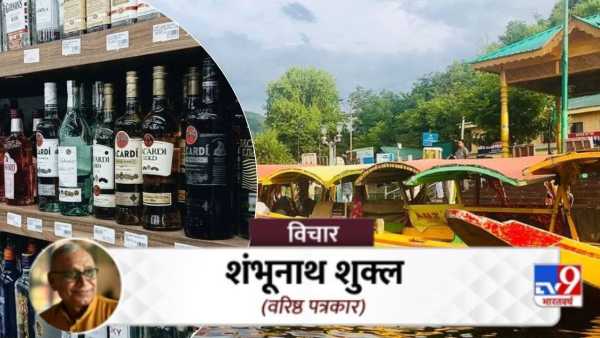
In Jammu and Kashmir, some religious organizations demonstrated strongly and staged dharnas to close the liquor shops. Sikh and Islamic organizations were leading this protest in Kathua and RS Pura. Shiv Sena has also opposed opening of contracts. However, quoting the Excise Minister of the National Conference government, it has been said that the government is not planning to open new liquor shops. But the income of state governments from liquor shops is so high that they themselves break the old rules and laws for these shops. They are no longer reluctant to open liquor shops near residential areas, religious places and schools. Then in Jammu and Kashmir, the main source of income is tourism and banning liquor shops and bars where tourism would generate income would mean ending the income.
In the last financial year (2024–2025) 83 more licenses of liquor shops were issued in Jammu and Kashmir. In view of this blind earning, the government had decided to issue licenses to more liquor shops. Perhaps that is why, to gauge the public mood, an MLA from the ruling National Conference had appealed for opening of more liquor shops. But this appeal was overshadowed by that MLA's party. Its political impact has reached far. After the MLA's appeal, many people have come out on the streets against the liquor shops. It is known that till now there were some liquor shops for tourists in many areas of Jammu and Kashmir but liquor was not available to the general public. There are a total of 223 liquor shops in Jammu and Kashmir. Of these, 219 are in Jammu region and four in Kashmir Valley. These four shops are in Srinagar.
Recently, National Conference MLA Hasnain Masoodi had enumerated the profits from liquor shops. According to him, the state's revenue has increased due to the opening of liquor shops. He had said that if licenses are not issued to liquor shops, the business of spurious liquor will increase in the state and it will lead to unnecessary loss of lives. Immediately after came the statement of Muttahida Majlis Ulema (MMU) that alcohol is banned in Islam. Alcohol causes domestic disputes and increases crimes. Mirwaiz-e-Kashmir's Dr. Maulvi Umar Farooq asked the ruling party to reconsider its decision to extend liquor licenses. He also urged the government to impose complete liquor ban in the state. Hasnain Masoodi said that even with prohibition, liquor still comes to Bihar and Gujarat through smuggling, so what benefit did the prohibition provide?
On the other hand, Maulvi Umar said, alcohol ruins the moral conduct of our society. Alcohol tears families apart. Women are most affected at home. Husbands drink alcohol and beat their wives at home. But everyone was disappointed by Hasnain Masoodi's arguments in favor of alcohol and religious organizations created a ruckus there on Wednesday. According to Islamic scholar Agha Syed Mohammad Hadi, the decision to open 51 more liquor shops in Jammu and Kashmir is unfortunate. He said, the government will open six shops in the valley. Then is the government going to open a dance bar here in future? MMU says that the government's decision to sell beer in departmental stores is against Islamic traditions. Seeing this, Sikh organizations and Shiv Sena also came out in protest.
Jammu and Kashmir is a Muslim majority state and drinking alcohol in Islam is the work of the devil, hence alcohol is considered a crime in the religion of Islam. Intoxication is also prohibited in Sikh, Jain and Buddhist religions. Among Jews and Christians, alcohol is accepted in their religious rituals. Some sects of Hindu religion consider alcohol as evil and for some it is a religious ritual. Alcohol is poured on Bhairav, a form of Shiva. It is a different matter that followers of any religion do not follow it strictly. Apart from Aurangzeb, no one among the Mughal emperors abstained from alcohol. Regarding Jahangir, medieval history scholar Ashirwadi Lal Srivastava has written that there was a popular saying - May I have a seer of kebab, half a seer of wine, may the whole Sultanate of Nur Jahan be prosperous or bad! Famous Urdu poet Ghalib and story writer Manto were fond of alcohol. Meena Kumari ended up drinking alcohol.
From all these statements and protests it seems that the cover of religion is being used to remove a social evil. If religion is brought into the picture, then in many religions alcohol or some other intoxicants are considered a part of the rituals. Leaving aside the Vaishnav sect among Hindus, many sects of Shaktas and Shaivites do not consider alcohol as anti-social. In Vaishnavism, non-vegetarian food is also strictly prohibited, but in many areas of India, Vaishnav Hindus also eat non-vegetarian food. Even staunch Vaishnavs in Bengal, Odisha and Assam do not include fish in their non-vegetarian diet. On the other hand, the Shaktas of North India are staunch vegetarians. They don't even eat onion and garlic. All types of intoxicants are prohibited in Buddhism, but in countries like Sri Lanka, Tibet, Taiwan, Thailand, Myanmar, Japan etc., followers of Buddhism eat a lot of non-vegetarian food. Sikhs abstain from all types of intoxicants. Still, people are found drinking alcohol and taking other drugs in the Sikh community.
People of Jain community strongly oppose non-vegetarianism and intoxication. They usually don't consume all this. But there are exceptions here too. Therefore food and drink is a regional tradition. Apart from India, followers of Buddhism will be found everywhere eating non-vegetarian and drinking alcohol. In Sri Lanka, Buddhists eat both cow and pig. That is why the workers here are in great demand in America and Europe because there are no restrictions on their food habits. Otherwise Indian Hindus do not eat cows and Muslims do not eat pigs. Jainism is limited to India only, hence they stick to the prohibitions of their religion. In the vast Hindu society, in Arya Samaj, alcohol, gambling, any kind of intoxicant, even tobacco has been considered wrong. But Arya Samaj gradually shrank. Anyway, Arya Samaj was a Hindu religious reform movement, not a new religion.
As far as Jews and Christians are concerned. Followers of these religions also eat non-vegetarian food and alcohol is a part of their religious rituals. By the way, Judaism, Christianity and Islam come from the same tradition (Abrahamic). These are called Semitic religions. Islam came last among these and that is why in Islam, Judaism and Christianity have been called Ahl-e-Kitab. There are no restrictions on food and drink in Judaism and Christianity. The truth is that in the past all religions taught the art of living. Therefore, it is wrong to consider any religion as suitable for all times. Alcohol certainly creates disintegration in the society but it also brings social brotherhood. Liquor, which increases mutual conflict, in excess quantity makes the society fight among itself. Every drug is also used as medicine. He both gives and takes life.
Therefore it is not right to link alcohol with religion. When we justify something as right or wrong on the basis of religion, then we move away from science. Therefore, reckless sale of liquor will break the society, this should be insisted. Otherwise, in Uttar Pradesh, where there is a Yogi government, liquor shops would not have opened in residential areas like this!